
Sponsored
Mishimoto’s 2015+ Mustang GT Performance Intake R&D - NOW RELEASED!!
- Status
- Not open for further replies.

BmacIL
Enginerd
- Joined
- Sep 21, 2014
- Threads
- 69
- Messages
- 14,989
- Reaction score
- 8,910
- Location
- Naperville, IL
- Vehicle(s)
- 2015 Guard GT Base, M/T
- Vehicle Showcase
- 1
I'm sure the plastic would be a little better for reducing IATs, but would also require a decent amount of tooling investment that would be passed onto us in the cost. I'm not sure the slight performance improvement would be worth it, given that it's a closed box design, and most of your IAT stability comes from closing that off from the engine bay.Got it, makes sense^^.
So, you'd say that metal vs. plastic is inconsequential in this case?

highvoltage
Well-Known Member
- Joined
- Jan 4, 2016
- Threads
- 12
- Messages
- 857
- Reaction score
- 239
- Location
- NorCal to SoCal
- First Name
- Brock
- Vehicle(s)
- 24 Mustang GT Atlas Blue, 23 Race Red Bronco
Subd
Rebellion
Well-Known Member
Is this because of the insulating properties of plastic?I'm sure the plastic would be a little better for reducing IATs, but would also require a decent amount of tooling investment that would be passed onto us in the cost. I'm not sure the slight performance improvement would be worth it, given that it's a closed box design, and most of your IAT stability comes from closing that off from the engine bay.
If this is the case, I guess one can attach some insulating material on the inside (if it's thin enough) to compensate for that up to some degree. I think one can engineer a number of solutions for that, cost and space permitting, but one will quickly turn into the point of diminishing returns, specially on a NA application.
BmacIL
Enginerd
- Joined
- Sep 21, 2014
- Threads
- 69
- Messages
- 14,989
- Reaction score
- 8,910
- Location
- Naperville, IL
- Vehicle(s)
- 2015 Guard GT Base, M/T
- Vehicle Showcase
- 1
Yes, the low coefficient of thermal conductivity = insulator. I wouldn't add material to the inside as it could limit maximum flow.Is this because of the insulating properties of plastic?
If this is the case, I guess one can attach some insulating material on the inside (if it's thin enough) to compensate for that up to some degree. I think one can engineer a number of solutions for that, cost and space permitting, but one will quickly turn into the point of diminishing returns, specially on a NA application.
Sponsored

Coyote Red
Well-Known Member
- Joined
- Oct 9, 2016
- Threads
- 8
- Messages
- 1,249
- Reaction score
- 371
- Location
- Port Lavaca,Tx.
- First Name
- Alan
- Vehicle(s)
- 2016 5.0 Coyote Red
- Vehicle Showcase
- 1
aFe drop-in
Yes, I had the aFe on my Cyclone and it performed well with an SCT 93 octane "canned" tune, chirped 2nd gear with the DSS aluminum driveshaft.I can't describe to your how annoying it is there is no panel cone for the 15+ S550's. When I had a stock airbox on my '14, I ran this aFe filter:
http://afepower.com/afe-power-30-80179-magnum-flow-pro-5r-air-filter
I just purchased an AEM dry flow panel last night. I would've jumped on the aFe design if it was available. Is this what you're referring to?
OP
OP

Mishimoto
Well-Known Member
- Thread starter
- #52
Yes as [MENTION=23439]Terminator2[/MENTION] said, the induction hose is only designed to work with the stock airbox.1) Will the existing (well, on pre-sales) intake tube be compatible with the airbox side of this intake
2) If so, will you be offering just the airbox for folks who by the intake tube
[MENTION=10281]BmacIL[/MENTION] you're really on it! Looks like I missed an engaging conversation during the weekend. As [MENTION=10281]BmacIL[/MENTION] said, plastic will heat up slower over metal due to their thermal conductivity properties, but the improvement may be minimal since they will see similar temps. Metal will heat up faster.Interesting. Two questions/comments:
1. Why a metal box? I realize that your maf housing will be plastic (good!) but the box itself will always be extremely hot - too hot to touch. Won't this affect performance, or, at least idle/initial response? You say "cuising" IATs are good but you don't say much about static. What data/experience can you share here?
I ran a metal lid/maf housing style box on my M3 that showed great gains on the dyno only to have it literally neuter the car for any type of city driving. From this, I'm a little gun-shy of anything metal in the intake stream.
2. You mention "initial" vs. "learned" gains. Your dyno shows good initial gains. But that's of no interest to me. Will you be showing the learned gains after some miles/time?
We did not collect much data for idle IAT's, but from what we did see, they were not far from stock. The air going into the engine doesn't spend much time in the airbox, especially at speed. So even though the box may be hot to touch, temps shouldn't see an incredibly sharp rise. Sitting in traffic is never going to have a positive effect on IAT's, and it's going to be hard to fight, but it's important to really dial in the on-road performance.
The data on the graph shown are the learned gains! Those runs were done after some mileage was put on the car to let the MAF relearn. Initial gains were higher, but to reiterate, the learned gains are the more reliable and repeatable numbers. That is what we published as final dyno numbers. Great questions! If you have anymore, don't hesitate to post.
BmacIL
Enginerd
- Joined
- Sep 21, 2014
- Threads
- 69
- Messages
- 14,989
- Reaction score
- 8,910
- Location
- Naperville, IL
- Vehicle(s)
- 2015 Guard GT Base, M/T
- Vehicle Showcase
- 1
Yes as [MENTION=23439]Terminator2[/MENTION] said, the induction hose is only designed to work with the stock airbox.
[MENTION=10281]BmacIL[/MENTION] you're really on it! Looks like I missed an engaging conversation during the weekend. As [MENTION=10281]BmacIL[/MENTION] said, plastic will heat up slower over metal due to their thermal conductivity properties, but the improvement may be minimal since they will see similar temps. Metal will heat up faster.
We did not collect much data for idle IAT's, but from what we did see, they were not far from stock. The air going into the engine doesn't spend much time in the airbox, especially at speed. So even though the box may be hot to touch, temps shouldn't see an incredibly sharp rise. Sitting in traffic is never going to have a positive effect on IAT's, and it's going to be hard to fight, but it's important to really dial in the on-road performance.
The data on the graph shown are the learned gains! Those runs were done after some mileage was put on the car to let the MAF relearn. Initial gains were higher, but to reiterate, the learned gains are the more reliable and repeatable numbers. That is what we published as final dyno numbers. Great questions! If you have anymore, don't hesitate to post.

Is the metal box sealed in any way? That would be a great way to minimize any delta from the stock box for IATs at idle.
Rebellion
Well-Known Member
I'd like to see some gaskets of some sorts in their final design in order to avoid metal to metal contact.
Is the metal box sealed in any way? That would be a great way to minimize any delta from the stock box for IATs at idle.
Sponsored
OP
OP
Mishimoto
Well-Known Member
- Thread starter
- #56
Is the metal box sealed in any way? That would be a great way to minimize any delta from the stock box for IATs at idle.
You're in luck! The box will be sealed against the body of the space with weather stripping to achieve exactly what you all are suggesting. Check out another shot of the intake on the flow bench, you can see that along side the edge of the shield, it will seal against the body of the car.I'd like to see some gaskets of some sorts in their final design in order to avoid metal to metal contact.
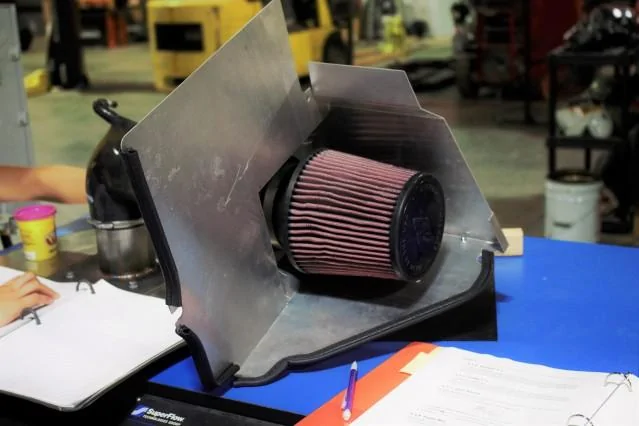
Also, there will be some weather stripping around the MAF inlet on the side of the box pictured below,
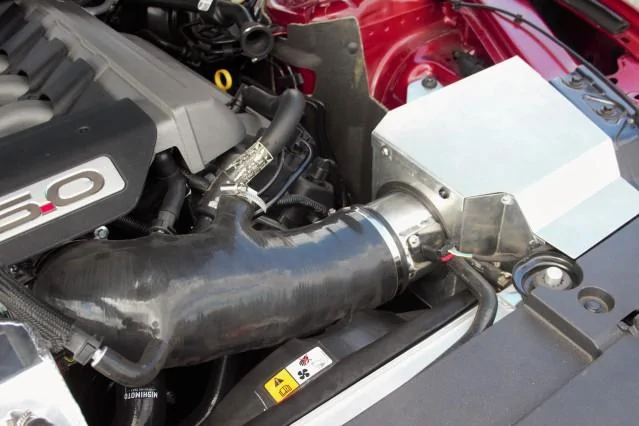
The MAF housing itself won't be made of aluminum, instead we will have it constructed with a glass-reinforced, plastic-injection molded piece. Hope this helps!
We are not close to a final release date quite yet, but we are aiming to have this fully released before the year is out. More on that to come!When is it going to be released???

EFI
Well-Known Member
- Joined
- May 19, 2015
- Threads
- 65
- Messages
- 5,287
- Reaction score
- 4,733
- Location
- Masshole central
- Vehicle(s)
- 5.Br0
What's also important to IATs is how quickly they come down once moving. Have you done any testing of both the OEM intake and your intake as far as how quickly the IATs come down after idling?We did not collect much data for idle IAT's, but from what we did see, they were not far from stock. The air going into the engine doesn't spend much time in the airbox, especially at speed. So even though the box may be hot to touch, temps shouldn't see an incredibly sharp rise. Sitting in traffic is never going to have a positive effect on IAT's, and it's going to be hard to fight, but it's important to really dial in the on-road performance.
We all know IATs will climb while stationary, that's just the nature of the beast. But once moving, the plastic OEM box cools down quickly and restores IATs to near ambient shortly after moving. However, I can't imagine that being the case with a metal box. Yes maintaining IATs near ambient is simple enough while moving...but what happens when a metal box gets hot? How long will it take to cool down?
From my experience, any metal in the engine bay will take much longer to cool down. It will eventually, but not nearly as quickly as plastic. So my concern is that you sit in the pits idling and the box heats up, then takes a long time to dissipate the heat even after moving.
Rebellion
Well-Known Member
Seems like a neat way to seal it and get a large volume in the cavity without making an actual "cube".
I'd be curious to know what are the effects of this covered up "open type" of design vs one that uses a cube/snorkel. It almost seems to include benefits of a cube/snorkel type (like the AR/Livernois) and a open type (like JLT/Roush). I don't know much of the topic, compressible fluid mechanics were never my thing...
I'd be curious to know what are the effects of this covered up "open type" of design vs one that uses a cube/snorkel. It almost seems to include benefits of a cube/snorkel type (like the AR/Livernois) and a open type (like JLT/Roush). I don't know much of the topic, compressible fluid mechanics were never my thing...
BmacIL
Enginerd
- Joined
- Sep 21, 2014
- Threads
- 69
- Messages
- 14,989
- Reaction score
- 8,910
- Location
- Naperville, IL
- Vehicle(s)
- 2015 Guard GT Base, M/T
- Vehicle Showcase
- 1
Excellent. Do you retain the snorkel to the grille in some fashion? How do you limit hot air coming off the radiator from coming through to the intake?You're in luck! The box will be sealed against the body of the space with weather stripping to achieve exactly what you all are suggesting. Check out another shot of the intake on the flow bench, you can see that along side the edge of the shield, it will seal against the body of the car.

Also, there will be some weather stripping around the MAF inlet on the side of the box pictured below,
The MAF housing itself won't be made of aluminum, instead we will have it constructed with a glass-reinforced, plastic-injection molded piece. Hope this helps!
We are not close to a final release date quite yet, but we are aiming to have this fully released before the year is out. More on that to come!
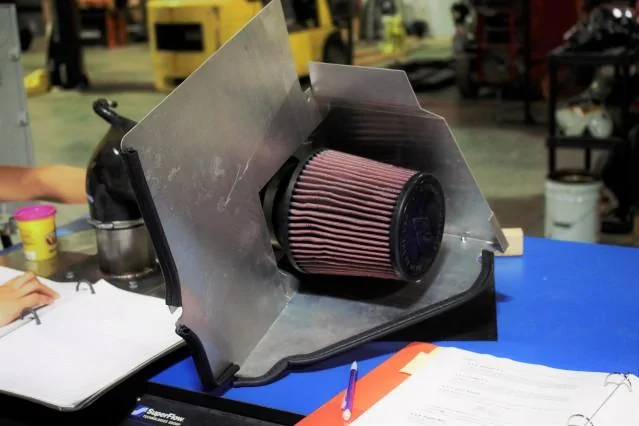
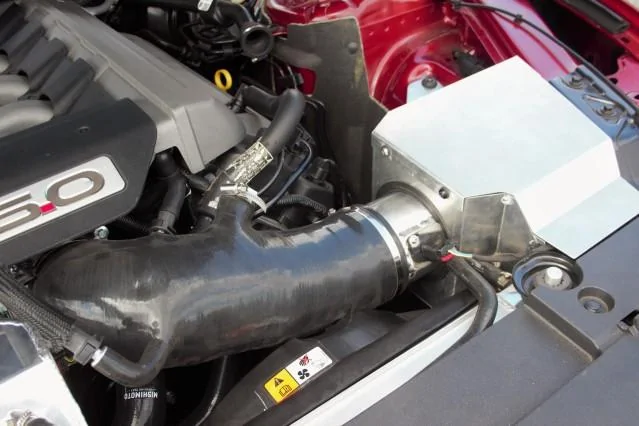
OP
OP
Mishimoto
Well-Known Member
- Thread starter
- #60
You bring up some interesting points. I know that this box is a little hot to the touch after driving it around, and when you are at the track, this is the same idle-time you have to account for on grid and at the pits. While we did not monitor how quickly the IATs come down after idling, this heat-soak is unavoidable when sitting at idle as I'm sure most of you are aware, even with the stock box, which itself is plastic. Like you said, it's just the nature of the beast. What we are theorizing here is that even if the heat soaking increases a bit with a metal box, once you get going, the motor is able to get over that pretty quickly.What's also important to IATs is how quickly they come down once moving. Have you done any testing of both the OEM intake and your intake as far as how quickly the IATs come down after idling?
We all know IATs will climb while stationary, that's just the nature of the beast. But once moving, the plastic OEM box cools down quickly and restores IATs to near ambient shortly after moving. However, I can't imagine that being the case with a metal box. Yes maintaining IATs near ambient is simple enough while moving...but what happens when a metal box gets hot? How long will it take to cool down?
From my experience, any metal in the engine bay will take much longer to cool down. It will eventually, but not nearly as quickly as plastic. So my concern is that you sit in the pits idling and the box heats up, then takes a long time to dissipate the heat even after moving.
Also, compared to temps coming down compared to plastic, we have been able to significantly improve pressure drop, lessening the resistance the air meets to get to the filter (so it's getting a thicker flow of air faster). It should help offset the affects of the aforementioned heat-soaking. Also, under acceleration, airflow could also reach speeds of up to 80 mph, and this doesn't give much time for a quick rise in air temperature when it is traveling the short distance of the filter to the throttle body. While there may be a slightly quicker rise in idle IATs with a metal box over plastic, the negative effects should be minimized once you start bringing in air, especially with this design.
The side of the box runs along side the entire width of the radiator, and this is what is helping to shield some of that heat. The air is being grabbed right from the front grill of the car, similarly in fashion to how the stock snorkel functioned. The difference is that we have much better airflow with the significant pressure drop improvement.Excellent. Do you retain the snorkel to the grille in some fashion? How do you limit hot air coming off the radiator from coming through to the intake?
Sponsored
- Status
- Not open for further replies.
Similar threads

- Replies
- 78
- Views
- 12,253
- Replies
- 96
- Views
- 18,704
- Locked
- Replies
- 217
- Views
- 28,582
- Replies
- 212
- Views
- 34,438
