Sponsored

New Water Pump and Tstat, CHT hotter than usual

RegboFoxtrot

Member
Joined
Aug 23, 2024
Threads
2
Messages
8
Reaction score
1
Location
Seattle
First Name
Reginald
Vehicle(s)
2017 Ford Mustang GT
Got my water pump and tstat replaced yesterday and now my car is consistently running 225-235 CHT, when previously I had never seen it above 220. It has always been between 190-205, 210-215 on hot days in bumper to bumper traffic. This morning on the way to work which is about 25 highway miles with intermittent stop and go traffic regular Thermostat gauge on dash never moved past the mid point, Oil temp maintained 'regular' status but was slightly above the mid point, and CHT fluctuated between 225-235 hitting a high of 243 at one point. On the way back home, traffic was lighter and I don't think it rose above 235.


Curious if a) driving is ok and if so, what is the red zone? I have read 240-250 so a little worried. And b) what's the cause here? Is it a faulty or insufficient thermostat? Worse?
Sponsored

 

G.T.

Well-Known Member
Joined
Apr 12, 2025
Threads
15
Messages
473
Reaction score
389
Location
Asia
First Name
Glenn
Vehicle(s)
2016 Ford Mustang GT Premium
You may have air pockets and need to bleed some more and/or add coolant.

Also, what parts did you put in? OE?
 
OP
OP

RegboFoxtrot

Member
Joined
Aug 23, 2024
Threads
2
Messages
8
Reaction score
1
Location
Seattle
First Name
Reginald
Vehicle(s)
2017 Ford Mustang GT
Not sure on the parts. I will need to check with the shop, I was going to take it back to them tomorrow and ask them to bleed the system again. I also ordered another thermostat in the midst of all this from Mishimoto.
 

Unas2k5

Well-Known Member
Joined
May 30, 2022
Threads
86
Messages
1,731
Reaction score
699
Location
Detroit
First Name
Samer
Vehicle(s)
2015 Mustang GT, 2021 Explorer ,2019 Impala
Are you sure both your fans are running? Or maybe the fan harness is unplugged ?
 

Sponsored

Skye

Well-Known Member
Joined
Jan 18, 2022
Threads
13
Messages
3,032
Reaction score
4,253
Location
≈39N
Vehicle(s)
"Skye" Mach1 N2144
Until the issue is resolved, I wouldn't drive the car more than you have to.

If you are driving and the temperatures are high, turn on the A/C.

In the logic of the 6G, both radiator fans should then come on, at 40% and later as high as 100% speed, if you turn on the A/C. Fans will continue to operate until A/C is turned off. The fans are running to keep air flowing across the A/C condenser.

If the engine's temperature reaches 212F / 100C, both radiator fans should switch on by themselves, at 40% power. If temperatures continue higher, they should then spin at 100% speed at 223F.

Routine driving around town or on highway, I run about 190F / 88C. My fans don't spin at those temps. When sitting still in traffic, I can see 212F / 100C, at which time both fans engage at 40%.

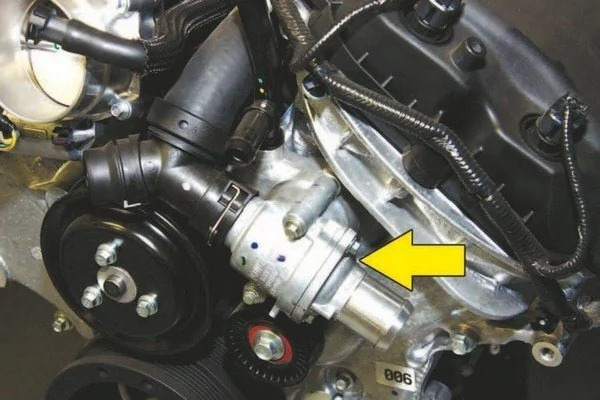
Attached is a photo of the Coyote thermostat housing. Given you're seeing such high temperatures at highway speed, IDK if they could have installed the thermostat backwards (if that's possible). Or one for another engine/application.

The thermostat is installed on the "cold" side of the engine and raditor. In previous applications, thermostats were installed at the top of an engine, the "hot" side, opening when needed. Cold water would then flow up from below. Temperature differences between bottom and top side could be quite large as cooler water entered the engine and flowed to the top.

Using the cold side method, the thermostat is attached to the cold side, to the bottom of the engine and lower end of the radiator. In the Coyote, water circulates in a circle from from front-to-back and bottom-to-top. Temperature changes are less abrupt, smoother. It suits the newer aluminum engines and longevity.

In the Coyote, the thermostat's sensor, the part of the thermostat that changes to open, should be facing the engine block. Being on the cold side, this is "upside down" versus a hot side application.

As mentioned previously, the coolant level might be lower after a few engine cycles. Attached is a Ford reference for coolant and other fluids.

https://www.fcsdchemicalsandlubricants.com/resources/quickreferencecharts

The Coyote operates on a logic known as Fail Safe cooling. Information on that follows. Fail Safe cooling is implemented when the engine's temperature reaches the red area in the gauge.

Fail Safe Cooling

A strategy called Fail Safe Cooling is built into the PCM that will control the engine if it starts to overheat.

Stage 1 of the strategy commences if the engine starts to overheat. The CHT sensor transmits a signal to the PCM , which moves the temperature gauge pointer into the red zone.

If the engine is not switched off and the temperature continues to rise, the Powertrain Check Lamp is illuminated. This indicates to the driver that the engine is approaching critical limits and should be stopped. At this point DTC P1285 is set in the PCM which can be retrieved using a scan tool.

Stage 2 of the strategy commences if the lamp and temperature gauge are ignored by the driver. The PCM will start to control the engine by cutting out 4 cylinders and restricting engine speed below 3,000 RPM . Simultaneously the MIL illuminates. This indicates that long term engine damage can occur and vehicle emissions will be affected. At this point DTC P1299 is set in the PCM which can be retrieved using a scan tool. Air is drawn into the deactivated cylinders. This helps to control the temperature of the engine internal components. The deactivated cylinders are alternated to allow even cooling of all the cylinders.

NOTE: If the driver is using a high percentage of throttle travel (for example, an overtaking maneuver) when the PCM starts engine deactivation (Stage 2), the deactivation will be delayed for 10 seconds.

NOTE: After 4-cylinder operation has begun, the engine will not revert to 8-cylinder operation, even if the temperature should fall, until the ignition is switched off and then on again.

NOTE: The MIL can only be extinguished by using a scan tool after the fault has been rectified and the DTC cleared.

Stage 3 of the strategy will commence if the engine temperature continues to rise. This results in the engine being totally disabled before major engine damage or seizure occurs. The Powertrain Check Lamp will begin to flash, indicating to the driver that the engine will be switched off after 30 seconds. This allows the driver time to choose a suitable parking place.

termostat housing.webp
 
Last edited:

GTP

Deutsche Pony
Joined
May 27, 2015
Threads
267
Messages
6,133
Reaction score
4,127
Location
Indy
Website
www.BambergAudio.com
First Name
Philip
Vehicle(s)
2019 GT PP1 A10 Outrageous Orange HPDE mods
So what you are saying is stop the damn car unless you are driving in Run For Your Life mode.
 
OP
OP

RegboFoxtrot

Member
Joined
Aug 23, 2024
Threads
2
Messages
8
Reaction score
1
Location
Seattle
First Name
Reginald
Vehicle(s)
2017 Ford Mustang GT
Are you sure both your fans are running? Or maybe the fan harness is unplugged ?
I can definitely hear the fans turn off when I shut the engine down, something I normally don’t hear.
Sponsored


Top