
Sponsored

LMS PCM Software Impessions

Juben

Well-Known Member
Joined
Jan 29, 2015
Threads
35
Messages
2,519
Reaction score
809
Location
Chattanooga, TN
First Name
Justin
Vehicle(s)
2015 EcoBoost Mustang (AT) w/PP
If you go to Green Filters USA, there's plenty of Ford products. They even have ads up for the F-150s and Focus STs. Perhaps you went to the Euro website?

Also, MAP probably uses an OTS cone filter. Multiple manufacturers produce wide varieties of cone filters in different sizes. If you have a 3.5" intake pipe, you could just choose a cone filter with the right inlet size, base diameter, and length. I'd guess it'd be something more akin to that than a custom filter.
Sponsored


 

Tune+

Well-Known Member
Joined
Oct 13, 2015
Threads
25
Messages
1,639
Reaction score
842
Location
St. Paul, MN
Website
www.facebook.com
First Name
Adam
Vehicle(s)
2015 Ecoboost Mustang Automatic
That's what I thought, they had it developed for the mustang as a custom product because nothing on the market supported their goals nor did they have the facility to do it themselves.

Maybe I'm wrong on that, but the "green filter" site doesn't even list Ford as a searchable product category. It doesn't really matter, I just thought it interesting.
No, they just buy them directly from Green Filter. Just because Green Filter's website sucks doesn't mean MAP is trying to swindle anyone lol.
 
OP
OP
TheLion

TheLion

Well-Known Member
Joined
Jul 1, 2016
Threads
68
Messages
1,621
Reaction score
601
Location
US
Vehicle(s)
Ruby Red 2016 Mustang GT PP 6-MT
No, they just buy them directly from Green Filter. Just because Green Filter's website sucks doesn't mean MAP is trying to swindle anyone lol.
That's not what I was trying to imply. I was under the impression MAP actually designed their own filter, what they are is a distributor for Green Filter. I posted the link as you can get the filter and recharge kit for the same price as just the filter by paying MAP's markup.

MAP isn't doing anything dishonest and if your ordering other parts from MAP and want to get a Green Filter then it would make sense to buy form them, otherwise if you want just the filter (you'll need a recharge kit anyway), it made more sense to go direct.
 
OP
OP
TheLion

TheLion

Well-Known Member
Joined
Jul 1, 2016
Threads
68
Messages
1,621
Reaction score
601
Location
US
Vehicle(s)
Ruby Red 2016 Mustang GT PP 6-MT
This is not an accurate test, it was done on stock tune so the throttle closed more up top due to torque limiting of the stock tune. When the throttle closes - there is power loss.

Green filter does not effect your top end when you have a proper tune without torque limitations.
My next question is, why do they torque limit at the top end? The only valid reason I have yet to see what from their 2.0L test showing high catalyst temps...I asked LMS about this and they said they do not have issues exceeding catalyst temps.

So I'm curious as to what PCM software FR used as their "competitor" and why the catalyst temps were so high. Other than outright detuning the engine to allow for a cheap internal upgrade path over the next decade (just keep revising the PCM software to get "more power" every couple of years, which is common practice) or to avoid affecting V8 sales I don't understand why the factory PCM software would be set up to torque limit at high rpm.

The smallish twin scroll turbo is certainly going to generate more heat as it moves outside of it's efficiency range, which is what FR claimed was causing the high catalyst temps and why the FR ecoboost PCM software did not alter the torque / power band past 5500 vs. the OEM software.
 

TEXAS HEAT

Well-Known Member
Joined
May 25, 2016
Threads
37
Messages
706
Reaction score
281
Location
TEXAS
Vehicle(s)
2019 Mustang GT PP1 A10
My next question is, why do they torque limit at the top end? The only valid reason I have yet to see what from their 2.0L test showing high catalyst temps...I asked LMS about this and they said they do not have issues exceeding catalyst temps.

So I'm curious as to what PCM software FR used as their "competitor" and why the catalyst temps were so high. Other than outright detuning the engine to allow for a cheap internal upgrade path over the next decade (just keep revising the PCM software to get "more power" every couple of years, which is common practice) or to avoid affecting V8 sales I don't understand why the factory PCM software would be set up to torque limit at high rpm.

The smallish twin scroll turbo is certainly going to generate more heat as it moves outside of it's efficiency range, which is what FR claimed was causing the high catalyst temps and why the FR ecoboost PCM software did not alter the torque / power band past 5500 vs. the OEM software.
I really think you should start data logging so you can really see what is going on with your current tuning strategy. It's invaluable insight regarding limitations and/or lack thereof. With you having a data logging device not tied to your tuning device, you can see things on both sides of the fence... Get on it already!!!:paddle:
 

Sponsored

Tune+

Well-Known Member
Joined
Oct 13, 2015
Threads
25
Messages
1,639
Reaction score
842
Location
St. Paul, MN
Website
www.facebook.com
First Name
Adam
Vehicle(s)
2015 Ecoboost Mustang Automatic
My next question is, why do they torque limit at the top end? The only valid reason I have yet to see what from their 2.0L test showing high catalyst temps...I asked LMS about this and they said they do not have issues exceeding catalyst temps.

So I'm curious as to what PCM software FR used as their "competitor" and why the catalyst temps were so high. Other than outright detuning the engine to allow for a cheap internal upgrade path over the next decade (just keep revising the PCM software to get "more power" every couple of years, which is common practice) or to avoid affecting V8 sales I don't understand why the factory PCM software would be set up to torque limit at high rpm.

The smallish twin scroll turbo is certainly going to generate more heat as it moves outside of it's efficiency range, which is what FR claimed was causing the high catalyst temps and why the FR ecoboost PCM software did not alter the torque / power band past 5500 vs. the OEM software.
The torque is limited through the entire pull on the stock tune, it is how they control boost/load. they hit their target torque numbers and that is it. The ETC does the rest.

Not sure where Catalyst temps came into play, and what information you are referring to from Ford Racing. I don't pay attention to any flash and go tuners and the information they share. I have no issues with any temperature limits being exceeded even on 350-360hp stock turbo cars so if they are having problems they need to realize their charge air temps are one of the major factors.
 
OP
OP
TheLion

TheLion

Well-Known Member
Joined
Jul 1, 2016
Threads
68
Messages
1,621
Reaction score
601
Location
US
Vehicle(s)
Ruby Red 2016 Mustang GT PP 6-MT
The torque is limited through the entire pull on the stock tune, it is how they control boost/load. they hit their target torque numbers and that is it. The ETC does the rest.

Not sure where Catalyst temps came into play, and what information you are referring to from Ford Racing. I don't pay attention to any flash and go tuners and the information they share. I have no issues with any temperature limits being exceeded even on 350-360hp stock turbo cars so if they are having problems they need to realize their charge air temps are one of the major factors.
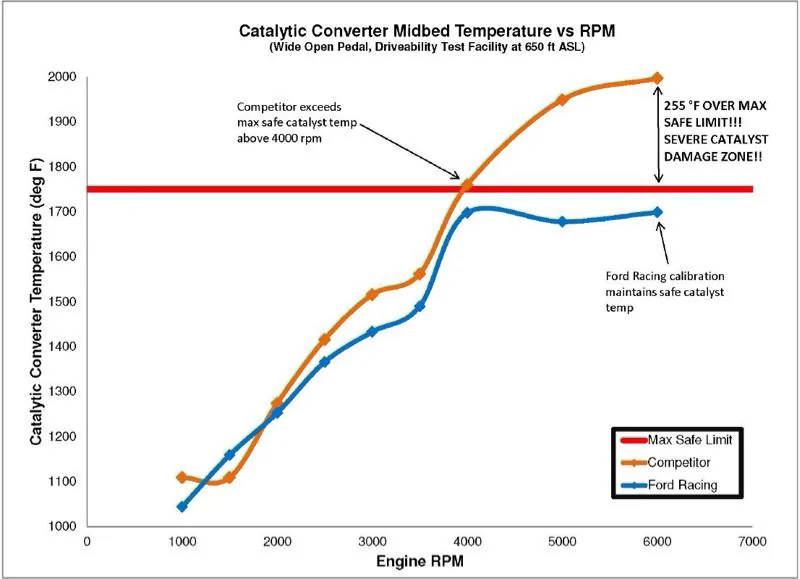
I was referencing FR's comments on the Focus ST, given it also uses a ceramic substrate catalyst (lower maximum operating temp than other substrate materials) and is a relative of the 2.3L. I'm curious if the catalyst in the 2.3L will see similar issues when upping the torque limit at the higher rpm range (I'm thinking this is primarily due to the turbo efficiency dropping at the higher rpm and generating more heat in proportion to it's rpm), which is where it is more desirable to see gains given it's severe tapering which normally makes the upper RPM band useless with the factory PCM software. Short shifting for drag racing may be acceptable, but for track use it creates more shift points, which slows the car's lap times obviously.

I spoke to LMS about this and the said the same thing you did, that there are no known issues with excessively high catalyst temperatures during any of their testing or on any customer vehicles (given they have been doing this since 2009, I think we would see lots of SHO's, ST's and F-150's with thermal failures of their catalysts). My question is, how did FR come up with this and what PCM software where they using as an example that could produce such results...? Also is it a possible issue on the 2.3L? It's been quite perplexing as I can't seem to find the answer to that...

Here is one thread I found that references the Ford Racing catalyst temp graph: http://www.focusst.org/forum/focus-st-performance/17404-catalyst-temperature.html

33539d1391834418-catalyst-temperature-image-169536296.webp
 

Tune+

Well-Known Member
Joined
Oct 13, 2015
Threads
25
Messages
1,639
Reaction score
842
Location
St. Paul, MN
Website
www.facebook.com
First Name
Adam
Vehicle(s)
2015 Ecoboost Mustang Automatic
I was referencing FR's comments on the Focus ST, given it also uses a ceramic substrate catalyst (lower maximum operating temp than other substrate materials) and is a relative of the 2.3L. I'm curious if the catalyst in the 2.3L will see similar issues when upping the torque limit at the higher rpm range (I'm thinking this is primarily due to the turbo efficiency dropping at the higher rpm and generating more heat in proportion to it's rpm), which is where it is more desirable to see gains given it's severe tapering which normally makes the upper RPM band useless with the factory PCM software. Short shifting for drag racing may be acceptable, but for track use it creates more shift points, which slows the car's lap times obviously.

I spoke to LMS about this and the said the same thing you did, that there are no known issues with excessively high catalyst temperatures during any of their testing or on any customer vehicles (given they have been doing this since 2009, I think we would see lots of SHO's, ST's and F-150's with thermal failures of their catalysts). My question is, how did FR come up with this and what PCM software where they using as an example that could produce such results...? Also is it a possible issue on the 2.3L? It's been quite perplexing as I can't seem to find the answer to that...

Here is one thread I found that references the Ford Racing catalyst temp graph: http://www.focusst.org/forum/focus-st-performance/17404-catalyst-temperature.html

33539d1391834418-catalyst-temperature-image-169536296.webp
SEVERE CATALYST DAMAGE ZONE!!!!!!!!!!!!!!!


Remember that picture I posted a few post back of my engine bay? That is a 420whp/420wtq car, on a stock downpipe and stock catback. When I did the live tuning session on Facebook the very first part of my video I stated that I kept all OEM temperature limits in place to make sure that the catalyst and all other temp limits would not be exceeded. They were not and still haven't been since the testing.

All Ecoboost engines are tuned the same way by Ford, high boost request, which is then kept in check with load, turbo, and torque limits. Most tuners out there just raise the torque limits and allow for more torque. More torque allowed = more power. You can turn torque limiting completely off and still use the throttle to keep boost/load in check. I personally tune completely different than everyone else and in the end still have all limiters in place, altered, but still in place.
 
OP
OP
TheLion

TheLion

Well-Known Member
Joined
Jul 1, 2016
Threads
68
Messages
1,621
Reaction score
601
Location
US
Vehicle(s)
Ruby Red 2016 Mustang GT PP 6-MT
Now you just need to run the dyno on the green filter vs. Paper filter in that stock airbox.
 

ypena02

Well-Known Member
Joined
Nov 14, 2015
Threads
27
Messages
789
Reaction score
203
Location
Massachusetts
Vehicle(s)
2017 Mustang GT
Now you just need to run the dyno on the green filter vs. Paper filter in that stock airbox.
Why? The testing I did at the track says it all, green filter is superior.
 
OP
OP
TheLion

TheLion

Well-Known Member
Joined
Jul 1, 2016
Threads
68
Messages
1,621
Reaction score
601
Location
US
Vehicle(s)
Ruby Red 2016 Mustang GT PP 6-MT
Why? The testing I did at the track says it all, green filter is superior.
That was on a stock car, i want to see how a car with a performance PCM software runs side by side. I'm particularly interested in the top end to see if the gains follow all the way through the RPM band, which I expect they would with modified PCM software, but the question is, how much?

BTW, I did some WOT pulls on the way home and recorded a max catalyst temp of 1369F, well under the 1750F limit, so I'm not sure what car they came up with that catalyst temp graph from. Exhaust gases typically don't exceed 1900F right out of the manifold worst case. It seems highly un-probable the catalyst could even see temps up to 2000F after passing through the turbine and S curve in the pipe assuming no blockage. I'm not sure how FR came up with that graph and what "competitor" they were using...smells like marketing propaganda.

And a second BTW, I stuck in a green filter today on my way home as well. At first it felt like the car lost power, but I believe this is perception as the power comes on earlier, so there's less of a "buildup". Dyno graphs clearly show in the low end and mid at the very least the car making more power. But one thing is certain, ypena02 proved his car traps higher with the green filter than without and I can definitely feel a more immediate throttle response. Now if VelossaTek would only get that darn ram air duct in the mail (got the green panel filter today and the GT grill comes tomorrow)!
Sponsored


Top