Sponsored

LMS PCM Software Impessions

ypena02

Well-Known Member
Joined
Nov 14, 2015
Threads
27
Messages
789
Reaction score
203
Location
Massachusetts
Vehicle(s)
2017 Mustang GT
Really? Tell us more about how you tested it. I didn't think it'd be that large of a difference but now I'm intrigued.
Well I typically trap between 94 and 98 mph depending on the weather and how heat soaked the shitty stock IC is. Yesterday, I threw on the stock filter and trapped 92 and 93 mph on my first two passes. I let it sit for a bit, put the green filter back on and trapped 95mph. 92 mph is lowest I've ever trapped in this car even on hotter days.

If you just look at the the two filters, it's obvious how much less restrictive the green filter is. I immediately felt a difference in throttle response as well.
Sponsored

 
OP
OP
TheLion

TheLion

Well-Known Member
Joined
Jul 1, 2016
Threads
68
Messages
1,621
Reaction score
601
Location
US
Vehicle(s)
Ruby Red 2016 Mustang GT PP 6-MT
The confirmed that the green filter outperforms the stock filter this weekend at the track. I lost ~2-3 mph going back to the factory filter on my stock car.
Trust but verify, I take it these were back to back runs? Also if your car is stock, did you run the stock filter first and then the green filter or the green filter then the stock filter? You may be seeing heat soak especially with the stock IC.
 

ypena02

Well-Known Member
Joined
Nov 14, 2015
Threads
27
Messages
789
Reaction score
203
Location
Massachusetts
Vehicle(s)
2017 Mustang GT
Trust but verify, I take it these were back to back runs? Also if your car is stock, did you run the stock filter first and then the green filter or the green filter then the stock filter? You may be seeing heat soak especially with the stock IC.
I outlined how I tested above, post 16. The stock filter was tested first.
 
OP
OP
TheLion

TheLion

Well-Known Member
Joined
Jul 1, 2016
Threads
68
Messages
1,621
Reaction score
601
Location
US
Vehicle(s)
Ruby Red 2016 Mustang GT PP 6-MT
I outlined how I tested above, post 16. The stock filter was tested first.
How I missed that is beyond me...lol. It would be interesting to see how the combination of the ram air duct and a green filter would perform in the stock airbox...compared to upgrading to just a CAI. I'm think cost vs. performance. The green filter and ram air duct will net about $175 total where most CAI's are around $350. Some of the tubular CAI's are about $200, however they are not sealed nor do they draw fresh air from the inlet at the front, but rather the fender well.

The fender well CAI's are also very prone to water injestion, I had that problem periodically on my 07 Focus St with the K&N Typhoon CAI. On the highway in heavy rain I would get frequent failure to ignite and power would cut out. On a high boost turbo engine I'd be more worried about hydrolock...which is why I don't think we should consider the tubular CAI's for a DD application (at least not where you are subjected to diverse environments). Just some food for thought.

http://www.velossatechdesign.com/product/2015-2016-s550-mustang-big-mouth-ram-air-kit/
 

TEXAS HEAT

Well-Known Member
Joined
May 25, 2016
Threads
37
Messages
706
Reaction score
281
Location
TEXAS
Vehicle(s)
2019 Mustang GT PP1 A10
How I missed that is beyond me...lol. It would be interesting to see how the combination of the ram air duct and a green filter would perform in the stock airbox...compared to upgrading to just a CAI. I'm think cost vs. performance. The green filter and ram air duct will net about $175 total where most CAI's are around $350. Some of the tubular CAI's are about $200, however they are not sealed nor do they draw fresh air from the inlet at the front, but rather the fender well.

The fender well CAI's are also very prone to water injestion, I had that problem periodically on my 07 Focus St with the K&N Typhoon CAI. On the highway in heavy rain I would get frequent failure to ignite and power would cut out. On a high boost turbo engine I'd be more worried about hydrolock...which is why I don't think we should consider the tubular CAI's for a DD application (at least not where you are subjected to diverse environments). Just some food for thought.

http://www.velossatechdesign.com/product/2015-2016-s550-mustang-big-mouth-ram-air-kit/
^^^ This only works if you have the upper GT grill.
 

Sponsored

CustomS550

Well-Known Member
Joined
May 10, 2016
Threads
51
Messages
335
Reaction score
77
Location
South Carolina
Vehicle(s)
2016 EB Mustang
For whatever reason I was seeing higher air inlet temps with the stock intake than with the fender mounted CAI I was comparing it against. It also took a long time for the air temps to drop once moving with the stock intake. I was surprised to see this, because supposedly the stock setup is sealed away from the hot underhood air, but that wasn't the case even with an extra opening I cut out in the stock grille. Maybe the draw location around the radiator is not ideal. Lastly, the difference in power and throttle response was very noticeable, but to be fair the car did have a CAI tune loaded.


How I missed that is beyond me...lol. It would be interesting to see how the combination of the ram air duct and a green filter would perform in the stock airbox...compared to upgrading to just a CAI. I'm think cost vs. performance. The green filter and ram air duct will net about $175 total where most CAI's are around $350. Some of the tubular CAI's are about $200, however they are not sealed nor do they draw fresh air from the inlet at the front, but rather the fender well.

The fender well CAI's are also very prone to water injestion, I had that problem periodically on my 07 Focus St with the K&N Typhoon CAI. On the highway in heavy rain I would get frequent failure to ignite and power would cut out. On a high boost turbo engine I'd be more worried about hydrolock...which is why I don't think we should consider the tubular CAI's for a DD application (at least not where you are subjected to diverse environments). Just some food for thought.

http://www.velossatechdesign.com/product/2015-2016-s550-mustang-big-mouth-ram-air-kit/
 
OP
OP
TheLion

TheLion

Well-Known Member
Joined
Jul 1, 2016
Threads
68
Messages
1,621
Reaction score
601
Location
US
Vehicle(s)
Ruby Red 2016 Mustang GT PP 6-MT
For whatever reason I was seeing higher air inlet temps with the stock intake than with the fender mounted CAI I was comparing it against. It also took a long time for the air temps to drop once moving with the stock intake. I was surprised to see this, because supposedly the stock setup is sealed away from the hot underhood air, but that wasn't the case even with an extra opening I cut out in the stock grille. Maybe the draw location around the radiator is not ideal. Lastly, the difference in power and throttle response was very noticeable, but to be fair the car did have a CAI tune loaded.
That would make some sense, hot air rises. The fender well CAI's have the filter mounted as low as possible, so they should be drawing in cool air. The issue is two fold however, the fender well does not pressurize the air at speed like a ram air intake, so there's lost efficiency there. The second as I mentioned for me where I live is water ingestion. If you live in a very dry area and rarely see heavy rains it's likely not an issue, but here in Ohio we get heavy rain storms throughout the summer and heavy water vapor on the highways, that's where my 07 Focus CAI had issues sucking up so much water vapor I would get ignition failures, have to slow down, back away form other cars and down shift just to keep enough power to keep moving. I'd be more concerned on a turbo engine, although the water vapor would cool the turbo and chamber, it may also cause failure to ignite as well.

I wasn't trying to suggest tubular fender well CAI's aren't any good, they just have limited application and are more track oriented than daily driver. I just ordered a GT front grill set off e-bay and the Velossa Tech Designs BIG MOUTH ram air duct. I figure I can use for now with the stock airbox to help eliminate the hot air intake temps you mentioned but also still allows for future upgrade to Air Aid type sealed box CAI's that interface with the stock ducting location. From what I saw with the BIG MOUTH development thread, customers were seeing AIT's just a few degrees above ambient.

One of the biggest issues with the stock air ducting is the poor flow at the front, not the air box itself, the high pressure zone (stagnation zone) is in the wrong spot (i'll bet this was intentional detuning, there's no reason Ford could not have molded their own version of the BIG MOUTH for a few dollars given all the other molded ducting). The BIG MOUTH accomplishes two things, it moves the stagnation zone into the airbox itself, thus assisting the engine in drawing in air while moving at higher speeds (60mph and above, which is very common) and it provides a sealed path from directly outside the vehicle which prevents radiator back wash when idling or driving at low speeds.

I've seen some arguments that the AIT's are some what irrelevant on turbo cars due to the presence of an inter cooler, while it is true a good IC can take out the extra heat, all that is accomplished is adding additional load to the IC and also increasing turbo temps. Cooler air going into the compressor will help keep the compressor cooler and allow for higher efficiency as the compressor will move more air (due to the higher incoming density) with each rotation. The ram air effect is well...self explanatory.
 

Tune+

Well-Known Member
Joined
Oct 13, 2015
Threads
25
Messages
1,639
Reaction score
842
Location
St. Paul, MN
Website
www.facebook.com
First Name
Adam
Vehicle(s)
2015 Ecoboost Mustang Automatic
I believe this is related to the PCM tuning, as a higher flow filter should allow for higher volume of flow without affecting velocity (which is important at higher RPM).


It seems the stock PCM software looses a bit of edge in the power band according to their own testing. All the gains are low and mid range. The top end is already weak, so I never considered a drop in panel filter with the stock airbox. HOWEVER, i'm NOT sure how it would perform with a custom PCM software, it MAY be a different story.

Fast forward to 1:15 and go full screen, you'll see the red line averages under the blue in the upper range in several regions.

This is not an accurate test, it was done on stock tune so the throttle closed more up top due to torque limiting of the stock tune. When the throttle closes - there is power loss.

Green filter does not effect your top end when you have a proper tune without torque limitations.
 

Tune+

Well-Known Member
Joined
Oct 13, 2015
Threads
25
Messages
1,639
Reaction score
842
Location
St. Paul, MN
Website
www.facebook.com
First Name
Adam
Vehicle(s)
2015 Ecoboost Mustang Automatic
For whatever reason I was seeing higher air inlet temps with the stock intake than with the fender mounted CAI I was comparing it against. It also took a long time for the air temps to drop once moving with the stock intake. I was surprised to see this, because supposedly the stock setup is sealed away from the hot underhood air, but that wasn't the case even with an extra opening I cut out in the stock grille. Maybe the draw location around the radiator is not ideal. Lastly, the difference in power and throttle response was very noticeable, but to be fair the car did have a CAI tune loaded.
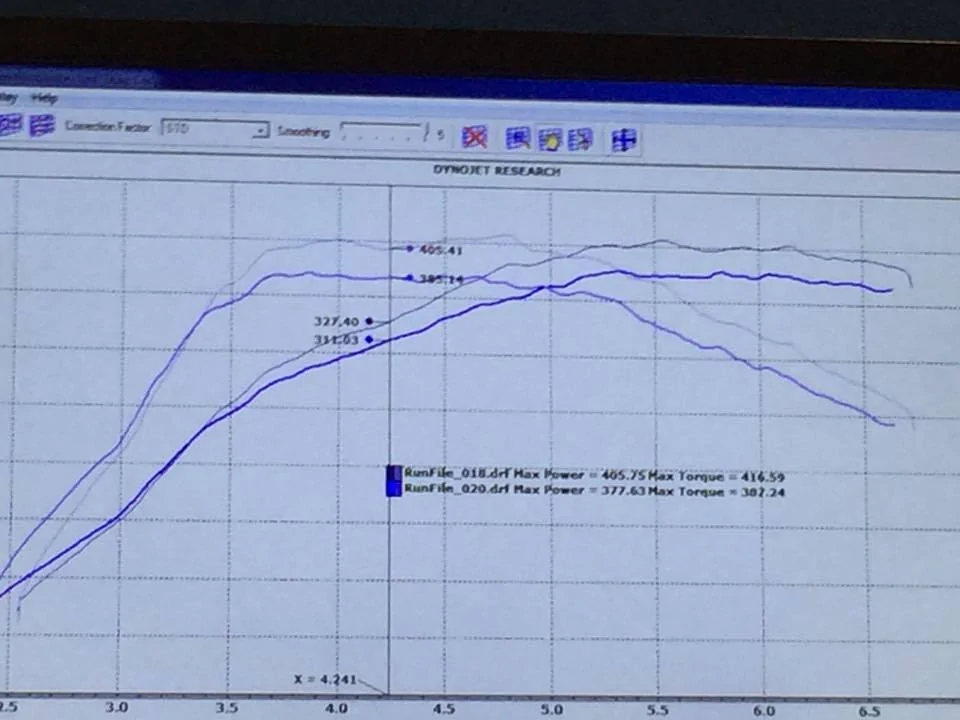
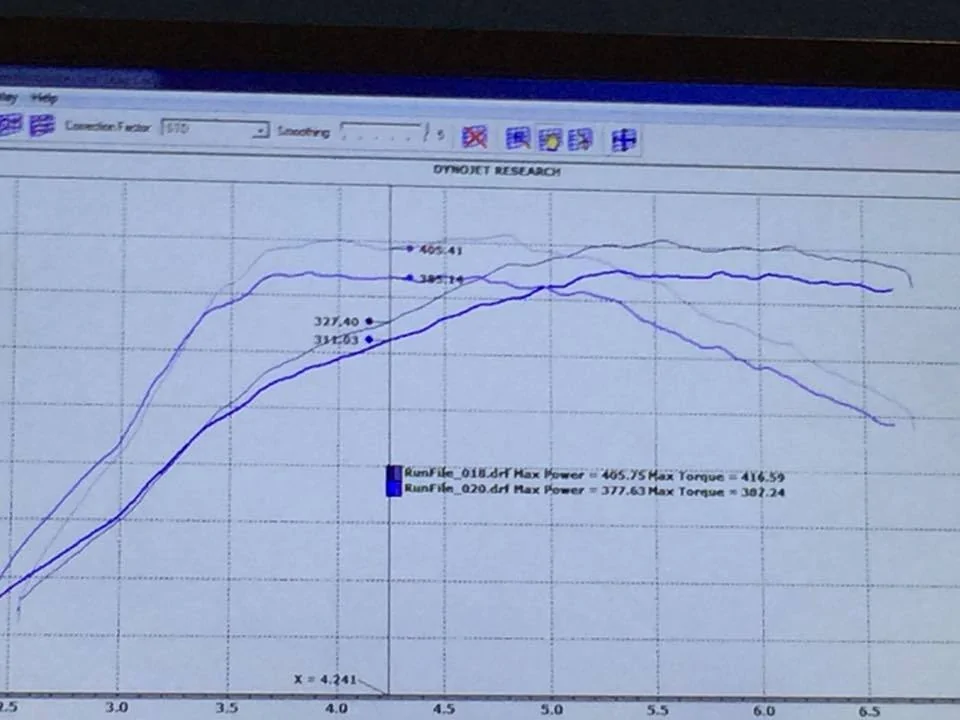
I have tested both extensively, a fender mounted intake will not recover anywhere near as fast as the stock intake and the stock intake has made more power (with tuning) than aftermarket intakes. The more power you make, the more power the stock airbox makes. When you get to a point where you outflow the stock airbox (450-500whp and up) you will need to get creative with the intake and keep temperatures in mind. Best option is to keep it short and big at those power levels.


Stock airbox versus 3.5" fender intake on a 7670EFR running 23psi on E85. This is also done with the stock downpipe (modified to fit my Full-Race turbo kit) and stock exhaust. This testing was done live on Facebook, you can find the video on the Ecoboost Facebook group. Same tune, no changes.Stock out performed by a long shot, and I even did a second run where I opened the hood and put the intake out of the engine bay directly into airflow and it only came up 12hp. So still underperformed compared to the stock airbox.


13537676_10206053048395823_3947282027253819663_n.webp


Since then I have put a Green filter in the box and could immediately hear and feel the difference in power. I haven't been back on the dyno as I am in the middle of a complete head swap and turbo kit.
 
OP
OP
TheLion

TheLion

Well-Known Member
Joined
Jul 1, 2016
Threads
68
Messages
1,621
Reaction score
601
Location
US
Vehicle(s)
Ruby Red 2016 Mustang GT PP 6-MT
I have tested both extensively, a fender mounted intake will not recover anywhere near as fast as the stock intake and the stock intake has made more power (with tuning) than aftermarket intakes. The more power you make, the more power the stock airbox makes. When you get to a point where you outflow the stock airbox (450-500whp and up) you will need to get creative with the intake and keep temperatures in mind. Best option is to keep it short and big at those power levels.


Stock airbox versus 3.5" fender intake on a 7670EFR running 23psi on E85. This is also done with the stock downpipe (modified to fit my Full-Race turbo kit) and stock exhaust. This testing was done live on Facebook, you can find the video on the Ecoboost Facebook group. Same tune, no changes.Stock out performed by a long shot, and I even did a second run where I opened the hood and put the intake out of the engine bay directly into airflow and it only came up 12hp. So still underperformed compared to the stock airbox.


13537676_10206053048395823_3947282027253819663_n.webp
Adam, thanks for the information. I just ordered a GT grill set and the Velossa Tech BIG MOUTH Ram Air Duct. My intent was to the optimize the ducting going into the stock air box and then use a drop in high flow panel filter.

The ram air duct provides two benefits: 1. eliminates radiator backwash at lower speeds (stock cavity ducting does not actually seal like the stock air box does) as the air is now being drawn from directly outside of the vehicle 2. moves the stagnation zone into the air box instead of the cavity at the front where the stock air box draws from. This the stagnation zone is the high pressure zone for reference, giving the turbo easy access to cool pressurized air (or depending on engine consumption, alleviating the vacuum requirement to adequately supply the engine).

RAM air ducting has been in place for decades on high performance cars such as corvettes and other super cars. I was thinking the combination of the drop in panel filter and the ram air ducting would provide better performance than anything else out there and is also consequently most friendly to daily driving. I would not even consider fender well CAI's due to water ingestion issues (I had that problem on my last car, an 07 Focus ST 2.3L NA with a K&N typhoon fender well CAI).

What your saying just reinforces my theories on the most optimal intake path. Although I'd be curious as to how well something the the Air Aid / Windstorm types do when combined with proper ducting. Perhaps the added flow rate of the filter isn't the issue, but rather the shape of the intake tracts, air box and front ducting having a much larger impact than simply using a large conical filter.
 

Sponsored

Tune+

Well-Known Member
Joined
Oct 13, 2015
Threads
25
Messages
1,639
Reaction score
842
Location
St. Paul, MN
Website
www.facebook.com
First Name
Adam
Vehicle(s)
2015 Ecoboost Mustang Automatic
Adam, thanks for the information. I just ordered a GT grill set and the Velossa Tech BIG MOUTH Ram Air Duct. My intent was to the optimize the ducting going into the stock air box and then use a drop in high flow panel filter.

The ram air duct provides two benefits: 1. eliminates radiator backwash at lower speeds (stock cavity ducting does not actually seal like the stock air box does) as the air is now being drawn from directly outside of the vehicle 2. moves the stagnation zone into the air box instead of the cavity at the front where the stock air box draws from. This the stagnation zone is the high pressure zone for reference, giving the turbo easy access to cool pressurized air (or depending on engine consumption, alleviating the vacuum requirement to adequately supply the engine).

RAM air ducting has been in place for decades on high performance cars such as corvettes and other super cars. I was thinking the combination of the drop in panel filter and the ram air ducting would provide better performance than anything else out there and is also consequently most friendly to daily driving. I would not even consider fender well CAI's due to water ingestion issues (I had that problem on my last car, an 07 Focus ST 2.3L NA with a K&N typhoon fender well CAI).

What your saying just reinforces my theories on the most optimal intake path.

I'm well aware of the benefits of the VelossaTech big mouth inlet, I'm the one that helped test it and produce it ;) haha.
 
OP
OP
TheLion

TheLion

Well-Known Member
Joined
Jul 1, 2016
Threads
68
Messages
1,621
Reaction score
601
Location
US
Vehicle(s)
Ruby Red 2016 Mustang GT PP 6-MT
I'm well aware of the benefits of the VelossaTech big mouth inlet, I'm the one that helped test it and produce it ;) haha.
Alright then, I'm on the right path confirmed by testing and experience. I originally went this route because the cost of the BIG MOUTH, drop in filter and GT grill was still less than most CAI's alone and would also allow for an upgrade path to closed box CAI's if there was any further benefit, but I think this will be well enough in and of itself. Thanks for the info Adam.
 
OP
OP
TheLion

TheLion

Well-Known Member
Joined
Jul 1, 2016
Threads
68
Messages
1,621
Reaction score
601
Location
US
Vehicle(s)
Ruby Red 2016 Mustang GT PP 6-MT
BTW if anyone is interested, MAP gets their "green filters" from Green Filter...not surprising. You can order the filter for $7 less, get free shipping and order their cleaner / recharger kit for $15 along with the filter. I usually clean my K&N's once a year or once every other year due to all the salt dust in winter they get pretty dirty (depending on how bad the winter is). I'd imagine the "greenfilter" cleaning interval is similar to K&N's (25k miles on average).

http://www.greenfilterusa.com/store/index.php?route=product/search&search=7275

and

http://www.greenfilterusa.com/store/filter-cleaning/2000
 

Tune+

Well-Known Member
Joined
Oct 13, 2015
Threads
25
Messages
1,639
Reaction score
842
Location
St. Paul, MN
Website
www.facebook.com
First Name
Adam
Vehicle(s)
2015 Ecoboost Mustang Automatic
BTW if anyone is interested, MAP gets their "green filters" from Green Filter...not surprising. You can order the filter for $7 less, get free shipping and order their cleaner / recharger kit for $15 along with the filter. I usually clean my K&N's once a year or once every other year due to all the salt dust in winter they get pretty dirty (depending on how bad the winter is). I'd imagine the "greenfilter" cleaning interval is similar to K&N's (25k miles on average).

http://www.greenfilterusa.com/store/index.php?route=product/search&search=7275

and

http://www.greenfilterusa.com/store/filter-cleaning/2000
If MAP didn't get their Green filters from Green Filter, they wouldn't be green filters.... I'm not sure how that is surprising, when you sell a product manufactured by someone else you buy it from the manufacturer. Maybe you meant it another way but it sounds like you are stating MAP is selling a "green filter" as their own product.
 
OP
OP
TheLion

TheLion

Well-Known Member
Joined
Jul 1, 2016
Threads
68
Messages
1,621
Reaction score
601
Location
US
Vehicle(s)
Ruby Red 2016 Mustang GT PP 6-MT
If MAP didn't get their Green filters from Green Filter, they wouldn't be green filters.... I'm not sure how that is surprising, when you sell a product manufactured by someone else you buy it from the manufacturer. Maybe you meant it another way but it sounds like you are stating MAP is selling a "green filter" as their own product.
That's what I thought, they had it developed for the mustang as a custom product because nothing on the market supported their goals nor did they have the facility to do it themselves.

Maybe I'm wrong on that, but the "green filter" site doesn't even list Ford as a searchable product category. It doesn't really matter, I just thought it interesting.
Sponsored


Top