Sponsored

Another Exploded Clutch

shogun32

Well-Known Member
Joined
Feb 8, 2019
Threads
92
Messages
16,223
Reaction score
14,019
Location
Northern VA
First Name
Matt
Vehicle(s)
'19 GT/PP, '23 GB Mach1, '12 Audi S5 (v8+6mt)
Vehicle Showcase
2
All I can say is the shifter and clutch on the refresh is a DREAM compared to the 15-17s I've driven.
Have to second that. Drove an early manufacture '16 v6 last night that had 62K miles on it. I had been wondering what all the moaning was about 2-3 lockout and such because my '19 doesn't have that pathology (or not enough to matter). Holy smokes! Talk about "notchy" shift-gate behavior on the '16 vs the near 'snick' on the '19. I drove a new '17 80mi GT Premium (almost bought it) and it seemed to behave itself though.,.
Sponsored


gqneon

Well-Known Member
Joined
Jun 25, 2015
Threads
91
Messages
867
Reaction score
144
Location
Westfield, IN
Vehicle(s)
18 GT PP / Manual
Anyone with an 18/19 have any issues to report? Just picked up a 19 GT and the clutch is WAY different (read: better) from the 16 v6 I was driving before I traded it. Wondering if they fixed the issue with the clutches on the refresh. I've been sending it every opportunity I get and it's been great so far.
I'm a little late chiming in but I love the stock 18 clutch - I jumped up to over 600 wheel torque so I'm going through some pains with a new Mantic cerametallic right now - but the stock clutch still looks like new - drives smooth - engages smooth - no noise. If it held up for the hit on a whipple with 850 wheel I'd just keep it. It's fine from a roll - mostly - but it's on borrowed time with that much torque.

The stock 18 clutch is a huge improvement over my stock 15 GT PP clutch - and I later swapped in a SPEC stage 2 I think in that car - EXEDY all the way for reasonable power is my vote on 15-17.

Do you have any advice for getting the top transmission bolts back in? While I was taking them out yesterday I realized I had no idea how I was going to get them back in their homes.

We are supposed to get some water from the sky here in Phoenix so I am in a holding pattern until that clears. I will absolutely post up some clutch carnage pics when I get there.
To the guy trying to get his bolts into the top two holes - I've done this on jackstands 4 times this month already on my 18. You can get them with the trans cross-member bolted all the way up or even easier with the trans dropping down in the back. Several long extensions, a universal 13mm socket or a u-joint and a normal 13mm, and you're in there. Feed them up from as far back as possible (near the crossmember usually) - use a good light so you can always see up there. Once you get eyes on it, it's not so bad. If you're having trouble getting the bolt into the hole first, use a long spring loaded pick up tool to hold the bolt and feed it up there - then you can hand start the bolts with the above extension bar combo.
 
OP
OP
Guarded15

Guarded15

Active Member
Joined
Feb 25, 2019
Threads
5
Messages
32
Reaction score
16
Location
Phoenix AZ
Vehicle(s)
S550 GT
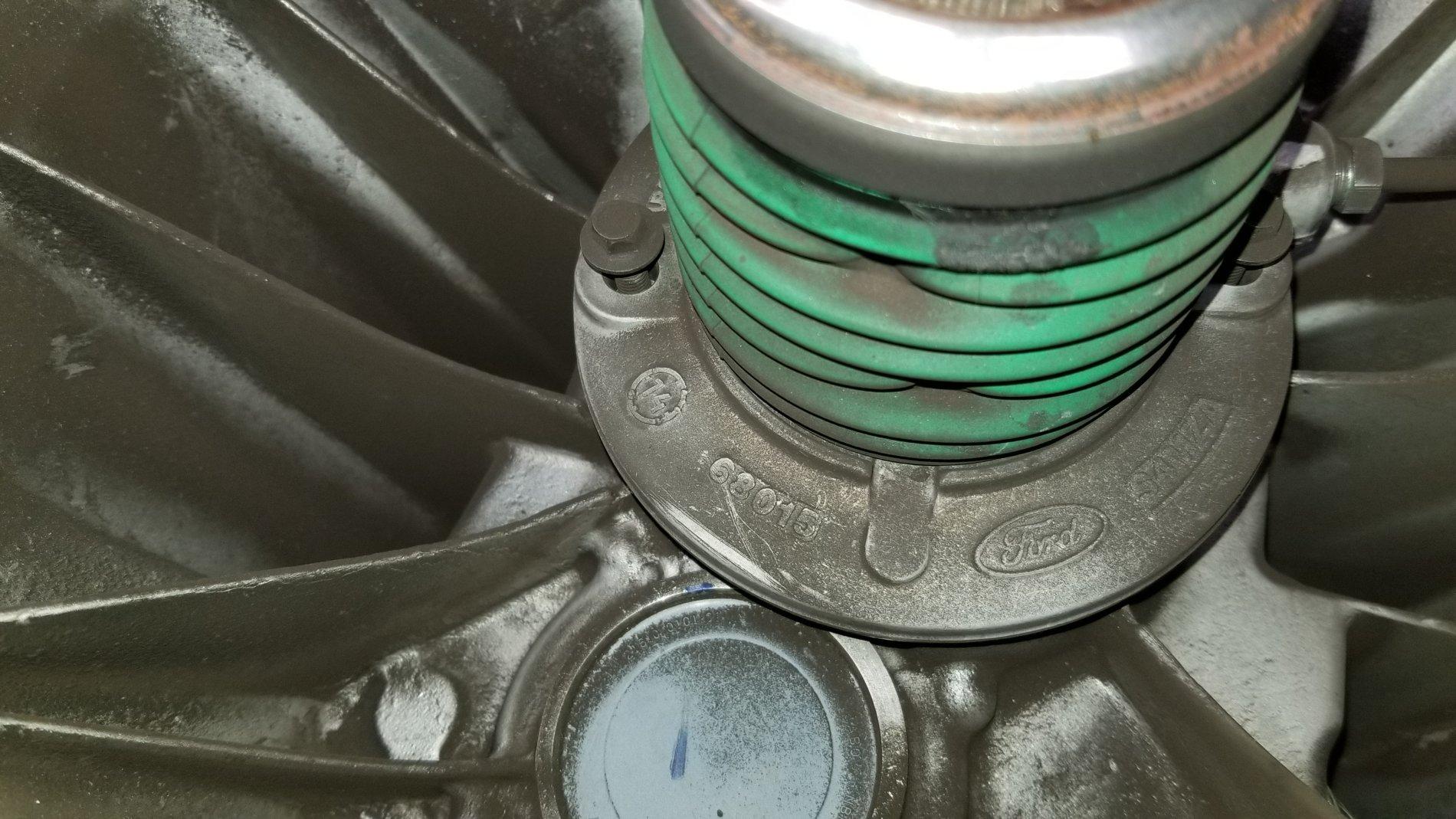
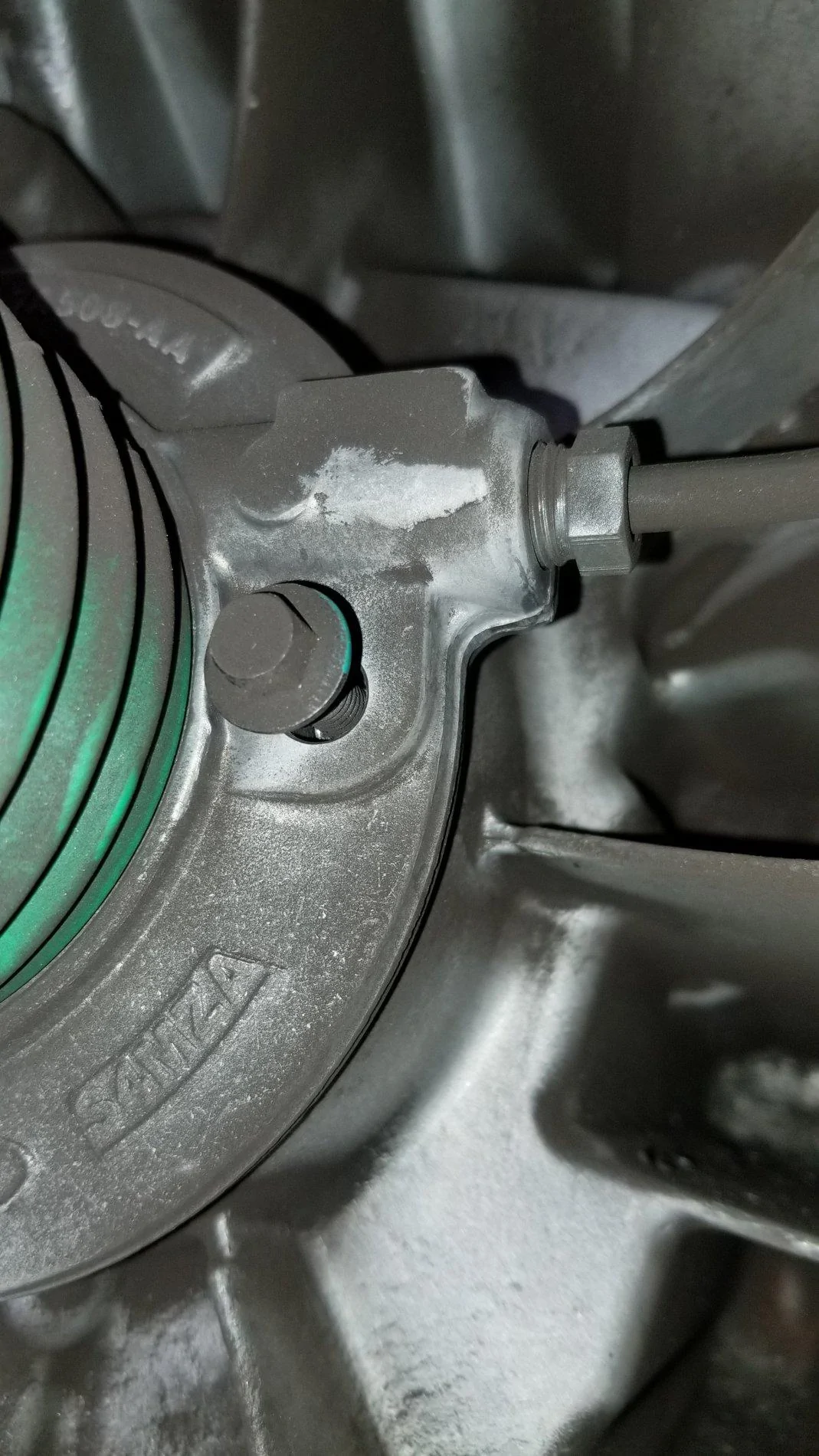
Get things apart today and check out the first thing I find. Both bolts for the slave cylinder are loose. Really great job here Ford.

20190317_130144.jpg
20190317_130154.webp
 
OP
OP
Guarded15

Guarded15

Active Member
Joined
Feb 25, 2019
Threads
5
Messages
32
Reaction score
16
Location
Phoenix AZ
Vehicle(s)
S550 GT
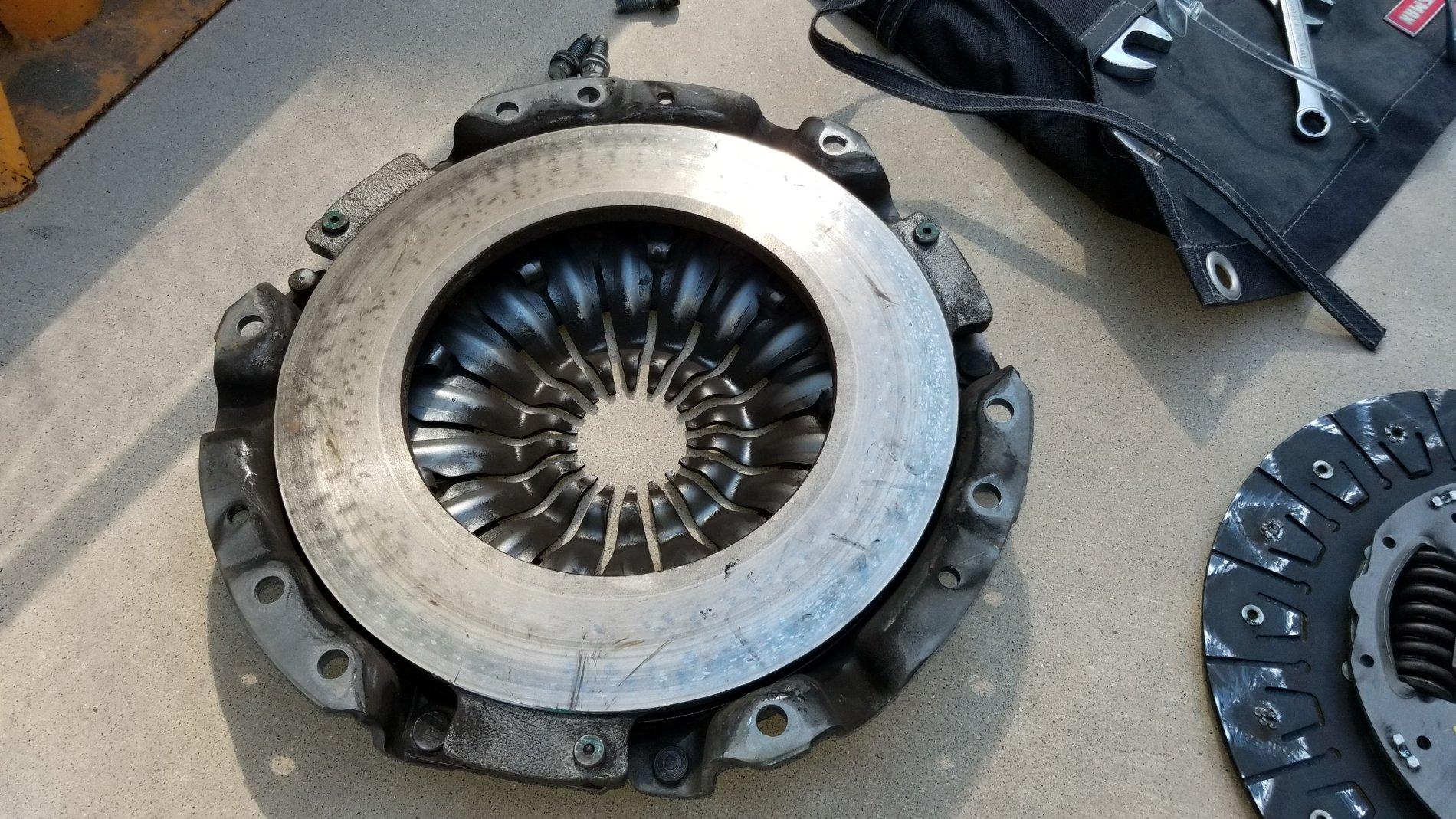
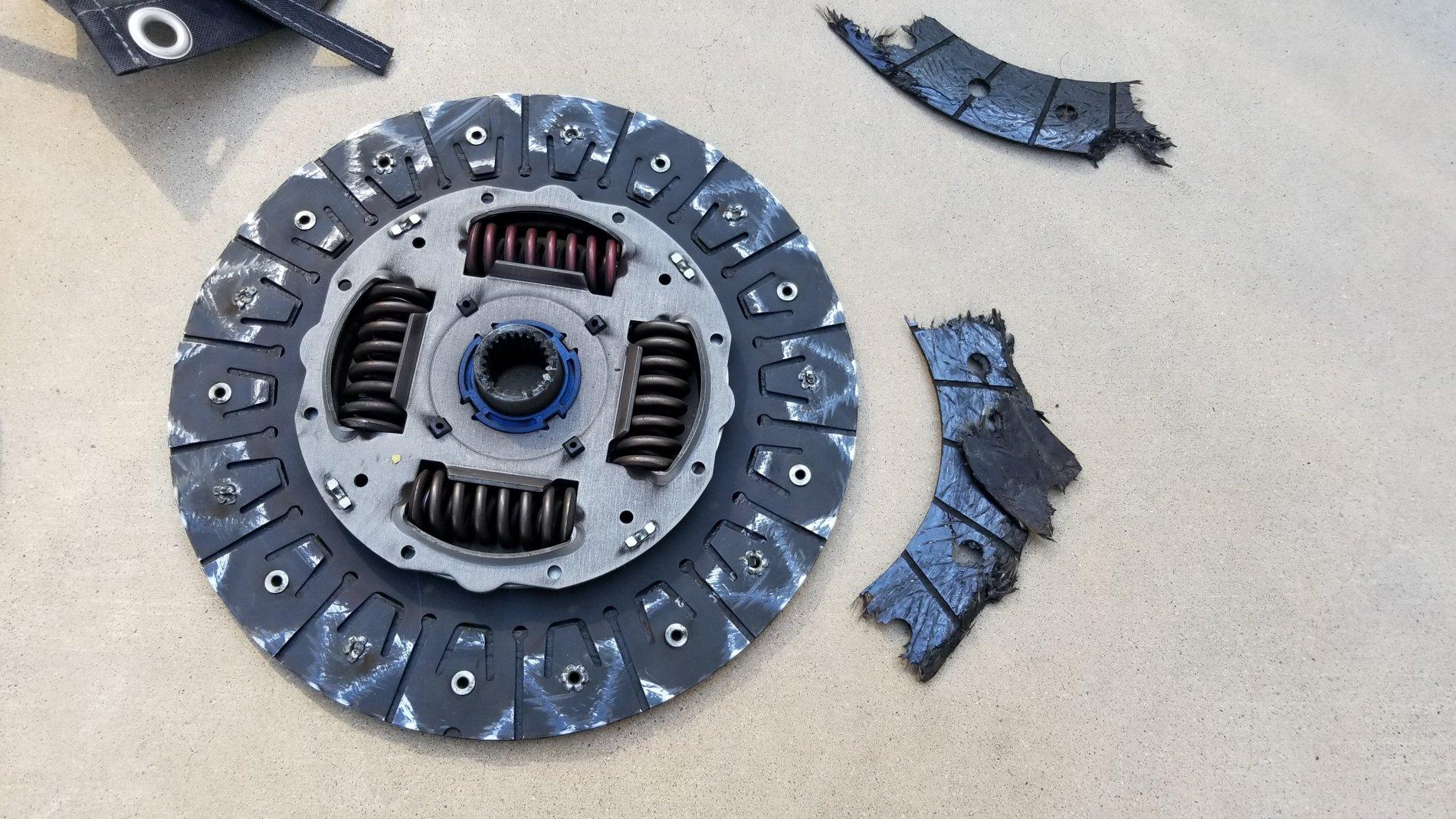
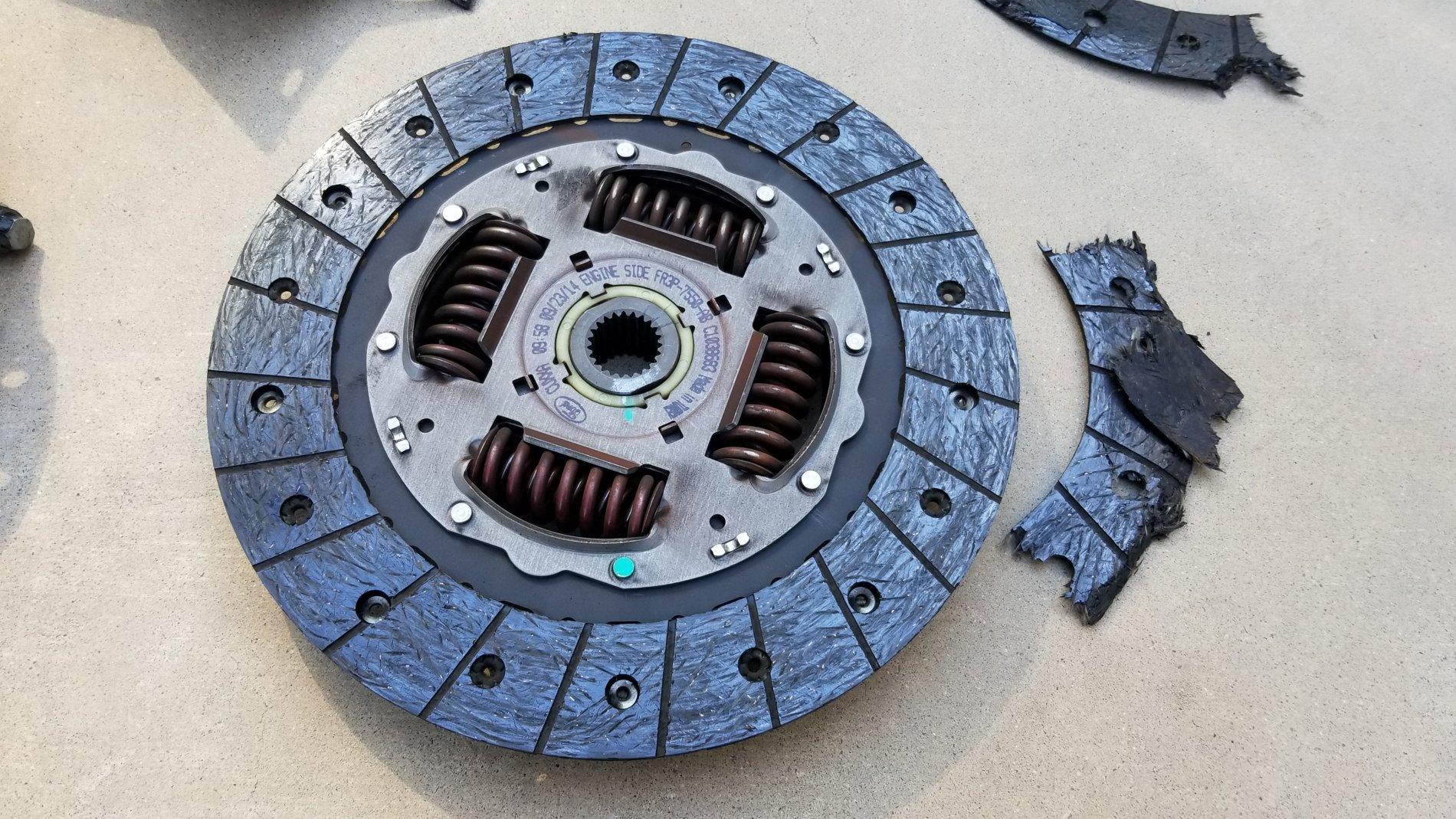
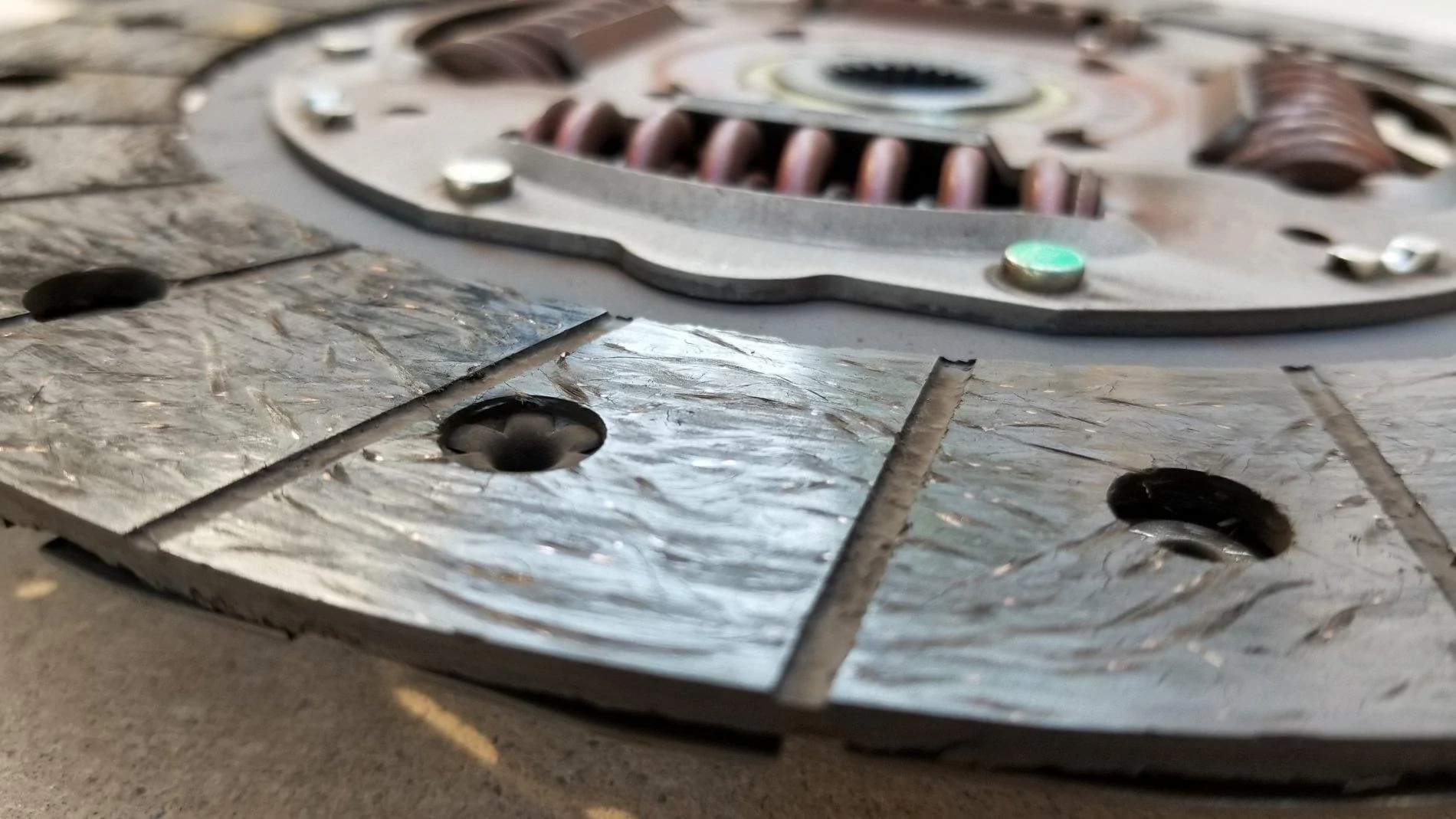
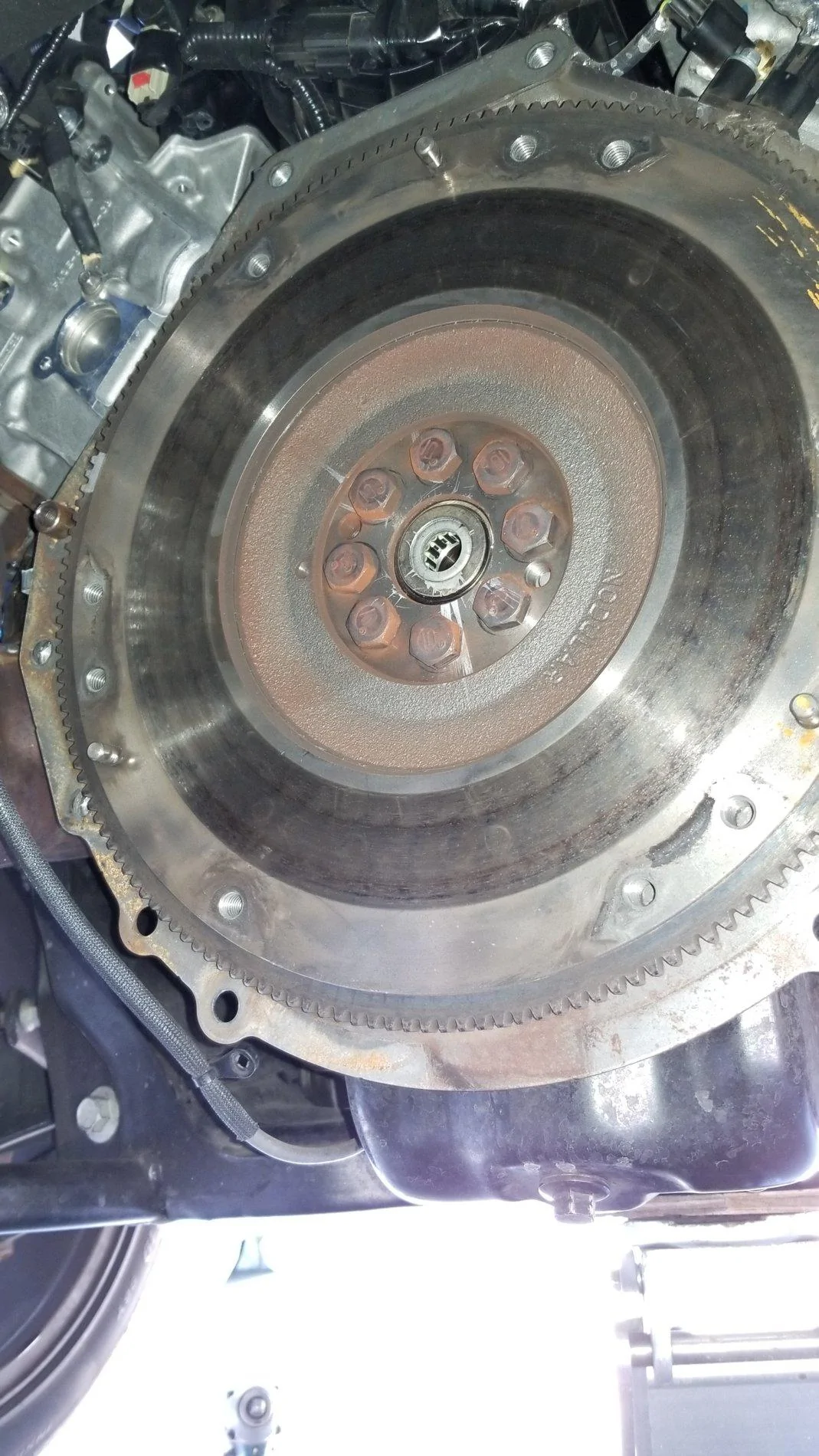
Got the pressure plate off. Torque on the bolts was all over the place. Looks like the classic clutch disk failure mode. Pressure plate side is exploded. Flywheel side is completely intact and has some meat on it.

I'll post up better pictures of the flywheel once I've got it out.

FYI whatever this clutch disk is made out of is itchy like fiberglass insulation. It gets everywhere.
20190317_144116.jpg
20190317_144144.jpg
20190317_144204.jpg
20190317_144227.webp
20190317_144622.webp
 

TheLion70x77

Well-Known Member
Joined
Apr 11, 2019
Threads
7
Messages
170
Reaction score
107
Location
US
Vehicle(s)
2016 Mustang GT Performance Package
I have a 2015 26k miles GT Track Pack, FRPP2. Bought it about three months ago. I have been driving all manual transmission cars for 16 years now and this is my first clutch failure.

Similar to what others have experienced here. Shifting near red line, push in clutch, hear a pop and can't select any gears. Clutch hydraulics feel fine from the pedal. I want to add another data point that this has happened to yet another person. And another data point for a failed clutch that wont disengage. Ford has got a serious problem here, I realized today I am going to handle it by buying Ford stock and every time something stupid like this breaks I will have that sweet dividend to pick up my spirits.

When I called up the Ford dealer they told me go have intercourse with myself. Decided to suck it up and change it out in my driveway. I got the transmission out today with a lot of help from a friend. It's a PITA. When I crack open the pressure plate/flywheel assembly I am guessing I am going to see the telltale friction surface separated from the clutch disk, I am already finding chunks of friction surface everywhere.

From what I can tell there is not a tutorial on transmission removal or doing a clutch job so if you guys have questions, please ask away.

I'm going to be swapping in a MGW shifter and ACT Twin Plate street clutch.
Same failure mode, also FP PP2. 30k. Been driving stick for 12 years. My last daily was a used 2007 Focus ST I drove til 175k with the original clutch...was still giong strong when I sold it for $1,500...my 2016 PP GT I bought with only 5,600 miles on it certified used mostly stock other than a Corsa cat back exhaust and some window tint. It's had the pedal sticking issue since I first got it nearly stock.

I don't drag race either nor do I ride the clutch. I do quasi-road race type driving (read very spirited) on empty winding back roads, but other than that, just enjoy driving it like a normal cruiser. Slave cylinder is fine according to the dealer. I also have had the pedal stick to the floor several times, did it constantly with the steeda 35lb assist spring, so after just a few days I put the stock one back in.

With the stock assist spring it wouldn't get stuck, but would often return slowly or partially. Finally gave out about a week ago. Currently I'm waiting on a Mantic 9000 Organic twin disk. I'm not going FI, it will stay NA and I won't want to make it miserable to drive on the street as it's still a dual purpose car. Mantic seems to have the best offering for a NA street car with a much more durable clutch design. We'll see if the after market twin disk fixes the sticking pedal issue.

I suspect that's the reason these OE clutches are failing. Boss 302's had a lot of those issues as well, more than the regular GT's because they rev out to 7500 rpm. Problem has only gotten worse with more power and higher rev limit of the Power Pack 2 (stock is 6,800 rpm, not 7,000, Power Pack revs out to 7,150). I believe because of the inertia of the clutch at high RPM, it acts more like a gyoscope. Take a fidget spinner, spin it on your finger tip and notice how it's very resistant to tilting? That gyroscopic stability causes issues with the single disk clutch Ford used at higher RPM's and power levels.

If the inertia is preventing the clutch from quickly engaging, it's likely slipping quite a bit and heating up. Eventually the thermal cycling fatigues the friction pads and they become brittle and crack. At that point the friction disk begins to separate an fall apart. The debris can cause different pedal feel and failure modes. My particular pedal got stuck, then suddenly came back out and I could no longer shift into any gears. The pedal would go in and come back out, but it felt extremely light.

I suspect the pad materials that delaminated wedged into the clutch and held it open, so the slave was just expanding and contacting without the fingers pushing against it. Either way, it's not just a Ford issue. Chevy has had that problem with the Corvetts and Camaros for years since the higher powered LS3 variants until they moved to a twin disc setup and the even more powerful 5th gen LT1.

So a smaller 9" twin disc should have notably lower MOI than larger 10~10.5" single disk units. The GT350's twin disk is only 8.5" to minimize MOI both for performance reasons and so that it actually works at 8,000 rpm. I chose the Mantic 9000 Organic White Box as a drop in for my NA dual purpose applications, I've read good things about it's engagement, being reasonably quite and it's power rating is well above where I"m at NA and it has a 1.5x safety factor in the torque rating as it is SFI certified, so I'm hoping it will hold up well as a dual purpose NA setup. I figured a twin disk will give me greater heat resistance even with organic pads (greater surface area), higher holding capacity with similar pedal effort to stock. Both are also sprung, so it should be a bit quieter than some of the non-sprung units out there. It's spendy, but I don't want to do it again any time soon and the their ceramic version is over kill for my applications.
 

Sponsored

Anthony 05 GT

Well-Known Member
Joined
Jun 4, 2015
Threads
21
Messages
1,453
Reaction score
494
Location
Northern Harford County Maryland
Vehicle(s)
2005 Mustang GT, 2015 Mustang GT Premium
So I have a question. I blew my stock clutch up yesterday. Pedal got very hard then a puff of smoke and no gears at all. Car actually wouldn’t start up for a few minutes ,guessing flywheel was welded to the plate. So I’m gonna go with a McLeod twin disk and a braided clutch line. Was wondering if anyone is using this adjustable throw out bearing controller ?
Don't do it, believe me. You'll be lucky to get 5k miles out of it. I've had 2 of them between my car and my son's and when they go....they go all at once. They are more intended for racing applications where you'd be tearing the car down frequently and you'd install a seal kit while it's out.
 
OP
OP
Guarded15

Guarded15

Active Member
Joined
Feb 25, 2019
Threads
5
Messages
32
Reaction score
16
Location
Phoenix AZ
Vehicle(s)
S550 GT
I used to do the same kind of driving you do. It teaches you to be really smooth with power application or you have a bad time.

I've read a number of your posts and really respect your opinion but in this case I find myself completely disagreeing your cause analysis. Gyroscopes do not offer any additional resistance when they are moved along their axis of rotation. I don't think inertia is the cause either. Here's why:

1. Reach shift point at say 7,000 rpm engine speed
2. Clutch in. Clutch disk and flywheel/pressure plate are now decoupled
3. Select higher gear. In the span it takes to engage the gear, the clutch disk has it's RPM reduced 7,000 to whatever the next gear is.
4. Hopefully at this point the engine is at a matching RPM or close to it when you couple it to the transmission.

Low inertia disks help with faster gear selection. One of the downsides of a twin disk is you are doubling the clutch supplied inertia and adding to the total mass the synchronizers need to change velocity on to select the next gear.

-----

What do I think is going on with the OEM clutch? I think it is a deficient design with overtones of costs savings and grossly not suitable for this application. I think Ford thought it would be fine for long enough to get out of warranty and for the most part they have been right.

I think there are a lot of contributing factors to these failures but I think all one really needs to do is focus on the friction surface attachment as I think this is the most glaring weakness. The OEM clutch uses 9 rivets per side for a total of 18. Assuming they are in a 10" diameter circle, at peak engine torque (400ft-lbs), each rivet has to withstand 26.4 ft-lbs. The friction material is not bonded to a metal backing of any kind so it is also being asked to be structural and I think this is ultimately why the failure is happening. I think the material fatigues at the rivets until its burst strength becomes so low that one high RPM shift kills it.

For comparison, my ACT has 16 rivets per side for a total of 32 per disk and 64 in the complete assembly. Averaging the rivet diameters to 9.5" (because they are in two diameters) at the maximum rated torque (891 ft-lbs) each rivet has to withstand 17.5 ft-lbs. At peak engine torque each rivet has to withstand 7.9ft-lbs. The friction surface material has a steel backing layer providing a far superior load interface with the rivets.

At this point it should be clear from this one design feature alone how stressed the OEM clutch is.

Simply put, I think the root cause here is similar to what happens when you try to hang something heavy on drywall and use a wood screw. Too much force on too small of an area in a material with the wrong properties.
 

TheLion70x77

Well-Known Member
Joined
Apr 11, 2019
Threads
7
Messages
170
Reaction score
107
Location
US
Vehicle(s)
2016 Mustang GT Performance Package
Good point on the gyroscope, I misinterpreted the axis of motion. But I disagree on the inertia of a well designed twin disk clutch. Case in point:

OE 10" single disk clutch pack (pressure plate, clutch disk and hardware) weights 24.6 lbs according to a SVT thread by someone who actually weighed them in their S197 (uses same clutch from 2011 to 2017) and compared them to both the RXT twin disk and Spec Stage 2.

OE flywheel weighed 21.6 lbs. I've seen reports of 22.5 up to 23.5 lbs, but well go with 21.6 since this measurement was all on the same scale as the clutch pack weight I'm using, weighed by the same person. Total is 46.2 lbs for OE 10" single disk clutch.

I just got my Mantic 9000 twin disk organic setup with lightened billet steel flywheel yesterday. I did NOT go aluminum flywheel as most owners have posted regretting using aluminum flywheels for a dual purpose car (drive ability on the street suffers quite a bit and lower heat tolerance resulting warped flywheel rings). There's a point where we get too light weight that drive ability suffers greatly and there's little gain for it.

On my scale at home the Mantic billet steel flywheel with ARP bolts all still sealed in the plastic bag together weighed 15.5 lbs. Next I weighed the entire clutch pack (red billet pressure plate, both steel friction rings, both sprung organic disks, bolts and billet studs, the whole shebang) at 20.4 lbs all still sealed in bubble wrap.

Total weight of a twin disk mantic 9000 with billet steel flywheel option is 35.9 lbs. 607 ft-lbs torque capacity with a 1.5x safety factor (meaning maximum holding torque is actually 910.5 lbs), SFI certified for reliability. MOI is also lower as the weight is concentrated more towards the center of the fly wheel and smaller diameter clutch pack is 9" instead of 10" like the single disk OE. It's a very well designed setup, expensive as heck, we'll see how it performs and holds up after I'm done bedding the disks over the next 500+ miles.

My only worry is that it will make the car hard to drive due to the lower mass, but most people seem to report the Mantic's have good street manners despite being lightweight, at least with the billet steel flywheel option. Also my lightweight tire / wheel setup has made a significant difference even with the stock clutch before it failed, lot less rotating mass to get moving (48 lbs over the OE PP setup). So that may help off-set the negatives with running a low mass flywheel as far as street use goes. I have a feeling it will be heaven for my road course use.
 

TheLion70x77

Well-Known Member
Joined
Apr 11, 2019
Threads
7
Messages
170
Reaction score
107
Location
US
Vehicle(s)
2016 Mustang GT Performance Package
BTW, the organic material on the OE clutch I believe is a standard woven non-metal backed organic (silvery appearance) where the Mantic disks use heavy duty metal backed organic (coppery appearance) which has a higher temp rating, up to 700F.

It's a great material for a street performance car (also for towing / hauling applications) that sees occasional track / auto x. However I don't believe it's suitable for drag racing or a dedicated track car given the high temps that a lot of slip can produce over extended periods. I'm not into drag racing, so I'd rather have the smooth engagement for street, occasional track and auto x applications.

https://www.phoenixfriction.com/t-clutch-materials-explained.aspx
Sponsored


Top