MYs197
Guest
- Thread starter
- #1
C&D posted a bunch of never before seen pics and interviews with the Mustang team. There is some interesting bits in here that I haven't seen before. Like they considered a hatchback. Oh what could have been.

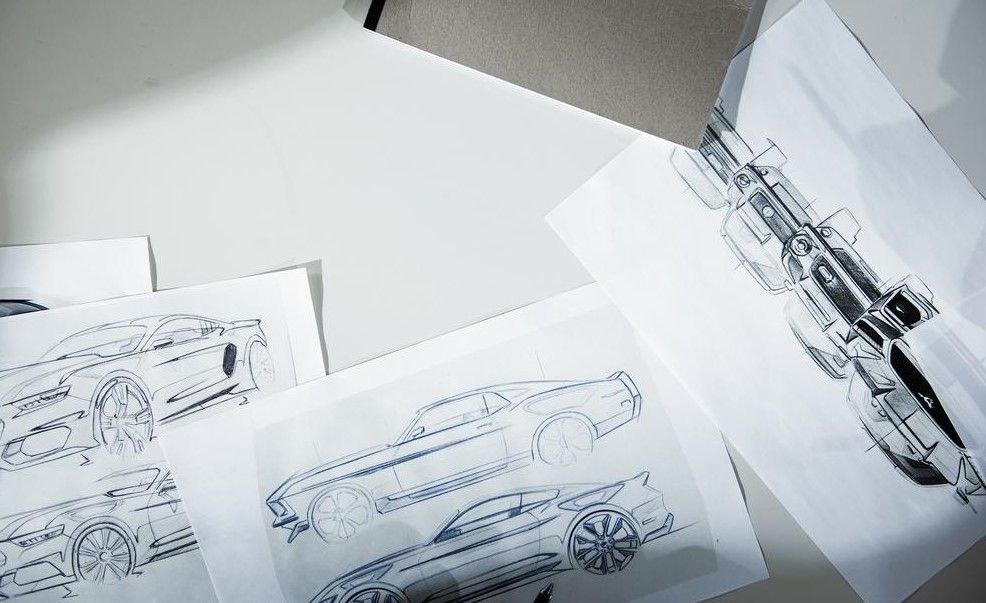
If it sounds as if the Blue Oval fobbed off the Mustang’s development to the same continental team that did the Focus and Fiesta, rest assured this is not the case. When asked what kind of involvement Europe had, chief engineer Dave Pericak answers immediately: “None.” Well, almost none. The exterior design was sketched by a European, Kemal Curic, who grew up in Croatia and now works in Dearborn. Regardless, the Mustang is still the raw, red meat of Midwestern ambition. Witness that its 5.0-liter Coyote V-8 carries on with an as-yet-unspecified bump in power.
When did development of the new Mustang start? How clean was the sheet of paper?
Dave Pericak, Chief Engineer:
In late 2009. You always start off with kind of a clean sheet, but as you go through the process, you start to reduce that. What happened on this program was we ended up making the sheet of paper a little bit cleaner because we realized there were some additional changes we had to make midstream. Our design team was struggling to get the proper differentiation from the current vehicle. So we told them: “We’re untying your hands. Everything that we said was sacred from an engineering perspective is no longer sacred. If we need to do a new floorpan, we’re going to do a new floorpan. Give me a Mustang that we can put a 50th anniversary badge on and be proud of.”
Joel Piaskowski, Design Director, Exterior:
The advent of the project is when we started moving the hard points in the car. The new proportions have really progressed the car to this very advanced, almost exotic level.
Pericak:
Track width in the front is about 15 millimeters (0.6 inch) wider. Track width in the back is about 70 millimeters (2.8 inches) wider. But the sheetmetal went out only 40 millimeters (1.6 inches), really pushing those wheels out. The roof is down 38 millimeters (1.5 inches), the hood is down 32 millimeters (1.3 inches), the decklid is down 70 millimeters (2.8 inches). Another big constraint that was freed up was the A-pillar, which went rearward by 30 millimeters (1.2 inches).
Moray Callum, Vice President, Design:
We wanted to sort of shrink-wrap the car around its mechanicals and make it look lighter, make it look more efficient, make it look like it could handle better.
Piaskowski:
We got rid of the body-colored B-pillar, and that gives it a more selfish look, very personal.
Kemal Curic, Design Manager, Exterior:
Today’s car, if you see it as a human body, it has a big head, which is the big greenhouse, and smaller shoulders. We have re-proportioned the entire car so the shoulders got wider, the waist got slimmer. It’s not just about numbers.
So you really blew up the whole platform?
Pericak:
I would’ve said in 2009 that this was an evolution of the platform. I sit here in front of you today and say it’s an all-new platform. There’s nothing on there, other than the wheelbase, that is consistent from the previous year. From the floorpan to the rails, there’s nothing that we have not changed.
And the Mustang finally gets independent rear suspension. When was that decision made?
Pericak:
Early on. Taking the Mustang global, we knew that was going to be critical to making it successful. But once we put an IRS in the car, the front suspension became the limiting factor. We didn’t think we would be tearing up the front suspension, but here we go—and we’re not just tearing it up a little bit, we’re tearing it up a lot. We went to a double-ball-joint front suspension, a complete geometry change in the front end. And then we decided to put a real subframe up front, as opposed to the crossmembers in today’s car. To package larger brakes, it was important to go to that double-ball-joint [strut] to move all the components inboard. That was a big deal, and it was not originally planned. Could we have made a car without changing the front suspension? Yes. Would it have been as awesome as this car is? No. We made several such commitments along the way, for fairly significant time, money, and engineering investment, in order to do this thing right.
What changes did you make to the convertible?
Callum:
One of the battles we won early on was to give the convertible a different decklid than the coupe, which is not what we have today. We wanted to get the decklid as low as possible to get that really squat stance and take the wedge out of the car.
Piaskowski:
The convertible’s unique rear-quarter panel and decklid allowed us to get a clean, uninterrupted beltline wrapping around the seatbacks from one A-pillar to the other, giving it a more elegant, premium look.
Pericak:
You might say, “What’s the big deal about a unique decklid?” It drove all kinds of investment in the Flat Rock assembly plant. The decision to go to an electric top with the single latch also added more cost to the convertible.
Were fastback and convertible the only body styles considered?
Pericak:
We talked about a hatchback, briefly. A notchback was explored, like the Fox body, but this was almost like nostalgia. Setting the tone for what we wanted to do with Mustang and the new customers that we’re going after, it just wasn’t the right thing to do.
Piaskowski:
People remember and resonate with the fastback. When you ask somebody about Mustang, one of the first things they imagine is the roof profile, along with the face of the car and the tri-bar taillamps.
What about powertrains?
Pericak:
We only had a two-engine lineup to start with, the EcoBoost and the 5.0-liter. The 300-hp V-6 was not part of the lineup. As we were developing the vehicle, we thought a three-engine lineup made more sense, to offer that entry point and continue to make the Mustang obtainable to just about anybody who wants one. We always knew we were doing the EcoBoost, though. It’s 305-plus horsepower; we’ll settle down on the final number as we get closer to launch.
The transmissions are carry-overs. Was a dual-clutch transmission ever considered?
Pericak:
No. The current transmissions are very capable, very robust. We knew we wanted to improve the six-speed manual to make it a bit smoother. We need to improve fuel economy, we need to improve overall performance, and we’re upping our torque and our horsepower, so we need to make some modifications for them to handle that. They’re both good ’boxes, we just wanted to continue to evolve them.
How did you arrive at the 2.3-liter displacement for the EcoBoost four-cylinder?
Pericak:
We started with multiple displacements. We went as low as 1.8 liters, but that clearly was not going to cut it. Whether we could’ve made the 1.8 work, a 2.0-liter work, a 2.5—we went even higher than that. But at the end of the day we needed an engine with huge performance. Our EcoBoost engines are great performers, but this is a Mustang. We settled on the 2.3 as the best engine to do all the upgrades, the twin-scroll turbocharger, and the steel crankshaft.
So is the EcoBoost the budget track-day car? How much lighter is it than the V-8?
Pericak:
We’re not talking weight today, but it is lighter than the V-8, for sure. Our own internal benchmark was the Boss 302. This is the best-handling Mustang we’ve ever done. We wanted to filter that down through all the levels, whether it be the V-6, the EcoBoost, or the V-8. But from an actual performance target in lap times and things like that, we want our V-8 Perform*ance Pack to beat a Boss on a track. And we’re definitely going to achieve that.
Were there other benchmarks?
Pericak:
We looked at Porsche 911, BMW M3, we looked at Audis, we even had a Nissan GT-R at a couple of our drives. So we used those as aspirational vehicles. We’re raising the bar, and we wanted to understand what’s good about those cars.
What about tuning the Mustang for driving on the autobahn?
Tom Barnes, Vehicle Engineering Manager:
We’ve raised the top speed to 155 on the V-8, 145 on the Performance Pack EcoBoost, and 121 on the base V-6 and base EcoBoost. By setting those top speeds you have to go through a litany of different things to make sure that the car cools, is tied down aerodynamically, doesn’t create wind noise, and that you’re not blowing seals open.
We tend to regard European drivers as more discriminating. Did the decision to sell the Mustang overseas motivate the interior design?
Callum:
There was no “we’d like to make this better for Europeans.” It’s better for everybody. That was one of the things going in—we didn’t want to Europeanize this car. We wanted to make it a good global car, but it still had to be an American Mustang. We didn’t want to change the style or the image of the car, we wanted to just say, “Look, we can do a Mustang with great quality and less hard plastic than maybe we’ve done in the past.”
Doyle Letson, Chief Designer, Global In*teri*ors:
We knew we had to have the large gauges. We had to have the symmetrical IP and the double brow. We wanted to make sure that the interior was designed and not styled, knowing the materials that we were using, how they intertwined with each other, how they related to each other, how they were manufactured, and actually design the elements of the interior to best optimize each of those materials.
Piaskowski:
Even though we’ve shrunk the exterior silhouette, the interior actually has more space and better usability than the outgoing car. It has more shoulder room, more hip room, more legroom for front-seat passengers. It has better visibility.
Letson
We’ve redesigned the seats. They are lighter and designed to be comfortable as well as really hold you in there. We’ve shifted the cup holders over to the far side to give the driver better ergonomics for shifting. Just the shape of the center stack, the way it actually tapers toward the bottom, creates more open space in the knee area. At the base of the center stack there’s a storage space that we don’t have now, with a media hub and a power plug right there. On the left side there’s actually a drawer that opens up to put your sunglasses in.
What is the hardest thing about launching a new car today?
Pericak:
The new government regulations—whether it be fuel economy, safety, or whatever—are very difficult and pose a significant challenge to the development of any new vehicle. We’re using materials in the car that we never had to use before. We’re up against almost opposing forces. Trying to manage a fresh, new design with all these requirements is really difficult.
Was it more difficult because it’s the Mustang?
Pericak:
Multiply it times 100. I love that everyone is so interested in the Mustang. That’s awesome. But it also requires more of our time as we try to address all the people who have opinions and ideas and thoughts. But the fact that everyone wants to be a part of Mustang really is a testament to the car.
How many times did Bill Ford call you?
Pericak:
He calls often. Obviously, Bill’s been a Mustang fan for many, many years. He’s really a part of the team, not just when we see him at the board of directors meeting or something like that.
Callum:
Bill is actually very gracious, and he always tells us when he’s going to come over and doesn’t do it unannounced. He’s a great guy. We actually had to prevent his son from taking a photograph of the car in the courtyard. Didn’t quite know the security protocols.
Would you have done anything differently with a larger budget?
Piaskowski:
I would have included active pedestrian protection on the hood to push the hood surface lower.
Callum:
Anything we could do to exaggerate the improvements we made, to make it lower, make it wider, we would’ve taken it.
Curic:
Magnetic ride, just to have bigger wheels. Because every designer sketches the car with big wheels.
Pericak:
But knowing what we want the Mustang to be, knowing the price range we want to keep it in, we’ve done everything we wanted. You can get crazy with carbon fiber and ceramic brakes and all kinds of stuff, but that would almost be silly. That would take the Mustang out of what it’s meant to be. There’s nothing that we said, “Oh, if we just had this last little bit . . . ”
You wouldn’t like to have some carbon fiber?
Barnes:
But think about the serviceability and what that would do to the person who owns the car. We still want this car to be very attainable.
Pericak:
That’s the magic of the Mustang. It’s a hell of a lot more car than what you paid for. That’s what makes me most proud. If you have a good engineering team and you have a lot of money, anybody can put out a $200,000 car. But this is a car that will compete with cars two and three times its price range. And in many cases it will beat them.
http://www.caranddriver.com/feature...pth-with-the-team-that-made-it-happen-feature


If it sounds as if the Blue Oval fobbed off the Mustang’s development to the same continental team that did the Focus and Fiesta, rest assured this is not the case. When asked what kind of involvement Europe had, chief engineer Dave Pericak answers immediately: “None.” Well, almost none. The exterior design was sketched by a European, Kemal Curic, who grew up in Croatia and now works in Dearborn. Regardless, the Mustang is still the raw, red meat of Midwestern ambition. Witness that its 5.0-liter Coyote V-8 carries on with an as-yet-unspecified bump in power.
When did development of the new Mustang start? How clean was the sheet of paper?
Dave Pericak, Chief Engineer:
In late 2009. You always start off with kind of a clean sheet, but as you go through the process, you start to reduce that. What happened on this program was we ended up making the sheet of paper a little bit cleaner because we realized there were some additional changes we had to make midstream. Our design team was struggling to get the proper differentiation from the current vehicle. So we told them: “We’re untying your hands. Everything that we said was sacred from an engineering perspective is no longer sacred. If we need to do a new floorpan, we’re going to do a new floorpan. Give me a Mustang that we can put a 50th anniversary badge on and be proud of.”
Joel Piaskowski, Design Director, Exterior:
The advent of the project is when we started moving the hard points in the car. The new proportions have really progressed the car to this very advanced, almost exotic level.
Pericak:
Track width in the front is about 15 millimeters (0.6 inch) wider. Track width in the back is about 70 millimeters (2.8 inches) wider. But the sheetmetal went out only 40 millimeters (1.6 inches), really pushing those wheels out. The roof is down 38 millimeters (1.5 inches), the hood is down 32 millimeters (1.3 inches), the decklid is down 70 millimeters (2.8 inches). Another big constraint that was freed up was the A-pillar, which went rearward by 30 millimeters (1.2 inches).
Moray Callum, Vice President, Design:
We wanted to sort of shrink-wrap the car around its mechanicals and make it look lighter, make it look more efficient, make it look like it could handle better.
Piaskowski:
We got rid of the body-colored B-pillar, and that gives it a more selfish look, very personal.
Kemal Curic, Design Manager, Exterior:
Today’s car, if you see it as a human body, it has a big head, which is the big greenhouse, and smaller shoulders. We have re-proportioned the entire car so the shoulders got wider, the waist got slimmer. It’s not just about numbers.
So you really blew up the whole platform?
Pericak:
I would’ve said in 2009 that this was an evolution of the platform. I sit here in front of you today and say it’s an all-new platform. There’s nothing on there, other than the wheelbase, that is consistent from the previous year. From the floorpan to the rails, there’s nothing that we have not changed.
And the Mustang finally gets independent rear suspension. When was that decision made?
Pericak:
Early on. Taking the Mustang global, we knew that was going to be critical to making it successful. But once we put an IRS in the car, the front suspension became the limiting factor. We didn’t think we would be tearing up the front suspension, but here we go—and we’re not just tearing it up a little bit, we’re tearing it up a lot. We went to a double-ball-joint front suspension, a complete geometry change in the front end. And then we decided to put a real subframe up front, as opposed to the crossmembers in today’s car. To package larger brakes, it was important to go to that double-ball-joint [strut] to move all the components inboard. That was a big deal, and it was not originally planned. Could we have made a car without changing the front suspension? Yes. Would it have been as awesome as this car is? No. We made several such commitments along the way, for fairly significant time, money, and engineering investment, in order to do this thing right.
What changes did you make to the convertible?
Callum:
One of the battles we won early on was to give the convertible a different decklid than the coupe, which is not what we have today. We wanted to get the decklid as low as possible to get that really squat stance and take the wedge out of the car.
Piaskowski:
The convertible’s unique rear-quarter panel and decklid allowed us to get a clean, uninterrupted beltline wrapping around the seatbacks from one A-pillar to the other, giving it a more elegant, premium look.
Pericak:
You might say, “What’s the big deal about a unique decklid?” It drove all kinds of investment in the Flat Rock assembly plant. The decision to go to an electric top with the single latch also added more cost to the convertible.
Were fastback and convertible the only body styles considered?
Pericak:
We talked about a hatchback, briefly. A notchback was explored, like the Fox body, but this was almost like nostalgia. Setting the tone for what we wanted to do with Mustang and the new customers that we’re going after, it just wasn’t the right thing to do.
Piaskowski:
People remember and resonate with the fastback. When you ask somebody about Mustang, one of the first things they imagine is the roof profile, along with the face of the car and the tri-bar taillamps.
What about powertrains?
Pericak:
We only had a two-engine lineup to start with, the EcoBoost and the 5.0-liter. The 300-hp V-6 was not part of the lineup. As we were developing the vehicle, we thought a three-engine lineup made more sense, to offer that entry point and continue to make the Mustang obtainable to just about anybody who wants one. We always knew we were doing the EcoBoost, though. It’s 305-plus horsepower; we’ll settle down on the final number as we get closer to launch.
The transmissions are carry-overs. Was a dual-clutch transmission ever considered?
Pericak:
No. The current transmissions are very capable, very robust. We knew we wanted to improve the six-speed manual to make it a bit smoother. We need to improve fuel economy, we need to improve overall performance, and we’re upping our torque and our horsepower, so we need to make some modifications for them to handle that. They’re both good ’boxes, we just wanted to continue to evolve them.
How did you arrive at the 2.3-liter displacement for the EcoBoost four-cylinder?
Pericak:
We started with multiple displacements. We went as low as 1.8 liters, but that clearly was not going to cut it. Whether we could’ve made the 1.8 work, a 2.0-liter work, a 2.5—we went even higher than that. But at the end of the day we needed an engine with huge performance. Our EcoBoost engines are great performers, but this is a Mustang. We settled on the 2.3 as the best engine to do all the upgrades, the twin-scroll turbocharger, and the steel crankshaft.
So is the EcoBoost the budget track-day car? How much lighter is it than the V-8?
Pericak:
We’re not talking weight today, but it is lighter than the V-8, for sure. Our own internal benchmark was the Boss 302. This is the best-handling Mustang we’ve ever done. We wanted to filter that down through all the levels, whether it be the V-6, the EcoBoost, or the V-8. But from an actual performance target in lap times and things like that, we want our V-8 Perform*ance Pack to beat a Boss on a track. And we’re definitely going to achieve that.
Were there other benchmarks?
Pericak:
We looked at Porsche 911, BMW M3, we looked at Audis, we even had a Nissan GT-R at a couple of our drives. So we used those as aspirational vehicles. We’re raising the bar, and we wanted to understand what’s good about those cars.
What about tuning the Mustang for driving on the autobahn?
Tom Barnes, Vehicle Engineering Manager:
We’ve raised the top speed to 155 on the V-8, 145 on the Performance Pack EcoBoost, and 121 on the base V-6 and base EcoBoost. By setting those top speeds you have to go through a litany of different things to make sure that the car cools, is tied down aerodynamically, doesn’t create wind noise, and that you’re not blowing seals open.
We tend to regard European drivers as more discriminating. Did the decision to sell the Mustang overseas motivate the interior design?
Callum:
There was no “we’d like to make this better for Europeans.” It’s better for everybody. That was one of the things going in—we didn’t want to Europeanize this car. We wanted to make it a good global car, but it still had to be an American Mustang. We didn’t want to change the style or the image of the car, we wanted to just say, “Look, we can do a Mustang with great quality and less hard plastic than maybe we’ve done in the past.”
Doyle Letson, Chief Designer, Global In*teri*ors:
We knew we had to have the large gauges. We had to have the symmetrical IP and the double brow. We wanted to make sure that the interior was designed and not styled, knowing the materials that we were using, how they intertwined with each other, how they related to each other, how they were manufactured, and actually design the elements of the interior to best optimize each of those materials.
Piaskowski:
Even though we’ve shrunk the exterior silhouette, the interior actually has more space and better usability than the outgoing car. It has more shoulder room, more hip room, more legroom for front-seat passengers. It has better visibility.
Letson
We’ve redesigned the seats. They are lighter and designed to be comfortable as well as really hold you in there. We’ve shifted the cup holders over to the far side to give the driver better ergonomics for shifting. Just the shape of the center stack, the way it actually tapers toward the bottom, creates more open space in the knee area. At the base of the center stack there’s a storage space that we don’t have now, with a media hub and a power plug right there. On the left side there’s actually a drawer that opens up to put your sunglasses in.
What is the hardest thing about launching a new car today?
Pericak:
The new government regulations—whether it be fuel economy, safety, or whatever—are very difficult and pose a significant challenge to the development of any new vehicle. We’re using materials in the car that we never had to use before. We’re up against almost opposing forces. Trying to manage a fresh, new design with all these requirements is really difficult.
Was it more difficult because it’s the Mustang?
Pericak:
Multiply it times 100. I love that everyone is so interested in the Mustang. That’s awesome. But it also requires more of our time as we try to address all the people who have opinions and ideas and thoughts. But the fact that everyone wants to be a part of Mustang really is a testament to the car.
How many times did Bill Ford call you?
Pericak:
He calls often. Obviously, Bill’s been a Mustang fan for many, many years. He’s really a part of the team, not just when we see him at the board of directors meeting or something like that.
Callum:
Bill is actually very gracious, and he always tells us when he’s going to come over and doesn’t do it unannounced. He’s a great guy. We actually had to prevent his son from taking a photograph of the car in the courtyard. Didn’t quite know the security protocols.
Would you have done anything differently with a larger budget?
Piaskowski:
I would have included active pedestrian protection on the hood to push the hood surface lower.
Callum:
Anything we could do to exaggerate the improvements we made, to make it lower, make it wider, we would’ve taken it.
Curic:
Magnetic ride, just to have bigger wheels. Because every designer sketches the car with big wheels.
Pericak:
But knowing what we want the Mustang to be, knowing the price range we want to keep it in, we’ve done everything we wanted. You can get crazy with carbon fiber and ceramic brakes and all kinds of stuff, but that would almost be silly. That would take the Mustang out of what it’s meant to be. There’s nothing that we said, “Oh, if we just had this last little bit . . . ”
You wouldn’t like to have some carbon fiber?
Barnes:
But think about the serviceability and what that would do to the person who owns the car. We still want this car to be very attainable.
Pericak:
That’s the magic of the Mustang. It’s a hell of a lot more car than what you paid for. That’s what makes me most proud. If you have a good engineering team and you have a lot of money, anybody can put out a $200,000 car. But this is a car that will compete with cars two and three times its price range. And in many cases it will beat them.
http://www.caranddriver.com/feature...pth-with-the-team-that-made-it-happen-feature
Sponsored
 I hate waiting...