RexlessTazz
Member
- Thread starter
- #1
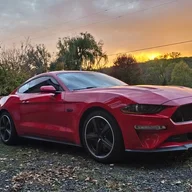
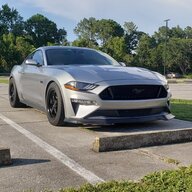
Struggles of getting an already modified and boosted GT... I am making this post due to trying everything I know of to try. I'm at the point of believing it needs a new tune. Which is $1,300 with Wengerd Performance. I am trying to cross every t and dot every i prior to spending that money.
I'm looking for some help diagnosing a strange intermittent idle issue on my 2020 Mustang GT. I've spent quite a bit of time troubleshooting this already and would really appreciate input from anyone experienced with Gen 3 Coyotes, especially boosted/ESS cars.
Car/setup:
The car will intermittently idle extremely poorly. It can shake/misfire badly enough that occasionally the engine will actually stall.
The weird part is that it isn't consistently bad.
Sometimes it'll sit around ~800 RPM and idle reasonably well. Other times it'll start struggling/misfiring badly. Cold starts around ~1,000 RPM are generally fine, and if I hold the engine around 2,000 RPM it runs smoothly.
It also drives great. I don't have an obvious problem under load, acceleration feels normal, and after an idle stall it'll start right back up.
Important history regarding fuel trims/injectors:
Earlier in the diagnosis, the car DID have a more significant lean condition. STFTs could reach roughly +12–16%, particularly when it was running poorly.
During that diagnosis, I swapped injectors 7 & 8 and subsequently discovered an issue with the lower injector O-rings. The injectors were cleaned and the lower O-rings were replaced.
That appears to have corrected the previous lean condition.
The current idle problem remained after that repair.
Currently, when the idle is behaving reasonably well, STFTs are generally low. When the rough idle/misfiring starts, the trims may increase somewhat, but I'm generally only seeing roughly +5–9% STFT now, NOT the +12% or higher numbers I was seeing before repairing the injector O-rings.
So I don't want the old +12–16% trim readings confused with the condition the car has now.
Fuel rail pressure also appears normal. I've observed roughly 79 psi desired vs ~81 psi actual.
Things already checked/tested:
I've also spent a lot of time smoke testing it.
I have an automotive smoke machine and have tested the intake/manifold through different locations, including the brake booster connection.
I've capped the throttle body/intake opening appropriately during testing and isolated/reconfigured the PCV connections while trying to locate a leak.
The smoke machine's leak/flow gauge continues to indicate some amount of leakage (generally around the ~0.5–1.0mm range on its gauge depending on configuration), but I cannot actually find smoke escaping anywhere.
One thing I DID previously find was a leaking air/oil separator. That separator has since been replaced and that leak is fixed, but the intermittent idle problem remains.
The car's PCV system is modified because of the ESS setup:
I've also verified smoke can reach other manifold-connected circuits—for example, smoke will come through the BOV vacuum reference line when smoke is introduced through the brake booster/manifold.
Despite all of this, I still haven't located a definite intake/vacuum leak that explains the intermittent idle.
Current behavior in a nutshell:
I'm especially interested in anything specific to a boosted Gen 3 Coyote/ESS setup that could cause an intermittent severe rough idle/stalling condition while allowing the engine to run perfectly fine with additional RPM or load.
If anyone sees something in this diagnostic process that I've overlooked—or knows additional PIDs/data I should record on the Autel while it's actively having the problem—I'd greatly appreciate the help.
I'm completely willing to collect additional live data, perform another specific test, take pictures of the PCV/vacuum routing, or upload recordings/logs if someone knows what they'd like to see.
Thank you for your time!
I'm looking for some help diagnosing a strange intermittent idle issue on my 2020 Mustang GT. I've spent quite a bit of time troubleshooting this already and would really appreciate input from anyone experienced with Gen 3 Coyotes, especially boosted/ESS cars.
Car/setup:
- 2020 Mustang GT, Gen 3 Coyote, 10R80
- ESS G3 supercharger, 120mm pulley
- ESS G4 intercooler
- Tial BOV
- FIC 1000cc injectors
- Fuel pump booster
- Long-tube headers/X-pipe
- 93 octane
- Unknown tune/tuner (car was purchased already modified)
The car will intermittently idle extremely poorly. It can shake/misfire badly enough that occasionally the engine will actually stall.
The weird part is that it isn't consistently bad.
Sometimes it'll sit around ~800 RPM and idle reasonably well. Other times it'll start struggling/misfiring badly. Cold starts around ~1,000 RPM are generally fine, and if I hold the engine around 2,000 RPM it runs smoothly.
It also drives great. I don't have an obvious problem under load, acceleration feels normal, and after an idle stall it'll start right back up.
Important history regarding fuel trims/injectors:
Earlier in the diagnosis, the car DID have a more significant lean condition. STFTs could reach roughly +12–16%, particularly when it was running poorly.
During that diagnosis, I swapped injectors 7 & 8 and subsequently discovered an issue with the lower injector O-rings. The injectors were cleaned and the lower O-rings were replaced.
That appears to have corrected the previous lean condition.
The current idle problem remained after that repair.
Currently, when the idle is behaving reasonably well, STFTs are generally low. When the rough idle/misfiring starts, the trims may increase somewhat, but I'm generally only seeing roughly +5–9% STFT now, NOT the +12% or higher numbers I was seeing before repairing the injector O-rings.
So I don't want the old +12–16% trim readings confused with the condition the car has now.
Fuel rail pressure also appears normal. I've observed roughly 79 psi desired vs ~81 psi actual.
Things already checked/tested:
- Compression checked and good
- Spark/plugs checked
- Injectors investigated
- Previously swapped injectors 7 & 8 during diagnosis
- Lower injector O-rings replaced after discovering the previous issue
- Previous significant lean condition improved after the injector/O-ring repair
- Throttle body cleaned/checked
- Desired vs actual throttle position appears to follow correctly
- MAF unplug test made it run worse
- Intake/filter removed/tested with no improvement
- EVAP purge valve disconnected during testing with no meaningful change
- Purge valve appears closed when it should be
- VCT data checked and appeared normal
- AFR/fueling otherwise appears normal
- Multiple rounds of live-data monitoring with an Autel scanner
I've also spent a lot of time smoke testing it.
I have an automotive smoke machine and have tested the intake/manifold through different locations, including the brake booster connection.
I've capped the throttle body/intake opening appropriately during testing and isolated/reconfigured the PCV connections while trying to locate a leak.
The smoke machine's leak/flow gauge continues to indicate some amount of leakage (generally around the ~0.5–1.0mm range on its gauge depending on configuration), but I cannot actually find smoke escaping anywhere.
One thing I DID previously find was a leaking air/oil separator. That separator has since been replaced and that leak is fixed, but the intermittent idle problem remains.
The car's PCV system is modified because of the ESS setup:
- Passenger-side PCV runs through an air/oil separator
- Driver-side PCV is routed into the ESS supercharger intake
I've also verified smoke can reach other manifold-connected circuits—for example, smoke will come through the BOV vacuum reference line when smoke is introduced through the brake booster/manifold.
Despite all of this, I still haven't located a definite intake/vacuum leak that explains the intermittent idle.
Current behavior in a nutshell:
- Cold/high idle: generally good
- ~800 RPM warm idle: intermittently terrible
- ~2,000 RPM stationary: smooth
- Driving/under load: runs great
- Can misfire/shake badly at idle
- Occasionally stalls at idle
- Immediately restarts
- Current STFT during the problem is generally only around +5–9%
- Previous +12–16% trims were BEFORE repairing the injector O-rings
- Problem can disappear again seemingly at random
I'm especially interested in anything specific to a boosted Gen 3 Coyote/ESS setup that could cause an intermittent severe rough idle/stalling condition while allowing the engine to run perfectly fine with additional RPM or load.
If anyone sees something in this diagnostic process that I've overlooked—or knows additional PIDs/data I should record on the Autel while it's actively having the problem—I'd greatly appreciate the help.
I'm completely willing to collect additional live data, perform another specific test, take pictures of the PCV/vacuum routing, or upload recordings/logs if someone knows what they'd like to see.
Thank you for your time!
Sponsored