Sponsored

GM is pulling back on EVs

Gregs24

Well-Known Member
Joined
Aug 31, 2018
Threads
23
Messages
4,759
Reaction score
3,038
Location
Wiltshire UK & Charente FR
First Name
Greg
Vehicle(s)
Mustang V8 GT, Ford Kuga PHEV
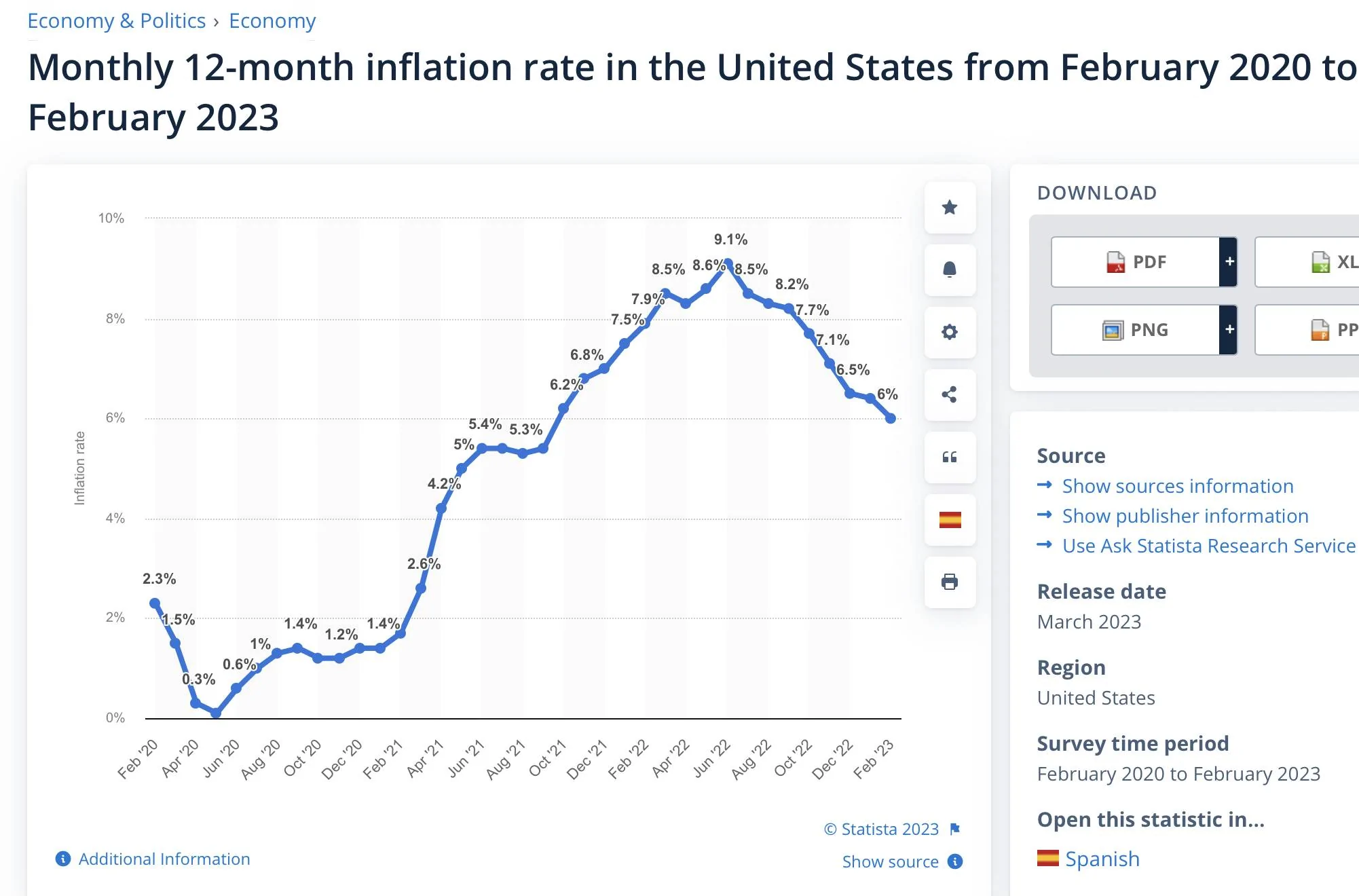
Economic experts the world over attributed the root cause of the global inflation increase to the Russian invasion of Ukraine. As the chart below shows, there was already some inflation beginning to take hold. Then when the invasion happened inflation increased dramatically. And now inflation is starting to decline, largely due to the Inflation Reduction Act.

0E6B5274-304A-403A-9033-FDC7298D3E55.jpeg
A major factor in the reducing inflation is the price of oil and gas dropping significantly as the Russian effect drops out now the war has been going on for a year and fuel sources have been realigned. Obviously IRA is a US only factor
Sponsored


Gregs24

Well-Known Member
Joined
Aug 31, 2018
Threads
23
Messages
4,759
Reaction score
3,038
Location
Wiltshire UK & Charente FR
First Name
Greg
Vehicle(s)
Mustang V8 GT, Ford Kuga PHEV
I stand by what I said with respect to Volvo. Things that I would say could violate non disclosure agreements and I ain’t gonna do that for an Internet forum skirmish.

As far as the mandates in place by the various states, in my opinion they are unnecessary over-reach and have enough loopholes in them that the states will find them problematic.

I look at Electric Vehicles as a product, not a political statement or the tool of a conspiracy theory. In my garage I have a modified muscle car, a modified sports car and a range extended EV that will soon be replaced by a battery electric vehicle. A tool for every job. At the end of the day, most things that an ICE car can do, EVs can do better. There aren’t any EV track cars. Yet. There aren’t any EVs that are designed to tow. Yet. ICE cars do cross country trips better than EVs for now. That will likely change within 10-15 years. EVs are more efficient, accelerate quicker, can package occupants better (no transmission tunnel), can package cargo better (frunk) and have a lower lifetime cost of operation. So unless you are consistently towing and hauling or you are deep into motorsports, beyond just weekend show and shine, and you don’t drive more than 300 miles in a day on a frequent basis, EVs can pretty much do everything better than an equivalent ICE.
Again using a perfectly reasonable argument. Where are your uninformed opinions?
 

Gregs24

Well-Known Member
Joined
Aug 31, 2018
Threads
23
Messages
4,759
Reaction score
3,038
Location
Wiltshire UK & Charente FR
First Name
Greg
Vehicle(s)
Mustang V8 GT, Ford Kuga PHEV
Do you happen to recall what percentage of the electricity for recharging came from renewables?
Seems a decent question dose it not? Clearly the source of the power is going to make a HUGE difference to the break even point.

EDIT: I did the research for you. The answer is here:

“First, the calculus used by Volvo says the results depend in large measure on the source of electricity its customers use to charge their vehicles. If they drive in Poland, where 90% of the electricity comes from burning coal, then yes, it will take 100,000 kilometers or more to reach parity with a conventional gasoline-powered car. On the other hand, if the electricity comes from renewable sources such as wind or solar, the crossover point is closer to 50,000 kilometers. The middle scenario, based on the currentEU energy mix, is 77,000 kilometers.”

50,000 km’s is 31,000 miles.
So yes, if you use coal and gas to power the nation (and your charger) it’ll take basically twice as long for the EV to become superior to the ICE.
The key point being that’s it’s STILL superior, regardless of the power source.

We both agreed earlier that facts matter. Perhaps we should continue to use them?

Also from the same article:

“All this talk about carbon emissions overlooks one important point. In addition to the carbon dioxide that pours out of the tailpipes of conventional cars, they also spew a cloud of fine particulate matter into the atmosphere. Whether its coal, oil, gasoline, or diesel, fossil fuels create FPM pollution when they are burned. Fine particulates are so small they pass directly into the bloodstream in the lungs and travel to every part of our bodies, from our brains to our livers to our toes. They are found in breast milk and human placentas. They impair cognitive function, make us ill, and make us die sooner than we should. And for this the fossil fuel advocates want to bash electric cars? What is wrong with you people?

The EV revolution has many pieces. It involves better battery technology, more efficient manufacturing, and an expansion of the supply of renewable energy. People who seize on one sentence of a 50-page report to flog their agenda are dishonest idiots. Ignore them. They will soon be irrelevant.”
You see the silly thing is that there is a significant and real problem (which to be fair is being worked on by tyre makers) that has been completely missed by the trolls on here fixated by batteries, slavery, freedoms, and government mandates / paranoia and that is tyre 'rubber'. As I'm sure you know EV's tend to be heavier needing bigger tyres that generate a lot more microparticles per vehicle mile. You would think anybody who knew anything about the subject may have mentioned this very real issue - but no!

I wonder why? Oh because the very people moaning about EV's drive big heavy trucks (and odd looking vans) or smoking hard driven Mustangs so aren't really in a position to mention it!
 

sk47

Well-Known Member
Joined
Nov 12, 2020
Threads
32
Messages
6,820
Reaction score
3,162
Location
North Eastern TN
First Name
Jeff
Vehicle(s)
Chevy Silverado & Nissan Sentra SE
You see the silly thing is that there is a significant and real problem (which to be fair is being worked on by tyre makers) that has been completely missed by the trolls on here fixated by batteries, slavery, freedoms, and government mandates / paranoia and that is tyre 'rubber'. As I'm sure you know EV's tend to be heavier needing bigger tyres that generate a lot more microparticles per vehicle mile. You would think anybody who knew anything about the subject may have mentioned this very real issue - but no!

I wonder why? Oh because the very people moaning about EV's drive big heavy trucks (and odd looking vans) or smoking hard driven Mustangs so aren't really in a position to mention it!
Hello; In fact the increased tire wear and thus also increased microparticles from heavier EV's has been mentioned in this thread. Guess because Gregs has so many on ignore he misses things. Likely an explanation of why he misses so many glaring issues in general if such is a normal approach to problem solving by shutting off sources of information. Enough about Gregs.

The tire wear will be a real issue as the battery packs are large and heavy. Smaller EV's will be significantly heavier than an equivalent ICE. Same for the trucks.
I guess Gregs misses that the pickups and heavier duty trucks will need bigger battery packs to move their larger mass around. If you want a truck to have hauling or towing capacity then even more battery capacity need be added. So my half ton ICE pickup may weigh something like 6000 pounds.
The same truck as an EV will have to weigh much more to have a similar work capacity. It will become an escalating issue. First because to carry the extra weight of a battery pack suspension components will have to be a bit more robust. Then to have any decent tow or haul capacity some additional battery cells are needed. Some amount of battery cells just to move the truck and additional battery cells to move any load.

Same sort of thing already happens when you go from a half ton pickup to a 3/4 ton or to a one ton pickup. I have worked on all three. Suspension parts get heavier and more stout as you move up in load or tow capacity. The EV trucks will have to be even heavier still because of the battery weights.

I get that Gregs will not see this while in his safe place, but ask yourself how he missed such a simple thing. That being any equivalent EV will be much heavier than the ICE it replaces.
 

Sponsored

sk47

Well-Known Member
Joined
Nov 12, 2020
Threads
32
Messages
6,820
Reaction score
3,162
Location
North Eastern TN
First Name
Jeff
Vehicle(s)
Chevy Silverado & Nissan Sentra SE
"First, the calculus used by Volvo says the results depend in large measure on the source of electricity its customers use to charge their vehicles. If they drive in Poland, where 90% of the electricity comes from burning coal, then yes, it will take 100,000 kilometers or more to reach parity with a conventional gasoline-powered car. On the other hand, if the electricity comes from renewable sources such as wind or solar, the crossover point is closer to 50,000 kilometers. The middle scenario, based on the currentEU energy mix, is 77,000 kilometers.”

50,000 km’s is 31,000 miles.
So yes, if you use coal and gas to power the nation (and your charger) it’ll take basically twice as long for the EV to become superior to the ICE.
The key point being that’s it’s STILL superior, regardless of the power source.
Hello; Having a Gregs moment I see. Thing is most electricity is generated from fossil fuels currently so the over 130,000 KM (68,000 miles) break even point is accurate.
Actually more accurate than the 31,000 mile break even number in the actual real world as we sit. Sure if "someday" more electricity comes from more renewable then "someday" the break even point of an EV vs an ICE will be less. Until that special day happens the 68,000 mile is accurate today. Especially if we factor in the coal use of India and China.

We live in todays world. Not yet in the cherry picked future world.
 

K4fxd

Well-Known Member
Joined
Apr 2, 2020
Threads
121
Messages
13,455
Reaction score
12,262
Location
NKY
First Name
Dan
Vehicle(s)
2017 gt, 2002 FXDWG, 2008 C6,
More lunacy coming from the UK
 

sk47

Well-Known Member
Joined
Nov 12, 2020
Threads
32
Messages
6,820
Reaction score
3,162
Location
North Eastern TN
First Name
Jeff
Vehicle(s)
Chevy Silverado & Nissan Sentra SE
Hello; Some questions came to mind when i started reading this story. Questions arising from my understanding of how cattle and other similar grazing animals manage to eat grasses. Not the chewing or swallowing of the grasses, but the digestion of those grasses. Grasses are very tough to breakdown. To get the job done cattle have an interesting digestive system with a four chambered stomach if memory serves but also a vital extra item.
The cattle fist graze and swallow some field grasses. After a time they have enough to go somewhere and often lay down. Then they regurgitate some of the grass and sti around chewing it to further mechanically grind it into finer bits. (chewing the cud) Then it is swallowed again.

Here is the trick and my concern. The cattle do not do the majority of the digestion of the grasses. Bacteria living in their gut do most of the digestion. My best guess is these are anerobic bacteria which produce methane as a byproduct of this digestion. The cattle get to eat a food source off limits to so many other animals. The bacteria get a good place to live.

This passage raised alarms for me.
"Methane-suppressing feed contains additives such as seaweeds, essential oils, organic acids, probiotics, and antimicrobials that reduce the amount of methane produced during a cow’s digestion"

Since the cattle depend on microbes it seems risky to add bacteria killing additives to cattle food.

Another point is the question of all the other grazing animals which use similar strategies to digest grasses. Are we to do this to a foodsource (domesticated cattle) and ignore all the wild stocks around the world???
What about termites who on the whole generate much more methane than any other type of living organism. Had a back and forth in the science is cancelled about this source of methane. One person claimed that because termites live underground the soil absorbs most of the methane. I found sources showing that even after such soil absorption the methane from termites is still the greater source into the air.

My point being this "true believer" mindset is so very flawed. We cannot do wholesale changes to established food production systems. Going after cattle just because those in power can rule the farmers while at the same time ignoring the rest of the organic methane production.
I have not yet mentioned landfill methane.
There is more to this story.
 

K4fxd

Well-Known Member
Joined
Apr 2, 2020
Threads
121
Messages
13,455
Reaction score
12,262
Location
NKY
First Name
Dan
Vehicle(s)
2017 gt, 2002 FXDWG, 2008 C6,
Burkey all my sources have been taken down, they are no longer on the internet. It seems contrary information gets redacted.
 

Sponsored

sk47

Well-Known Member
Joined
Nov 12, 2020
Threads
32
Messages
6,820
Reaction score
3,162
Location
North Eastern TN
First Name
Jeff
Vehicle(s)
Chevy Silverado & Nissan Sentra SE
Burkey all my sources have been taken down, they are no longer on the internet. It seems contrary information gets redacted.
Hello; same as during Covid??? Control the information sources to favor the agenda.
 

K4fxd

Well-Known Member
Joined
Apr 2, 2020
Threads
121
Messages
13,455
Reaction score
12,262
Location
NKY
First Name
Dan
Vehicle(s)
2017 gt, 2002 FXDWG, 2008 C6,

sk47

Well-Known Member
Joined
Nov 12, 2020
Threads
32
Messages
6,820
Reaction score
3,162
Location
North Eastern TN
First Name
Jeff
Vehicle(s)
Chevy Silverado & Nissan Sentra SE
Exactly, and these sources are/were NASA ect.
Hello; If I recall from many posts back in this thread there were some posts between myself and perhaps Burkey about the predictions of how long current atmospheric Co2 would continue to warm the earth. The older NASA information was where we were getting the 50 to 100 years figures.
In one quoted bit a NASA spokesperson stated they were to reexamine things. I speculated in that exchange the revised material will favor the agenda. Guess we will see if all of a sudden reducing Co2 will somehow immediately start to slow or stop warming and no longer be 50 years in the future.

Control the narrative.
 

martinjlm

Retired from GM
Joined
Feb 4, 2018
Threads
15
Messages
1,669
Reaction score
3,341
Location
Detroit
Vehicle(s)
2017 Camaro Fifty SS Convertible
Hello; Volvo is a client explains a lot. The study lays things out well enough. Too bad an insider cannot enlighten us, but so be it.

I also figure the mandates will be problematic for states which have them. Too much of a power grab for one thing, but other problems as well.

The EV as a tool is what several of us have also stated. If an EV fits a lifestyle I and others have said that is just fine. But it is become something other than each gets to pick the vehicle that suits. It is a change being pushed onto us by mandates and also incentives we have to pitch in for. It is not clean competition and let the better vehicle win.
You are selectively parsing my words to imply meanings inconsistent with what I actually said. What I SAID is that each of my vehicles is a tool, not just the EV.
My Camaro is my dragstrip /road course tool and is modified to do those things well. Currently there are no EVs that are similarly purposed, although the Porsche Taycan can do a respectable job at both. <insert “but how many track sessions can you do…” comments here>.
My Toyota MR2 Turbo is my autocross car and is modified to do those things well. Currently there are no EVs that are similarly purposed.
My Volt and my SRX are go to work, go to Costco / Lowe’s / supermarket cars. Pretty much any EV offered for sale in the US can do those things better, so both will likely be replaced by a Blazer EV SS. Which, by the way will probably be nose to nose with my Camaro on the dragstrip, even though that would not be my reason for buying it.
Hybrids were around in 2001 when i bought my car new. I rejected then then as have most folks for the intervening 22 years. Some few years later the EV's came along and were largely ignored. So, the EV for sure is not better than an ICE else it would not need the incentives and mandates for purchase. The auto companies are being forced into the EV market in a similar way. Not exactly by choice.
Hybrids would be the ideal solution if not for the cost of initial purchase and the looming budget bursting cost of a replacement battery.
A ten-year-old hybrid or EV with a funky battery will be a toss away. How will that add up in the environmental calculations of saving the earth?
I highlighted the part in orange because I really don’t understand what you’re trying to say there. The point you start with does not align with where you ended unless I’m totaling misreading something. Hybrids… GM made the decision to go all EV after I left and they didn’t ask my opinion :crackup:. I WAS still there when the decisions were made to walk away from hybrids so I totally understand and wholeheartedly agree with the decision. And being in the product portfolio planning team some of my team’s analysis went into those decisions. Without getting into the gory details, it goes something like this…

  • Full hybrids (think Prius) are good at delivering good real world fuel economy improvement, but that doesn’t translate well to CAFE achievement, especially in the classes of vehicles where GM sales are concentrated. For those type vehicles, the better option would be...
  • Plug-in Hybrids (think RAV4 Prime). The issue with PHEVs is that to do it right, you have to engineer two complete powertrains in the vehicle, each capable of driving the vehicle through the entire speed range. So you need a battery approaching the size and expense of an EV, plus the full cost and mass of a transmission, and engine, and exhaust system, and the added expense of a sophisticated controls system that seamless transfers from one propulsion system to the other, as well as managing the blending of the two. They are also not zero emissions, which became an issue after I left.
So when I was there, two key decision were made. 1) any hybrids would need to be PHEVs or EREVs (Volt) in order to get the right CAFE balance. 2) For the cost and complexity to get to PHEV or EREV, any GM electrified product will just go straight to EV. There was and is one glaring exception. Corvette. The Corvette portfolio was so far down the line in terms of powertrain development that canceling the hybrid would have flushed millions of dollars down the drain. Plus, the Corvette hybrid (hybrids?) were never about fuel economy. It’s all about AWD and additional performance. Period.

We already have enough knowledge and experience with Prius, Leaf, Tesla, and Volt products that are more than 10 years old to see that there is an existing and growing industry in the remanufacturing of hybrid and EV batteries. Just like the remanufacturing industries for engines and transmissions. The growth of EV models is just sending the growth in these areas straight up. There is also a fast growing industry in lithium battery recycling. It’s already been there because of smart phones and other consumer electronics, but now it’s poised to grow exponentially because EVs bring the prospect of bigger lithium batteries / more minerals to reclaim in the recycling process.
You are new to this thread so I do not know if you have been keeping up all along or just dropped in. You say an EV will beat an ICE in every aspect except to tow, haul, make trips or drive 300 miles. ( seems a lot). What about apartment or other renters who cannot have at home charging? We have posted lots of links about how it costs more to charge an EV at commercial chargers. Only cost less to run an EV if you can home charge it seems.
You are correct about people who don’t have direct access to overnight charging. I believe I stated that in an earlier post. In the post you are referring to I was only speaking of the EV as a product, not the scenario of the people using them. “Johnny on the 5th floor” has been one of my talking points internally and at multiple conference speaking engagements when discussing how long ICE will be viable. There are solutions that are available and capable of mitigating this issue, but until they are implemented, it remains a hurdle. It is one of the key reasons I maintain that ICE and EV will need to coexist for several decades. It’s also a major reason why I think the states that mandate no new ICE vehicle sales after 2035 are over-reaching.

You are fitting in well with the others who champion EV's. That being the someday problems will be fixed stuff.
"Yet. ICE cars do cross country trips better than EVs for now. That will likely change within 10-15 years."
We have gotten so many of these someday EV's will be fixed lines when current EV issues are pointed out. When the problems are fixed then let us make a choice. Choice is not in the plan tho is it?
I don’t champion EVs. I see the innate value proposition in them and understand why automakers are going so hard in that direction. I’ve driven examples of almost every EV currently available in the US market. I haven’t driven a Lucid Air, but pretty much everything else. Again, part of my job. I’m perfectly happy with having a 500+ hp Camaro and a 577hp Blazer EV in the same garage. The thing is, because of where I’m placed in the industry and what I do for a living, who I talk to on a day-to-day basis, I see what’s coming. I know who is working on what and what their target timing is for bringing things to market. My company is the leading automotive forecaster in the world. I used to do the Powertrain forecast for North America and still talk to that group on a daily basis. They see EVs being 40%+ US new vehicle sales by 2030. And we aren’t even the most aggressive in forecasting EV growth. We often have to defend why our projections aren’t higher. 🤷‍♂️ We talk to the charging network providers, we talk with every major auto manufacturer. As consultants, my team talks to EV manufacturers and suppliers that you haven’t even heard of…yet. It is not a question of me being a proponent or not. It’s a matter of having access to an enormous amount of information that shows the path we’re on. No doubt, things will change up and down on the path to implementation, but what I’m bringing to this discussion is anonymized interpretation of what those who are developing the next thing are working towards. My position is as neutral as I can make it.
Sponsored

 
Last edited:


Top