OP
OP

GT Pony
Well-Known Member
- Joined
- Mar 13, 2015
- Threads
- 77
- Messages
- 9,402
- Reaction score
- 4,839
- Location
- Pacific NW
- Vehicle(s)
- 2015 GT Premium, Black w/Saddle, 19s, NAV
- Thread starter
- #31
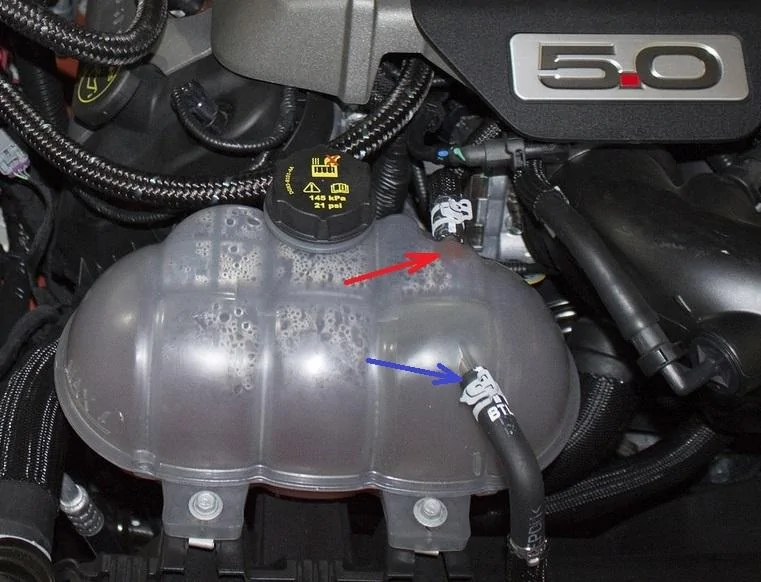
I called Moroso's Tech Dept today and had a good discussion with them about their tank design. The guy I spoke with said he thinks that when the engine is running there is always positive flow through the hose connected to the rear tank nipple that I'm concerned about not having the internal submerged tube. I'm not sure if there really is positive flow from the engine block to the rear tank nipple without verifying it myself.
I think any coolant flow into the tank would be purely caused by expansion of the coolant as the system heats up. I don't think there is a constant active stream of coolant flowing through the hose I'm talking about, but I could be wrong. One way to verify would be to feel that hose while the engine was warming up to see of the hose I'm concerned about heats up relatively fast, meaning warm coolant was actively flowing through it.
As mentioned before, if there was air ingested back down that hose and into the top of the engine during cool offs, it's likely to be purged back out into the tank the next time the engine is heated up.
He also said the Moroso coolant tank for the 2011 - 2014 Mustangs has the same basic hose connections and works the same basic way as the 2015+ tanks (Coyote used in those models also). The Moroso tank design for the 2011 - 2014s Mustangs also doesn't have the internal submerged tube. They have never received any complaints that their tanks have caused issues with the Coyote cooling system.
Also, I'm willing to bet that other aftermarket coolant tanks such as the JLT and LMR don't use the internal submerged tube for the rear/top nipple either. I haven't read about any complaints on those tanks.
So, based on what I've found out I'll install the Moroso and just go with the flow so to speak. I just wanted to understand how the coolant system interacts with the surge tank and feel comfortable that a tank missing the submerged internal tube wasn't going to cause any problems. Hope this info helps.
I think any coolant flow into the tank would be purely caused by expansion of the coolant as the system heats up. I don't think there is a constant active stream of coolant flowing through the hose I'm talking about, but I could be wrong. One way to verify would be to feel that hose while the engine was warming up to see of the hose I'm concerned about heats up relatively fast, meaning warm coolant was actively flowing through it.
As mentioned before, if there was air ingested back down that hose and into the top of the engine during cool offs, it's likely to be purged back out into the tank the next time the engine is heated up.
He also said the Moroso coolant tank for the 2011 - 2014 Mustangs has the same basic hose connections and works the same basic way as the 2015+ tanks (Coyote used in those models also). The Moroso tank design for the 2011 - 2014s Mustangs also doesn't have the internal submerged tube. They have never received any complaints that their tanks have caused issues with the Coyote cooling system.
Also, I'm willing to bet that other aftermarket coolant tanks such as the JLT and LMR don't use the internal submerged tube for the rear/top nipple either. I haven't read about any complaints on those tanks.
So, based on what I've found out I'll install the Moroso and just go with the flow so to speak. I just wanted to understand how the coolant system interacts with the surge tank and feel comfortable that a tank missing the submerged internal tube wasn't going to cause any problems. Hope this info helps.
Sponsored