Sponsored

THERMOSTAT!!

Busser48

Well-Known Member
Joined
Sep 7, 2015
Threads
40
Messages
1,637
Reaction score
171
Location
La
Vehicle(s)
2015 mustang ecoboost
? Still neither company has some possible reasons why ones better than the other. Hot side V's cold? Was hoping livernoise could chime in? :). I and maybe some others are amateurs so as best u can explain would be very appreciated!!!!
Sponsored


Juben

Well-Known Member
Joined
Jan 29, 2015
Threads
35
Messages
2,519
Reaction score
809
Location
Chattanooga, TN
First Name
Justin
Vehicle(s)
2015 EcoBoost Mustang (AT) w/PP
? Still neither company has some possible reasons why ones better than the other. Hot side V's cold? Was hoping livernoise could chime in? :). I and maybe some others are amateurs so as best u can explain would be very appreciated!!!!
I'm trying to get to the bottom of the cold side vs hot side build info. I'll update here once I find out.
 

Busser48

Well-Known Member
Joined
Sep 7, 2015
Threads
40
Messages
1,637
Reaction score
171
Location
La
Vehicle(s)
2015 mustang ecoboost
I'm trying to get to the bottom of the cold side vs hot side build info. I'll update here once I find out.
Ty Jew! ;)
 

Juben

Well-Known Member
Joined
Jan 29, 2015
Threads
35
Messages
2,519
Reaction score
809
Location
Chattanooga, TN
First Name
Justin
Vehicle(s)
2015 EcoBoost Mustang (AT) w/PP
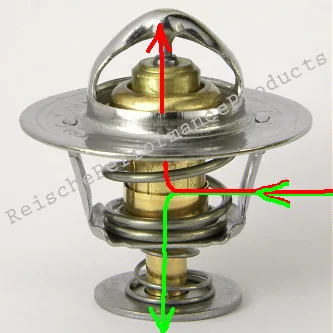
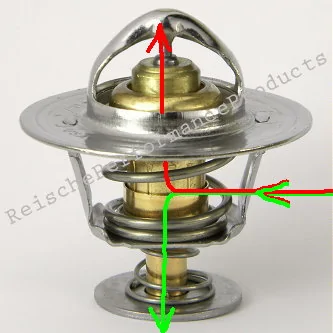
I found the following on the F-150 EcoBoost forum and it provides some very interesting insight into the operation of the different types of thermostats:

9157d1394666419-thermostats-your-f150-hotside.webp


So in the hot-side system the thermostat is placed pre-radiator: coolant flows in from the side (GREEN/RED) and, depending on it's temp, coolant is directed either up to the radiator to be chilled or if the coolant is not hot enough, the thermostat stays closed and the coolant is directed down through the bypass to recirculate. Of course the thermostat will often run partially open, directing a little coolant to both paths.

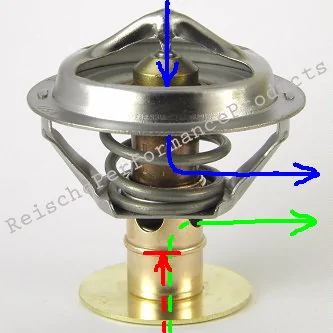
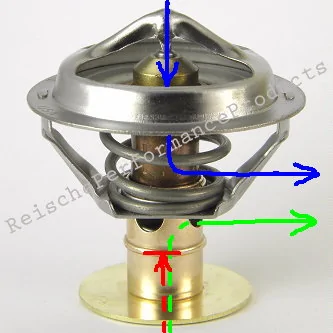
9158d1394666464-thermostats-your-f150-coldside.webp


In the cold-side system coolant flows the opposite direction and the thermostat is post-radiator: Unlike a hot-side thermostat, the bypass control (brass bottom) is not attached to the upper assembly/diaphragm and does not move when the thermostat opens. It maintains contact so the bypass coolant can only flow up through the inside of the pipe, keeping the heat motor in direct contact with the bypass coolant temperature so the thermostat can function properly at all times. When the bypass coolant is hot enough the thermostat opens (bringing in chilled coolant from the radiator - BLUE); this also pushes the heat motor further down into the pipe which closes off the holes in the pipe for the bypass (RED) and shields it from the chilled coolant. However a small amount of bypass coolant is allowed to flow across the heat motor at all times so it can still monitor and respond to changes in the coolant temp.

A hot-side thermostat can function in a cold-side setup to a large degree but there are some drawbacks: When the thermostat opens some of the chilled coolant will mix in and expose the heat motor to cooler temps then it should be seeing to operate properly. Cooler temps then force the thermostat to start closing prematurely and once this happens, the hot bypass coolant will then start to make it open back up... and the cycle repeats. Another issue is the thermostat will always struggle to stay fully open because as soon as the bypass is completely shut off, the heat motor will no longer be exposed to hot coolant, forcing it to close again. The LMS/Even Flo thermostat attempts to address this by placing 4 holes in the bypass valve but then you always have a good amount of coolant recirculating through the bypass instead of being directed through the radiator as it should be.

In my own real world testing with a hot-side thermostat in a cold-side application I found the primary drawback was the way it handled changing conditions. You could see a nice stable temp cruising down the freeway but as soon as you exited and started slowing down to a stop the temp would immediately spike up and it took a little time for it to re-stabilize and cool back down.


Source link

Hopefully, when Livernois returns to the thread, they can shed some insight as to why they specifically chose a hot side function over a cold side function.
 
Last edited:

Busser48

Well-Known Member
Joined
Sep 7, 2015
Threads
40
Messages
1,637
Reaction score
171
Location
La
Vehicle(s)
2015 mustang ecoboost
Jew!!! As always, coming through big time..... I guess I still trying to understand which has more performance and or protection benefites for a FBO EBM? Proof is in the pudding, and like the intercooler mods we know without doubt they work, we know that the wastegate mod without a doubt works. We know e30, is insane and amazing and it works! I have yet to see much talk or proof of what these do. I guess.
 

Sponsored

Juben

Well-Known Member
Joined
Jan 29, 2015
Threads
35
Messages
2,519
Reaction score
809
Location
Chattanooga, TN
First Name
Justin
Vehicle(s)
2015 EcoBoost Mustang (AT) w/PP
Jew!!! As always, coming through big time..... I guess I still trying to understand which has more performance and or protection benefites for a FBO EBM? Proof is in the pudding, and like the intercooler mods we know without doubt they work, we know that the wastegate mod without a doubt works. We know e30, is insane and amazing and it works! I have yet to see much talk or proof of what these do. I guess.
From what I gather from the above, the cold side function would be better suited to consistency and thereby performance as well. The key to me is consistency and that's what the cold side function would appear to offer.

I'm going to pick up a unit from Rat Stat for testing and may also pick up one from Livernois. They're both cheap enough that it's not a big deal to toss the one that is the lesser performing of the two. It seems like this topic is one of growing interest, so it'd be good to have some data available on it.

I've long said that the key to making good, consistent, and reliable power is heat management and proper maintenance, so I'm hopefully that this is mod, albeit a small one, that can further widen the safety net for performance and reliability.
 

Busser48

Well-Known Member
Joined
Sep 7, 2015
Threads
40
Messages
1,637
Reaction score
171
Location
La
Vehicle(s)
2015 mustang ecoboost
From what I gather from the above, the cold side function would be better suited to consistency and thereby performance as well. The key to me is consistency and that's what the cold side function would appear to offer.

I'm going to pick up a unit from Rat Stat for testing and may also pick up one from Livernois. They're both cheap enough that it's not a big deal to toss the one that is the lesser performing of the two. It seems like this topic is one of growing interest, so it'd be good to have some data available on it.

I've long said that the key to making good, consistent, and reliable power is heat management and proper maintenance, so I'm hopefully that this is mod, albeit a small one, that can further widen the safety net for performance and reliability.


Please keep me posted
 

TheLion

Well-Known Member
Joined
Jul 1, 2016
Threads
68
Messages
1,621
Reaction score
601
Location
US
Vehicle(s)
Ruby Red 2016 Mustang GT PP 6-MT
Got my latest updates in. Mishimoto radiator and BIG MOUTH Ram air duct (took some cutting and configuring to get to fit to my satisfaction, but was well worth it!).

I've already been running the 160F thermostat. My cylinder head temps are now stable between 170F and 180F. When I give it more throttle they drop to around 165ish. I did seem them up into 190 while idling for 10 minutes, but immediately dropped the moment I started moving. That's to be expected however.

The car makes VERY consistent power with the above additions and the LMS 93 tune which I was now brave enough to run with all of the other supporting cooling mods.

It would depend on your radiator, but even those running a PP radiator would greatly benefit from the Mishimoto upgrade and a 160F thermostat if your running a hot tune, especially in hot weather.
 

ypena02

Well-Known Member
Joined
Nov 14, 2015
Threads
27
Messages
789
Reaction score
203
Location
Massachusetts
Vehicle(s)
2017 Mustang GT
Are you not worried about running too cool in the winter?
 

Sponsored

Brazenbuck

Well-Known Member
Joined
Dec 24, 2014
Threads
4
Messages
187
Reaction score
40
Location
United States
Vehicle(s)
Mustang
Got my latest updates in. Mishimoto radiator and BIG MOUTH Ram air duct (took some cutting and configuring to get to fit to my satisfaction, but was well worth it!).

I've already been running the 160F thermostat. My cylinder head temps are now stable between 170F and 180F. When I give it more throttle they drop to around 165ish. I did seem them up into 190 while idling for 10 minutes, but immediately dropped the moment I started moving. That's to be expected however.

The car makes VERY consistent power with the above additions and the LMS 93 tune which I was now brave enough to run with all of the other supporting cooling mods.

It would depend on your radiator, but even those running a PP radiator would greatly benefit from the Mishimoto upgrade and a 160F thermostat if your running a hot tune, especially in hot weather.
I have a PP car in Vegas. When stock, my temps were anywhere between 190 - 215 in the summer. With the Mishimoto rad and LMS thermostat I run between 180 - 190. Very happy with the results.
 

lisandra

mama smurf
Joined
Jul 3, 2015
Threads
18
Messages
959
Reaction score
203
Location
Puerto Rico
First Name
lisandra
Vehicle(s)
ecoboost PP non premium
There is no such thing as winter where i live, which one is the better one out there
 

beefcake

Well-Known Member
Diamond Sponsor
Joined
Oct 18, 2014
Threads
1,531
Messages
12,790
Reaction score
5,283
Location
Bethel
Vehicle(s)
2018 Ford Mustang

Livernois Motorsports

Well-Known Member
Joined
Oct 25, 2014
Threads
226
Messages
2,801
Reaction score
955
Location
Dearborn Heights, Michigan
Website
www.livernoismotorsports.com
First Name
S550 HQ
Vehicle(s)
2016 Mustang GT (TVS 2650) (6R80)
Are you not worried about running too cool in the winter?
The coolant thermostat is a control valve actuated by coolant temperature. When the thermostat is closed, coolant flow bypasses the radiator circuit and returns to the coolant pump. When the thermostat is opened, coolant is allowed to flow through the radiator circuit in order to transfer engine-generated heat to the outside air. The HVAC and engine coolant systems are not the same system. We have plenty of winter here in Michigan. There are no issues at all with reaching operating temperatures.

I found the following on the F-150 EcoBoost forum and it provides some very interesting insight into the operation of the different types of thermostats:

9157d1394666419-thermostats-your-f150-hotside.webp


So in the hot-side system the thermostat is placed pre-radiator: coolant flows in from the side (GREEN/RED) and, depending on it's temp, coolant is directed either up to the radiator to be chilled or if the coolant is not hot enough, the thermostat stays closed and the coolant is directed down through the bypass to recirculate. Of course the thermostat will often run partially open, directing a little coolant to both paths.

9158d1394666464-thermostats-your-f150-coldside.webp


In the cold-side system coolant flows the opposite direction and the thermostat is post-radiator: Unlike a hot-side thermostat, the bypass control (brass bottom) is not attached to the upper assembly/diaphragm and does not move when the thermostat opens. It maintains contact so the bypass coolant can only flow up through the inside of the pipe, keeping the heat motor in direct contact with the bypass coolant temperature so the thermostat can function properly at all times. When the bypass coolant is hot enough the thermostat opens (bringing in chilled coolant from the radiator - BLUE); this also pushes the heat motor further down into the pipe which closes off the holes in the pipe for the bypass (RED) and shields it from the chilled coolant. However a small amount of bypass coolant is allowed to flow across the heat motor at all times so it can still monitor and respond to changes in the coolant temp.

A hot-side thermostat can function in a cold-side setup to a large degree but there are some drawbacks: When the thermostat opens some of the chilled coolant will mix in and expose the heat motor to cooler temps then it should be seeing to operate properly. Cooler temps then force the thermostat to start closing prematurely and once this happens, the hot bypass coolant will then start to make it open back up... and the cycle repeats. Another issue is the thermostat will always struggle to stay fully open because as soon as the bypass is completely shut off, the heat motor will no longer be exposed to hot coolant, forcing it to close again. The LMS/Even Flo thermostat attempts to address this by placing 4 holes in the bypass valve but then you always have a good amount of coolant recirculating through the bypass instead of being directed through the radiator as it should be.

In my own real world testing with a hot-side thermostat in a cold-side application I found the primary drawback was the way it handled changing conditions. You could see a nice stable temp cruising down the freeway but as soon as you exited and started slowing down to a stop the temp would immediately spike up and it took a little time for it to re-stabilize and cool back down.


Source link

Hopefully, when Livernois returns to the thread, they can shed some insight as to why they specifically chose a hot side function over a cold side function.
Just as a side note, what you copied from that post is was actually "documented" by one of our competitors in the EB category. So that is definitely unbiased information.

EvenFlo thermostats are made of stainless steel and have enlarged openings to provide increased flow. We are the only provider of thermostats that produce true "High Flow" thermostats for today's higher performance engines. These parts also feature a triple-bridge design that increases strength, stability and reliability. EvenFlo thermostats also have a bypass valve that allows a small amount of coolant to circulate just before fully opening. The difference is that the Reische units have several holes in their charge cylinder and BPV that continually allow coolant to flow unregulated. This continual leaking cannot be accounted for and/or measured. For several years we worked hard at devising the perfect approach to cooling. This included testing other vendor's parts, and we actually sold Reische tstats for years until we could perfect our EvenFlo design.

For those of you who are unfamiliar, here are a couple simulations that show how this system works:

[ame="[MEDIA=youtube]Z7ugPUoSomk[/MEDIA]"]
[ame="[MEDIA=youtube]y5p31F_dVJU[/MEDIA]"]

Our tstat is designed to operate just as the OE part is. This ensures that there is no conflict with performance, reliability or dependability when using our parts.
 
Last edited:

TheLion

Well-Known Member
Joined
Jul 1, 2016
Threads
68
Messages
1,621
Reaction score
601
Location
US
Vehicle(s)
Ruby Red 2016 Mustang GT PP 6-MT
I have a PP car in Vegas. When stock, my temps were anywhere between 190 - 215 in the summer. With the Mishimoto rad and LMS thermostat I run between 180 - 190. Very happy with the results.
Same here. The mishimoto has helped keep temps cooler under full load, which is where I had some issues with the stock rad running a bit not, never hit 200 on the stock rad once I installed the LMS 160F thermostat, but came close, now it's typically around 170~180 under load or on hotter days low 190's.
Sponsored


Top