
doulos4jc
......looking^
The V6 with the 17" wheels is gonna scream 'hertz rental':shrug:I'm starting to wonder why there's any reason to buy the EB over the V6 other than it seems to be the cool thing to do.
Sponsored

The V6 with the 17" wheels is gonna scream 'hertz rental':shrug:I'm starting to wonder why there's any reason to buy the EB over the V6 other than it seems to be the cool thing to do.

Wow, you've just spent an incredible amount of time convincing yourself, that a really good tuned live rear axle, is the epitome of automotive engineering...I'm EXTREMELY serious. What this car offers me is added weight, added width (a problem in autocross, even more so in this amount), similar power and torque at peak, similar gearing, same weight distribution, same capability for tires (still limited to 285's in STU) and added ability to tweak rear alignment.
In the grand scheme of things, are the negatives in that going to outweigh the ability to tweak rear alignment and a reduction in unsprung weight? Answer for me is a resounding no. My home concrete is the Lincoln Air Park which while not Sebring International Raceway's bump every 6" mantra, isn't exactly without massive pavement heaves. Almost every course I have run out at LAP has taken "advantage" of several of these features in an attempt to throw off car's balance. That said, my car is extremely composed over these bumps.
While it isn't the "easy button" that an IRS is, a live axle can soak up bumps almost as well if you are willing to address the issues with it. On the S197 chassis the biggest complaint is the "feeling" of uneasyness over bumps at the back end of the car. Most reviewers attribute this to a live axle, I attribute most of it to the pan hard bar arrangement. Not only is the stock PHB controlling 300lbs of live axle, it does so with soft rubber bushings. Even if we eliminate the soft bushings entirely and run rod ends we still have a lateral displacement of the axle as the PHB moves because it is fixed at the chassis on one end and to the axle on the other. While that displacement is easily measured in the hundredths of an inch we are talking about moving a 300lb axle laterally any displacement. The force of this movement is going to really mess with the contact patch, hence the uneasy feeling in the rear axle.
So what is the cure? A watts linkage operates on a principle that virtually eliminates lateral displacement of the axle. This reduces changes in the contact patch drastically by eliminating a 300lb pendulum from under the car.
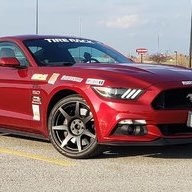
Not convinced about the PHB nonsense? Here is a watts link under my car, 265/40/18 Hankook RS3 summer tires, Lincoln Air Park's concrete, watts link, 275lbs/in rear springs and the stock GT 20mm rear swaybar:
At 2.5" of rear axle travel (which is possible out at the Lincoln Air Park even with 275lbs/in rear springs) over a bump we are talking about 0.0745" (over 1/16th of an inch) of lateral displacement of the axle if the PHB is level at rest. That is no small number when you consider the effects that has at the contact patch with tire loading.
The rest of the issue comes with damping. There are some pimpy shocks out there that have huge blowoff curves for compression and rebound forces, some that even regress to lower values at higher shock speeds. That pays off dividends in keeping the tires on the pavement without shocking (punny, I know) the contact patch. My rear shocks aren't that pimpy but they do have a amount of digressive nature to their compression curve:
That helps blow off some of those bump forces and makes the rear more composed. Your average off the shelf shock doesn't do that.
I get to play on the Nationals concrete at Lincoln Air Park. It isn't perfectly smooth and have some large pavement heaves and uneven concrete pads but it is, for the most part, smooth. As for what STX (and now STU for pony cars) allows, it allows a lot actually, Watts link is legal, diff mounted or chassis mounted, torque arm for the S197 is legal (surprisingly), as are adjustable spring perches and coilover springs, rear swaybar (which I'm doing my damnedest to get RID of) and next year LCA's and relocation brackets are legal. Right now the only stock part of my rear suspension is the rear swaybar and the axle itself.
That said you have picked exactly what my comment was intended to mean. The cost of changing cars and developing a new car, pound for pound and dollar for dollar does not necessarily make a better car for my intended purposes. The "additional" alignment changes by going to an IRS isn't going to make the car appreciably faster for autocross use in the class I'm in. It certainly isn't the panacea magic bullet concoction that cures all handling woes. My S197 fights weight and tire width limitations (thanks SCCA!) and not rear tire wear or rear grip.
Quite the opposite actually, I've had a number of people drive my car from varying levels of national competitiveness and they all have basically the same things to say about the car. Most notably is a.) It puts power down WAY better than they imagined a V8 powered car would and b.) it has way more grip then they ever anticipated the car having for its weight.


That about sums it up. Not sure what the great revelation is here. If your goal is to have the fastest track or drag car for the least amount of money, the answer is never going to be buy a brand new car, strip it down and modify it. :shrug:Wow, you've just spent an incredible amount of time convincing yourself, that a really good tuned live rear axle, is the epitome of automotive engineering...
...and that you don't want to spend time n learning the IRS in the Mustang.
No, no I didn't. What I spent my time doing was explaining why switching to a new car doesn't make sense as an IRS is not the magic bullet for handling woes when you saddle the chassis with more weight and more width and not a lot of additional power (if any) in the lightest model of the group. Really the only advantage to be had with an IRS over a live axle is going to be dynamic camber gain (better tire wear), bump compliance (although not really when you add stiff springs and big swaybars), and weight distribution (my car is already 53/47 as confirmed on a set of scales, not a stat figure from Ford). Dynamic camber gain would be great, but the whole package isn't worth the cost for me.Wow, you've just spent an incredible amount of time convincing yourself, that a really good tuned live rear axle, is the epitome of automotive engineering...
...and that you don't want to spend time n learning the IRS in the Mustang.
The EcoBoost will respond better to the mods you do vs. the naturally aspirated engine. Shifting can and has had a great affect on trap speed. If the powerband falls off abruptly at 5500RPMs, you're wasting time and speed by shifting at a 6500RPM redline. Ultimately, we won't know until some owners are getting their hands on them and really seeing what they can do. The difference again will be the EcoBoost will be capable of much higher power potential dollar for dollar than the 3.7.If the 4.6 mods then it'll pull on the EB so that's an invalid point..Stock for Stock is the best way to be fair.
I think you're wrong. Shifting won't make up for the trap speed. The EB is 98mph and the 4.6 is 104. It's just not there. Come to terms with what the EB is or you'll run into the crap 3.7 owners did(I was one of them). Always chasing the 4.6.
No, no I didn't. What I spent my time doing was explaining why switching to a new car doesn't make sense as an IRS is not the magic bullet for handling woes when you saddle the chassis with more weight and more width and not a lot of additional power (if any) in the lightest model of the group. Really the only advantage to be had with an IRS over a live axle is going to be dynamic camber gain (better tire wear), bump compliance (although not really when you add stiff springs and big swaybars), and weight distribution (my car is already 53/47 as confirmed on a set of scales, not a stat figure from Ford). Dynamic camber gain would be great, but the whole package isn't worth the cost for me.
Had the EB + PP been a lighter car with a similar track width and better options it would have been fine and more appealing to buy a new car and tweak it. I actually have a lot of time spent in studying the Cobra IRS units and setup tweaks for them but I have more hands on experience with the live axle under the S197.
This has absolutely NOTHING to do with not learning about the IRS in the new Mustang. I will probably put MORE effort into the S550 chassis's rear end then the average enthusiast will and I wont even OWN one. Why? Because I enjoy suspension work and the kinematics involved in the suspension. Heck, I've put more effort into studying it then most on this website have.
My car currently rides on 550lbs/in front springs and 275lbs/in rear springs and the ride, while firm, is not harsh or jarring. My dad, who is extremely sensitive to ride changes, described the setup as slightly stiffer than his 2001 FX4 F150. Proper damping is required to make for a non-harsh ride. There is a big difference between firm and harsh. My setup is not harsh, just firm. It is my daily driver over roads that see 4 seasons as well as brick roads that have existed for a time longer than the Mustang has ever existed and probably before cars existed.You're missing the whole point of an IRS unit though. It makes up gains EVERYWHERE. You can absolutely make a love axle handle great like an IRS car without hopping everywhere. But you do that at the expense of ride quality. Making the live axle handle better is just a compromise. The IRS will give you what you need to keep the car planted without having to run crazy spring rates and huge sway bars that ruin how it rides on the road.
It likely wouldn't make sense for you to invest in the new car for the same purpose since you already have yours set up where you need it. But for those looking to get into it or just do it on occasion, it makes total sense vs. buying the old car

It's already been posted many times, the Bare Body of the S-550 weighs less than the S-197. It is the IRS, the fact that they Added More Air Bags, Bigger Brakes across the board, etc that caused the weight gain. As for using More Aluminum in the future, I wouldn't expect it till the Next Platform because using Aluminum like the F-150 would require a Completely Different Body Shop Section to Glue and Rivet it together. Just search the amount of investment Ford had to put into the Plant that produces the F -150. Since the Mustang wont even come close to the Volume of the F -150 and it has to Share a Production Line with Another Model a more Aluminum Intensive Mustang just isn't Economically Feasible.This is the big thing that worries me about the EB in this 2015...it's going to put more strain on the EB.
I have a feeling Ford is going to trim some weight in the 2016 because every article is basically mentioning the weight gain. You can't have that and then have the EB be required to pull a heavier car.
The question is what can they do to make the 150-200 lbs back?