Sponsored

400 pound weight loss??

azsnake

Well-Known Member
Joined
Jan 18, 2014
Threads
2
Messages
142
Reaction score
17
Location
Tucson
Vehicle(s)
2010 Raptor
Know why everyone is still keeping quiet? Because the car is still half a year away from actually being built. Auto show cars are just that: show cars meant to give customers an idea of what the car will look like. Everything else? preproduction. Not finished yet.

Patience is a virtue.
1st post here but I've been lurking for quite a long time.
I have to agree with this and take into account the 99 Cobra. At the time I had a 98 Cobra vert and was eagerly waiting for the news on the new car. Ford released numbers pretty early as I recall. Right before production changes were made with the IRS and exhaust creating a horrible (and I guess unforeseen) flow issue. That and the intake castings were just horrible from their supplier causing some wicked turbulence thus leading to the 99 Cobra hp debacle. I'm sure that stung for Ford and I don't see them making that mistake again.
Sponsored

 

thePill

Camaro5's Most Wanted
Joined
Aug 13, 2012
Threads
37
Messages
6,561
Reaction score
699
Location
Pittsburgh
Vehicle(s)
S550
Not true. The entire subframe and rear-end (differential) are bolted to the chassis and is SPRUNG weight. About half of the weight of the CV axle shafts and half of the weight of all the control arms (including the aluminum lower arm) is unsprung. I could be wrong but i think the unsprung hubs/uprights are also aluminum.

Either way the ILIRS will have A LOT LESS UNSRUNG weight than a solid axle which the entire thing is unsprung (except half of the weight of the 4 arms -which includes the phb).
The upper spring cup mounts to the chassis and is considered part of the shell. It is indeed sprung but, that sub-frame is not part of the system like Short/Long Arm or CBIRS. It reduced overall cost and weight for BMW and Merc Benz, it is also far more compact. The S550 had a small cross member in front of the rear-end if I remember correctly and, it appears to have no rear cross-member from the pics taken of the rear end. Most of this particular ILIRS is unsrung weight, everything below the spring to the steering knuckle is unsprung. Even still, the ILIRS
s unsprung weight should still only be a fraction of what the solid axle was. Like you said, a majority of the 190lbs of solid axle is unsprung. According to the diagram, the steering knuckle, links, wheel/tire, brakes and shafts will be unsprung weight in the ILIRS, it will still be considerably less than the solid axle and traditional IRS.

Solid axle vs. ILIRS, pound for pound, they will be very close... With the limited info and diagram, it appears the ILIRS will be lighter overall and have less unsprung weight vs. the rear axle (including the rear-end).

Yeah I wasn't sure where he was going with that. I would guess around 60% of the weight of an IRS is in the diff and subframe, with about 30% in the knuckles/brakes and the rest being the control arms and springs/shocks. However, the LCA with the ILIRS looks pretty big but being aluminum hopefully means it's stiff without being too massive.
I think you are missing the point here Grim... The ILIRS does not have a bulky sub-frame. It is compact in comparison...

Let me show you...

This is why I post these things months in advanced, Here is Control Blade IRS. Notice the bulky sub-frame that conceals the rear-end. This is from the Falcon. The bulky sub-frame mounts to the chassis as you said... remember this sub-frame, size, location... Most of the CBIRS's weight comes from the sub-frame... You are correct... Here..


Again, CBIRS... See the sub-frame, you can see I marked the upper cradle and spring cup in green... The sub-frame is in blue.


The 5th Gen Camaro and the Terminators IRS is a basic Short-Long Arm system. It uses an intricate sub-frame system... These SLA IRS systems are crap, they are from Mini-vans, sedans... They are fragile and complicated and very heavy...
Camaro


Cobra


The old 2005 S197 IRS, notice the sub-frame... You can't miss it here... It also has an upper cradle with the spring cups intergrated into the sub-frame...


Now, what many of you must have missed, the S550 (like the M3/M4) DO NOT have an upper cradle portion of the sub-frame...


Here is the diagram again, notice, there is no sub-frame in the rear nor upper cradle spring housing... They are gone... Which means, most of that sprung weight IRS is responsible for, has just disappeared. That Sub-frame has now become part of THE-FRAME or chassis as some call it. Here is a pic taken from farther back...


The solid Axle looks big in comparison to the ILIRS.


The S550's ILIRS diagram... There is no way 150lbs has been added on to the weight from what is pictured below.


Again, here is a sub-frame from the back... Sub-frame traced in blue, spring housing traced in green...


ILIRS, missing sub-frame in blue, missing upper spring cup housing in green "?" and struts in red.


I understand what you guys meant about the sub-frame mounts to the chassis. However, the spring housing is part of the chassis now (like the Cobra and Camaro IRS and does not pay a weight penalty for the upper cradle. As I said, because the ILIRS eliminates the large sub-frame and upper spring housing, it has eliminated the sprung weight that accompanies IRS. Now, with that gone, and as you can see from the diagram, the ILIRS system is 90% unsprung weight... which, is still less than the solid axle AND traditional IRS. As well as weighing less overall.

Any questions on any of this?

A Mercedes W211 E-Class rear IRS with airstruts minus the brakes and knuckles is right at 150lbs, figure 225lbs complete. Adding 150lbs on top of the SRA is unlikely to say the least, especially for a small car like the Mustang.
I have tried to figure in as much as I can to get the whole ILIRS system to break 200lbs, I have even included the rear end... I can't even get close to 200lbs.

I'm gonna need you guys to help me out here, I must be missing something.
 

Stuntman

Well-Known Member
Joined
Dec 12, 2013
Threads
5
Messages
1,448
Reaction score
488
Location
SoCal
Vehicle(s)
many
Most of this particular ILIRS is unsrung weight, everything below the spring to the steering knuckle is unsprung. Even still, the ILIRSs unsprung weight should still only be a fraction of what the solid axle was. Like you said, a majority of the 190lbs of solid axle is unsprung. According to the diagram, the steering knuckle, links, wheel/tire, brakes and shafts will be unsprung weight in the ILIRS, it will still be considerably less than the solid axle and traditional IRS.

Solid axle vs. ILIRS, pound for pound, they will be very close... With the limited info and diagram, it appears the ILIRS will be lighter overall and have less unsprung weight vs. the rear axle (including the rear-end).
Pretty much all of the components that ford has shown in the diagram below are either unsprung (the Green uprights/knuckels, brakes) or half of which is unsprung (Yellow & Red control arms, CV axles, springs, and shocks). The other half of the weight of these components are sprung.


The 5th Gen Camaro and the Terminators IRS is a basic Short-Long Arm system. It uses an intricate sub-frame system... These SLA IRS systems are crap, they are from Mini-vans, sedans... They are fragile and complicated and very heavy...
Are you saying that the Short-Long-Arm IRS design is crap or the specific one used for the camaro?

Here is the diagram again, notice, there is no sub-frame in the rear nor upper cradle spring housing... They are gone... Which means, most of that sprung weight IRS is responsible for, has just disappeared. That Sub-frame has now become part of THE-FRAME or chassis as some call it. Here is a pic taken from farther back...
There most likely is a subframe. You can see the black stamped steel subframe which the lower H-arm, toe link, and most likely the upper camber link attaches to. Pretty much every car has a subframe of some sort which the control arms and the rear diff attaches to. It was considered 'revolutionary' when the current M5 and the new M3/4's diffs are bolted directly to the unibody/frame/chassis rather than the traditionally to a subframe which is then bolted to the unibody. We will have to wait for better pictures...

The S550's ILIRS diagram... There is no way 150lbs has been added on to the weight from what is pictured below.

I understand what you guys meant about the sub-frame mounts to the chassis. However, the spring housing is part of the chassis now (like the Cobra and Camaro IRS and does not pay a weight penalty for the upper cradle. As I said, because the ILIRS eliminates the large sub-frame and upper spring housing, it has eliminated the sprung weight that accompanies IRS. Now, with that gone, and as you can see from the diagram, the ILIRS system is 90% unsprung weight... which, is still less than the solid axle AND traditional IRS. As well as weighing less overall.
I get what your saying, but the true weight of the ILIRS, control arms, diff, etc... are unknown until someone weighs them. But remember only HALF of the weight of the arms, axles, springs, and shocks is unsprung.

I have tried to figure in as much as I can to get the whole ILIRS system to break 200lbs, I have even included the rear end... I can't even get close to 200lbs.

I'm gonna need you guys to help me out here, I must be missing something.
150-200lbs are guesstimates and weight gains in the rear of the car could be from parts of the subframe/cradle that connects to the control arms and houses the diff, or from re-designing the rear of the chassis. Nothing is known for sure but rather applied from the weight numbers of the cobra setup which has nothing to do with this chassis which was originally designed for an IRS rather than adapted to one.
 

thePill

Camaro5's Most Wanted
Joined
Aug 13, 2012
Threads
37
Messages
6,561
Reaction score
699
Location
Pittsburgh
Vehicle(s)
S550
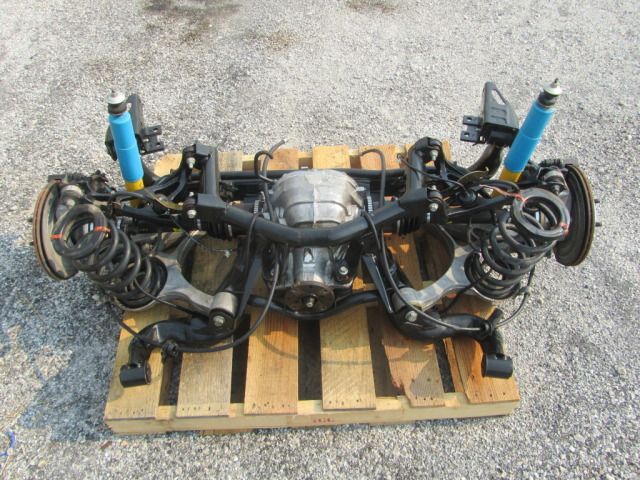
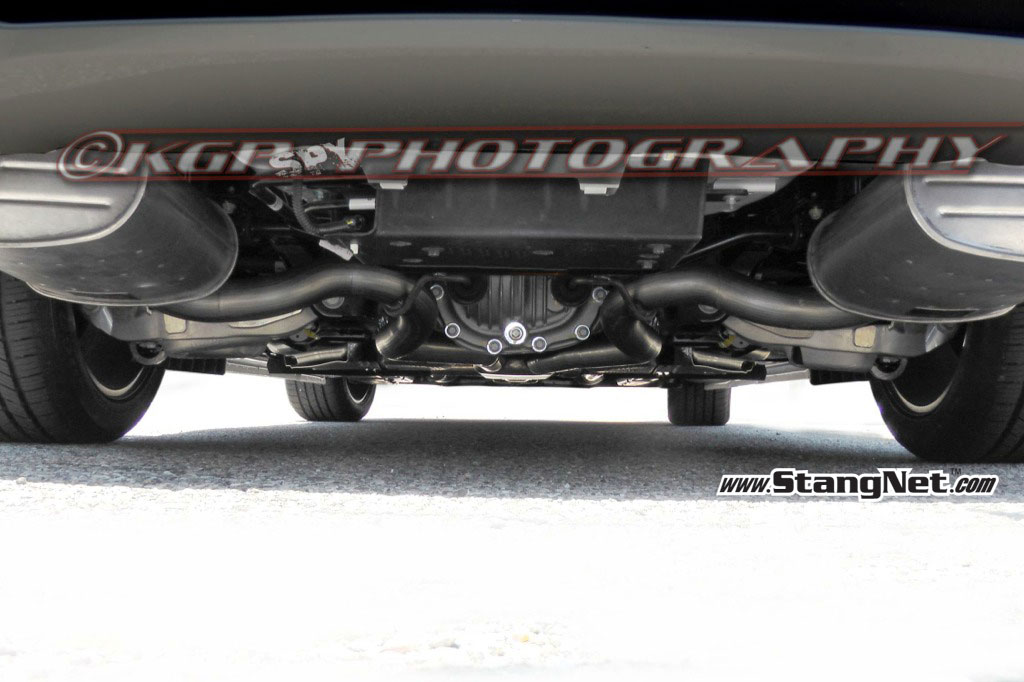
ILIRS has a sub-frame, it is a small cross member in the front of the rear end (not shown) and it bolts to the chassis. The rear cross member is gone as well as the upper cradle/spring housing. A majority of the weight from IRS comes from the sub-frame...

I should have said high performance applications that use a Short-Long Arm requires the spring/shock to mount to the chassis, it has no upper spring housing, therefore, far less rigidity. This is where the complicated (and fragile) IRS sub-frames came from. Perfect examples would be the '03-'04 Cobra and the 5th Gen Camaro. Any equipment bolted in will eventually flex something terrible... As you seen with the 2005 prototype IRS, Ford created a huge sub-frame for rigidity... Eventually, part of that sub-frame became part of the shell/chassis. A better name to call these over weight, over complex and over priced IRS systems would be "Modular". This "modular" type system can require full replacement when damaged, it was built to save time in service labor, not parts. Warranty work vs. Replacement Part cost... The work is free, and obviously covered so, modular designs caught on. After about 5 years, we said "Wow!!! This stuff is expensive to replace and I can't just get the part I need"

As Grim said above, the Merc Benz W's IRS (almost identical to the Mustang's ILIRS) weighs about 225lbs complete, about 150 as shown in the Mustang diagram. The MB W is a large car, and heavy as well... I just can't see the S550's ILIRS being 350lbs when some of the heaviest IRS (5th Gen Camaro) weighs about that...

I cannot exceed 200lbs and I am even using some of the Fusions steel stamped links for weight instead of Aluminum (they are the same castings). If he said that ILIRS weighed 150lbs, that I could see, without the pumpkin and small front mounted sub-frame, yes... But 150lbs on top of the solid axles 190lbs?

The metal just isn't there...


You can see here, all the mounting point geometry is pointed towards the front of the car. None of the links appear to mount behind the rear-end. The rear-end is secured to the chassis by two bolts (maybe more) at the rear and top of the rear-end. The rear bolt of the lower control arm could possibly link to the ends of the rear-end sub-frame (which is now part of THE frame) instead of being below or sub-frame.


This is not a 350lbs IRS which makes gaining weight solely from the ILIRS impossible... They may have lost weight in the rear suspension or, very well may have stayed the same. Maybe the Mustang's weight will be exactly the same as the 2014 Mustang. That said, I will still side with Mitchell on the weight although I still am calling it 3380lbs. The ILIRS has 4 things the Solid Axle doesn't... A small sub-frame (too small to see from even under the car), an Aluminum Lower Control Arm, a toe, camber and I-Link... Springs, shocks, struts, shafts, Knuckle (S550's is Aluminum), disc brakes, wheel/tires, 8.8 rear-end are similar in size and weight. Those links are small, the knuckle is Aluminum as well as the Control Arm. The half-shfts and the solid axle shaft (internal axle and external shaft) should be similar in weight... 150lbs is like... 40lbs heavier than the Getrag MT82 6 speed transmission... That is how much metal we are missing here...


It's easy to stack on 200lbs, look at the Stingray... It lost 99lbs in the chassis but gained 200lbs overall... If Ford can do this, it will completely shake the American Automotive Industry up over night...
 

Grimace427

Well-Known Member
Joined
Dec 6, 2013
Threads
14
Messages
6,467
Reaction score
1,702
Location
NoVA
Vehicle(s)
2011 Mustang 5.0

This part looks like a traditional crossmember compared to a few others I've seen. Reducing the total size of a subframe can be good for weight reduction but being a tech I think that would make it a bitch to work on.
 

Sponsored

Stuntman

Well-Known Member
Joined
Dec 12, 2013
Threads
5
Messages
1,448
Reaction score
488
Location
SoCal
Vehicle(s)
many
I should have said high performance applications that use a Short-Long Arm requires the spring/shock to mount to the chassis, it has no upper spring housing, therefore, far less rigidity. This is where the complicated (and fragile) IRS sub-frames came from. Perfect examples would be the '03-'04 Cobra and the 5th Gen Camaro. Any equipment bolted in will eventually flex something terrible... As you seen with the 2005 prototype IRS, Ford created a huge sub-frame for rigidity... Eventually, part of that sub-frame became part of the shell/chassis.
Actually transferring the load directly into the unibody/chassis makes for a far more rigid system than having the load go into a subframe that's bolted (especially on rubber mounts) to the unibody/chassis. S2000s, Miatas, Corvettes, Vipers, and most race cars utilize a SLA IRS setups.

The 2005 IRS is so huge to fit within the constraints of a chassis not designed for an IRS, and be able to bolt to the chassis as well as mount the differential (and be strong enough to handle those loads) and create points where the upper and lower arms could connect to.

As Grim said above, the Merc Benz W's IRS (almost identical to the Mustang's ILIRS) weighs about 225lbs complete, about 150 as shown in the Mustang diagram. The MB W is a large car, and heavy as well... I just can't see the S550's ILIRS being 350lbs when some of the heaviest IRS (5th Gen Camaro) weighs about that...

I cannot exceed 200lbs and I am even using some of the Fusions steel stamped links for weight instead of Aluminum (they are the same castings). If he said that ILIRS weighed 150lbs, that I could see, without the pumpkin and small front mounted sub-frame, yes... But 150lbs on top of the solid axles 190lbs?
BMW 5 series utilize the same ILIRS and does not look to be too huge:


http://www.pro-touring.com/attachment.php?attachmentid=51928&d=1322740091
 

thePill

Camaro5's Most Wanted
Joined
Aug 13, 2012
Threads
37
Messages
6,561
Reaction score
699
Location
Pittsburgh
Vehicle(s)
S550
This part looks like a traditional crossmember compared to a few others or seen. Reducing the total size of a subframe can be good for weight reduction but being a tech I think that would make it a bitch to work on.
Keep in mind, there is still no upper cradle for the upper spring housing. That too has been miniaturized and is now part of the shell. There is a special reinforcement used in new Fords, it's called the "Lions Foot" and is strenghtens the area from the base

Nevermind...

FOUND IT!! My CD4 Chassis School Thread http://www.mustang6g.com/forums/showthread.php/cd4-chassis-school-842.html?t=842

TA DA!!!


Same as the Fusion, the sub-frame is SUPER compact.

See how all the suspension geometry mounts are pointed the forward position? (top pic)

Before I get side tracked, here is the Lions Foot... It is important as it magnifies the ILIRS systems capabilities and adds even more rigidity.
 

thePill

Camaro5's Most Wanted
Joined
Aug 13, 2012
Threads
37
Messages
6,561
Reaction score
699
Location
Pittsburgh
Vehicle(s)
S550
Actually transferring the load directly into the unibody/chassis makes for a far more rigid system than having the load go into a subframe that's bolted (especially on rubber mounts) to the unibody/chassis. S2000s, Miatas, Corvettes, Vipers, and most race cars utilize a SLA IRS setups.

The 2005 IRS is so huge to fit within the constraints of a chassis not designed for an IRS, and be able to bolt to the chassis as well as mount the differential (and be strong enough to handle those loads) and create points where the upper and lower arms could connect to.


BMW 5 series utilize the same ILIRS and does not look to be too huge:


http://www.pro-touring.com/attachment.php?attachmentid=51928&d=1322740091
That system uses a coil-over too, it is slightly heavier than the shock/strut. Also from my CD4 thread... http://www.mustang6g.com/forums/showthread.php/cd4-chassis-school-842.html?t=842 Whats a sub-frame like that weigh? 30-40lbs...

If you get time, read over some of that CD4 thread, a lot of that will be applied to the Mustang.


Grimace427

Well-Known Member
Joined
Dec 6, 2013
Threads
14
Messages
6,467
Reaction score
1,702
Location
NoVA
Vehicle(s)
2011 Mustang 5.0
Actually transferring the load directly into the unibody/chassis makes for a far more rigid system than having the load go into a subframe that's bolted (especially on rubber mounts) to the unibody/chassis. S2000s, Miatas, Corvettes, Vipers, and most race cars utilize a SLA IRS setups.
All very true, but since the Mustang is no world-class racecar I'd like to see a little compromise to make the at a little easier to work on. If the entire IRS can be dropped out as an assembly that would be awesome.

Keep in mind, there is still no upper cradle for the upper spring housing. That too has been miniaturized and is now part of the shell. There is a special reinforcement used in new Fords, it's called the "Lions Foot" and is strenghtens the area from the base

Nevermind...

FOUND IT!! My CD4 Chassis School Thread http://www.mustang6g.com/forums/showthread.php/cd4-chassis-school-842.html?t=842

TA DA!!!


Same as the Fusion, the sub-frame is SUPER compact.

See how all the suspension geometry mounts are pointed the forward position?
That looks quite traditional. I would be happy with that.
 

thePill

Camaro5's Most Wanted
Joined
Aug 13, 2012
Threads
37
Messages
6,561
Reaction score
699
Location
Pittsburgh
Vehicle(s)
S550
Also something to take notice of...

You can see that the Fusion's IRS sub-frame was designed initially for RWD. It leaves space between the sub-frames to accommodate an 8.8 rear-end.

This is proof that a RWD car was designed around the ILIRS first and that part was adopted and literally unchanged when handed down to the FWD sedan.

This suspension will also be cost efficient when shared with the best selling Fusion/Mondeo... This ILIRS is already paid for... Lots of spare links will be laying around in 3-6 years. All new but still dime a dozen, God I love Ford Motor Company...
 

Sponsored

Whiskey11

Kill ALL the Cones!
Joined
Oct 19, 2013
Threads
2
Messages
523
Reaction score
102
Location
US of A
Vehicle(s)
2016 Ruby Red Base GT/PP
Also something to take notice of...

You can see that the Fusion's IRS sub-frame was designed initially for RWD. It leaves space between the sub-frames to accommodate an 8.8 rear-end.

This is proof that a RWD car was designed around the ILIRS first and that part was adopted and literally unchanged when handed down to the FWD sedan.

This suspension will also be cost efficient when shared with the best selling Fusion/Mondeo... This ILIRS is already paid for... Lots of spare links will be laying around in 3-6 years. All new but still dime a dozen, God I love Ford Motor Company...
The Fusions subframe was designed for AWD which just happens to work for a RWD car. I'm not sure Ford ever intended for the Fusion to be anything but AWD and FWD though. Certainly the handling dynamics for a Mustang will be much, much, much higher than that of a Fusion so while the overall design is similar, it is really like comparing the S197 struts to a Fox or SN95 strut suspension. Similar idea, way different execution.

The main reason OEM's don't attach an IRS directly to the chassis is for NVH reasons. It requires far less bushings to get a nice cushy ride and it allows for much stiffer bushings in the actual IRS unit itself. This allows them to tune the ride characteristics and how they are transmitted through the body.

So long as rear subframe doesn't do this:
[ame]

I'll be happy! :)
 

thePill

Camaro5's Most Wanted
Joined
Aug 13, 2012
Threads
37
Messages
6,561
Reaction score
699
Location
Pittsburgh
Vehicle(s)
S550
The Fusions subframe was designed for AWD which just happens to work for a RWD car. I'm not sure Ford ever intended for the Fusion to be anything but AWD and FWD though. Certainly the handling dynamics for a Mustang will be much, much, much higher than that of a Fusion so while the overall design is similar, it is really like comparing the S197 struts to a Fox or SN95 strut suspension. Similar idea, way different execution.

The main reason OEM's don't attach an IRS directly to the chassis is for NVH reasons. It requires far less bushings to get a nice cushy ride and it allows for much stiffer bushings in the actual IRS unit itself. This allows them to tune the ride characteristics and how they are transmitted through the body.

So long as rear subframe doesn't do this:


I'll be happy! :)
Ah, AWD too, forgot about that. The Mustang could still have some differences in the front cross-member but, to save money, I doubt it does.

...and that sub-frame is doin' the James Brown...

Dear Camaro5,

Remember I always complained about the luxury car IRS the Camaro was using? Please watch video above, now put hockey pucks where those bushings use to be, now call that the 2014 z28...
 

WestRace

Well-Known Member
Joined
Sep 8, 2013
Threads
11
Messages
295
Reaction score
4
Location
SoCal
Vehicle(s)
E46 M3
Actually transferring the load directly into the unibody/chassis makes for a far more rigid system than having the load go into a subframe that's bolted (especially on rubber mounts) to the unibody/chassis. S2000s, Miatas, Corvettes, Vipers, and most race cars utilize a SLA IRS setups.
Actually it may depend. With a subframe, the mounting points will be a bit more toward the center of the chassis which unload will not flex the chassis as much as if the mounting points were more toward the outer edge of the chassis. It's like trying to bend a ruler when holding both ends vs holding more toward the center of the ruler.
That's why for example in open wheel race cars, the control arms are mounted almost at the center of the tub.
 

Whiskey11

Kill ALL the Cones!
Joined
Oct 19, 2013
Threads
2
Messages
523
Reaction score
102
Location
US of A
Vehicle(s)
2016 Ruby Red Base GT/PP
Actually it may depend. With a subframe, the mounting points will be a bit more toward the center of the chassis which unload will not flex the chassis as much as if the mounting points were more toward the outer edge of the chassis. It's like trying to bend a ruler when holding both ends vs holding more toward the center of the ruler.
That's why for example in open wheel race cars, the control arms are mounted almost at the center of the tub.
I'm willing to bet that the main reason for the more central mounting point on open wheel cars has more to do with alignment change then it does from chassis stiffness although I'm sure the reduction in the size of the mounting area does reduce weight. The longer arms need less dramatic angles to keep the tires flat to the ground. If you look at F1 cars, the arms are damn near parallel. The combination of high springs, aero and long arms means they can ditch a lot of the angle required to get an SLA setup to gain negative camber.
Sponsored


Top