Sponsored

Stock exhaust back pressure

Bugasu

Member
Joined
Apr 14, 2016
Threads
0
Messages
15
Reaction score
10
Location
Bismarck, ND
Vehicle(s)
Hellcat
Exhaust back pressure (Exhaust Barometric Pressure in Ford terms) is modeled, as is turbine inlet pressure (Exhaust Manifold Pressure in Ford terms).

If you have an AccessPort, EGBP corresponds to the modeled turbine inlet pressure.
It would be neat to see if this correlates well with what you see with an actual sensor.
Sponsored
 
OP
OP

Kjewer1

Well-Known Member
Joined
May 30, 2015
Threads
3
Messages
161
Reaction score
52
Location
MA
First Name
Kevin
Vehicle(s)
2015 Mustang, 92 Eagle Talon
Good one, I'll log it. I'll bet the model is only close when the car is bone stock of course, but it will be interesting to see.
 

ypena02

Well-Known Member
Joined
Nov 14, 2015
Threads
27
Messages
789
Reaction score
203
Location
Massachusetts
Vehicle(s)
2017 Mustang GT
It seems to be similar in capacity to an EVO3 16g, obviously, but if these back pressure numbers are right, the turbine side is a vast improvement. When I ran 10.31 at ~130 on an EVO3 turbo in my Talon, airflow was 42 lbs/min at 19-20 psi at redline, but back pressure was 40-80 psi depending on what I was doing. It ran the best at ~45 psi back pressure. That would have been with 0 psi at the turbine outlet of course, the "exhaust" was a single 3" bend. So that shows the difference in turbine expansion ratios. Also noteworthy, no difference whatsoever between that 3" bend and a 2.5". 3" is always the standard, and there's nothing wrong with going bigger, but I've been able to put 103 lbs/min through a 3" downpipe for reference. :)
130mph is crazy for that turbo, that is quite the accomplishment!
I remember wayyy back when the EVO3 was THE turbo upgrade to get in the dsm world. Anything bigger was only for drag cars :p....that standard quickly changed though lol
 
OP
OP

Kjewer1

Well-Known Member
Joined
May 30, 2015
Threads
3
Messages
161
Reaction score
52
Location
MA
First Name
Kevin
Vehicle(s)
2015 Mustang, 92 Eagle Talon
Those were the days. :D

And thanks, it was a hell of an effort. It was a DSM record for about a year, and has been surpassed since by a few hundredths. By a lightweight FWD car of course, bastards.
 
OP
OP

Kjewer1

Well-Known Member
Joined
May 30, 2015
Threads
3
Messages
161
Reaction score
52
Location
MA
First Name
Kevin
Vehicle(s)
2015 Mustang, 92 Eagle Talon
Well, strange results.

Today the cheap downpipe came in. I welded a bung to it and threw it in. Here are the numbers.

Stock downpipe, stock catback - 14 psi exhaust pressure, 42 psi turbine pressure

Stock downpipe only, no catback at all - 14 psi exhaust pressure, 42 psi turbine pressure

Offroad downpipe, stock catback - 8 psi exhaust pressure, 40 psi turbine pressure

Offroad downpipe, no catback at all - 0 psi exhaust pressure, 32 psi turbine pressure.


The open offroad downpipe no cat back picked about 1 tenth and 1 mph. This configuration combined with the cooler air later in the night caused the boost to spike a little higher, HPFP pressure to drop a little more, and brought back the misfire that this car has been plagued with since new. If I could have combined the higher MPH from a no misfire run with the better 60 foots I had on a few runs, it might have dropped another tenth or two, but I was in no mood to mess with it at that point. Funny to actually be able to hear the misfiring now with no cat back.

VE did improve a couple percent, but at the compressor limit it really just means a couple percent less MAP.

I'm not really sure where to go from here. I should test a cat back next in the same way, but I really don't want to buy one. I don't like the way these engines sound. Part of it is probably the asinine DI head. Part of it is probably that at redline this thing doesn't even reach my launch RPM in the Talon. It is what it is. I have some 3" boost actuated cutouts I may add to this downpipe and just deal with the noise at the track, but it doesn't seem worth it for a tenth.

Hopefully you guys found this a little bit interesting. If I test any further I'll update the thread.
 
Last edited:

Sponsored

Edkiefer

Well-Known Member
Joined
Aug 6, 2015
Threads
0
Messages
324
Reaction score
38
Location
NYC
Vehicle(s)
XR4ti
Well, strange results.

Today the cheap downpipe came in. I welded a bung to it and threw it in. Here are the numbers.

Stock downpipe, stock catback - 14 psi exhaust pressure, 42 psi turbine pressure

Downpipe only, no catback at all - 14 psi exhaust pressure, 42 psi turbine pressure

Offroad downpipe, stock catback - 8 psi exhaust pressure, 40 psi turbine pressure

Offroad downpipe, no catback at all - 0 psi exhaust pressure, 32 psi turbine pressure.


The open offroad downpipe no cat back picked about 1 tenth and 1 mph. This configuration combined with the cooler air later in the night caused the boost to spike a little higher, HPFP pressure to drop a little more, and brought back the misfire that this car has been plagued with since new. If I could have combined the higher MPH from a no misfire run with the better 60 foots I had on a few runs, it might have dropped another tenth or two, but I was in no mood to mess with it at that point. Funny to actually be able to hear the misfiring now with no cat back.

VE did improve a couple percent, but at the compressor limit it really just means a couple percent less MAP.

I'm not really sure where to go from here. I should test a cat back next in the same way, but I really don't want to buy one. I don't like the way these engines sound. Part of it is probably the asinine DI head. Part of it is probably that at redline this thing doesn't even reach my launch RPM in the Talon. It is what it is. I have some 3" boost actuated cutouts I may add to this downpipe and just deal with the noise at the track, but it doesn't seem worth it for a tenth.

Hopefully you guys found this a little bit interesting. If I test any further I'll update the thread.
Hi, thanks for data .
"Downpipe only, no catback at all - 14 psi exhaust pressure, 42 psi turbine pressure"
you mean stock downpipe here, right ?

That is interesting results, on the stock catback, the resonator seems to be biggest restriction, one reason it gets so hot, discolored (maybe remove it).
From these results the catback is just a little less restictive than DP, wasn't expecting that.
 
OP
OP

Kjewer1

Well-Known Member
Joined
May 30, 2015
Threads
3
Messages
161
Reaction score
52
Location
MA
First Name
Kevin
Vehicle(s)
2015 Mustang, 92 Eagle Talon
Yes, that is stock downpipe.

I should also point out that this offroad downpipe has the removable piece that necks down to the stock catback. The test was without the adapter, straight 3" to atmosphere. I meant to test with that on to see what that drop in diameter is worth. At 42 lbs/min I don't think it's a big deal, but you never know.

Most surprising to me is the difference in turbine pressure change vs exhaust pressure change. The 42 psi still seems impossibly low to me.
 

Juben

Well-Known Member
Joined
Jan 29, 2015
Threads
35
Messages
2,519
Reaction score
812
Location
Chattanooga, TN
First Name
Justin
Vehicle(s)
2015 EcoBoost Mustang (AT) w/PP
Exhaust back pressure (Exhaust Barometric Pressure in Ford terms) is modeled, as is turbine inlet pressure (Exhaust Manifold Pressure in Ford terms).

If you have an AccessPort, EGBP corresponds to the modeled turbine inlet pressure.
It would be neat to see if this correlates well with what you see with an actual sensor.
It's nice to see you around here. I'm sure you can add a lot of depth to the conversations! :headbang:

Well, strange results.

Today the cheap downpipe came in. I welded a bung to it and threw it in. Here are the numbers.

Stock downpipe, stock catback - 14 psi exhaust pressure, 42 psi turbine pressure

Stock downpipe only, no catback at all - 14 psi exhaust pressure, 42 psi turbine pressure

Offroad downpipe, stock catback - 8 psi exhaust pressure, 40 psi turbine pressure

Offroad downpipe, no catback at all - 0 psi exhaust pressure, 32 psi turbine pressure.


The open offroad downpipe no cat back picked about 1 tenth and 1 mph. This configuration combined with the cooler air later in the night caused the boost to spike a little higher, HPFP pressure to drop a little more, and brought back the misfire that this car has been plagued with since new. If I could have combined the higher MPH from a no misfire run with the better 60 foots I had on a few runs, it might have dropped another tenth or two, but I was in no mood to mess with it at that point. Funny to actually be able to hear the misfiring now with no cat back.

VE did improve a couple percent, but at the compressor limit it really just means a couple percent less MAP.

I'm not really sure where to go from here. I should test a cat back next in the same way, but I really don't want to buy one. I don't like the way these engines sound. Part of it is probably the asinine DI head. Part of it is probably that at redline this thing doesn't even reach my launch RPM in the Talon. It is what it is. I have some 3" boost actuated cutouts I may add to this downpipe and just deal with the noise at the track, but it doesn't seem worth it for a tenth.

Hopefully you guys found this a little bit interesting. If I test any further I'll update the thread.
This! I have a couple of old wastegates laying around (the DSM days too :cheers:) and thought about adding them to the downpipe for use as a cutout like you mentioned. Although I can live with my exhaust as it sits, I'm still never going to be a fan of the sound. I think a BAC would be a great setup because one could essentially keep the factory cat-back in place, but still have the benefit of an opened up exhaust while WOT. If I can get the spare time, I might try it and set the wastegate to something like 17 lbs.
 

perfweld

Well-Known Member
Joined
Feb 14, 2016
Threads
12
Messages
484
Reaction score
215
Location
Northern CA
Vehicle(s)
2015 Ecoboost Mustang
Great Read, now where to go from here. I didnt want to change anything out as far as exhaust, but I knew id hit a wall, now you have the answers, Thanks !! As far as the stock downpipe, its not as bad as I thought as per your #s. Between the CAT and the tight radius 90 bends and that restrictive crimped down flex joint, its not as bad as I thought, but not good either.
 
OP
OP

Kjewer1

Well-Known Member
Joined
May 30, 2015
Threads
3
Messages
161
Reaction score
52
Location
MA
First Name
Kevin
Vehicle(s)
2015 Mustang, 92 Eagle Talon
I've got some old ATP 3" vband boost actuated cutouts. Real slick parts, I'm glad I grabbed a couple back when they still made them, which was at least 10 years ago. I used one on my EVO with a couple of solenoids, a 1 quart pressure tank, and a MBC to provide a little more control. I could lock it closed, lock it open, or leave it boost actuated at any pressure I wanted. I'm probably going to end up doing something with this, since I really like the stock cat back, but also that 0 psi exhaust pressure. The mustang ECU is also easily able to cope with the change in VE, which is a big improvement over the older cars which would need an airflow sensor, or map switching for SD to work right. I'll probably end up doing something like this.
 

Sponsored

ypena02

Well-Known Member
Joined
Nov 14, 2015
Threads
27
Messages
789
Reaction score
203
Location
Massachusetts
Vehicle(s)
2017 Mustang GT
This is very helpful, thank you for sharing!
 

bestbacon

Active Member
Joined
Jan 13, 2014
Threads
1
Messages
34
Reaction score
9
Location
Markham
Vehicle(s)
EB 2015 Mustang DIB
Thanks Kjewer1, this really helps anyone trying to change the car bit by bit.
 

Radiation Joe

Well-Known Member
Joined
Feb 8, 2016
Threads
17
Messages
373
Reaction score
199
Location
Allentown, PA
Vehicle(s)
2017 EcoBoost PP Manual Recaro
The great thing about a Mustang forum compared to an M3 forum is the vastly greater number of people participating. Great technical threads like this one are much more likely here than a BMW forum.

I did some data logging, trying to force BMW to admit they had faulty software installed for the DCT transmission in the e9x M3s. For the most part, it fell on deaf ears.

Thanks for the info!
 

Bugasu

Member
Joined
Apr 14, 2016
Threads
0
Messages
15
Reaction score
10
Location
Bismarck, ND
Vehicle(s)
Hellcat
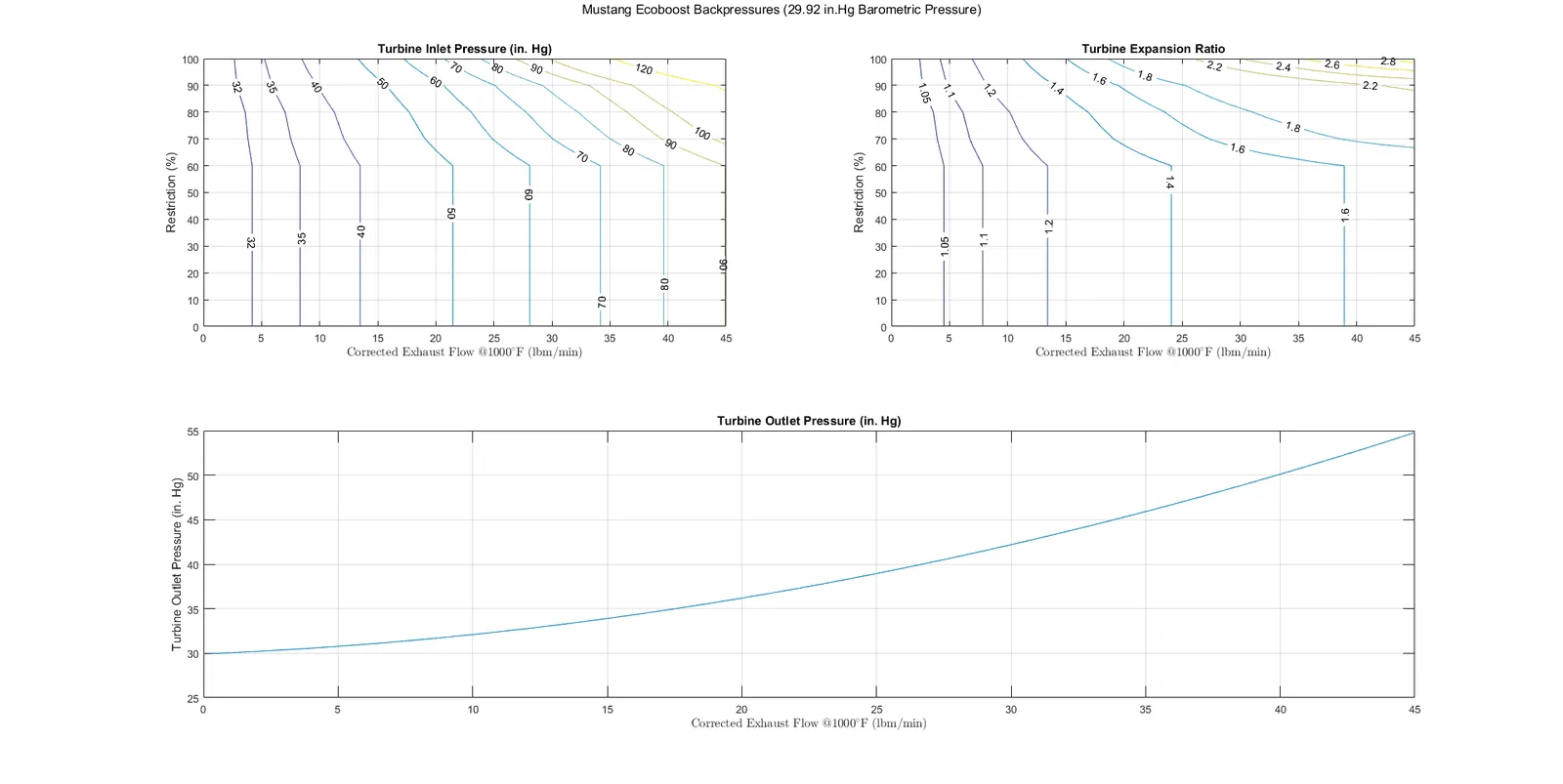
So I pulled the modeled values out, and constructed some plots of what the Mustang EB models the various values as.

Restriction in this case is from another model based on the wastegate that determines just how restricted the flow is. Below 60%, the EBM treats all values the same.

The pressures are in inches of Mercury, which the ECU uses as its native pressure unit for this.

RSWDrGF.webp
 

arghx7

Well-Known Member
Joined
Feb 3, 2015
Threads
3
Messages
284
Reaction score
97
Location
cold
Vehicle(s)
50 years Ecoboost
Well, strange results.

Today the cheap downpipe came in. I welded a bung to it and threw it in. Here are the numbers.

Stock downpipe, stock catback - 14 psi exhaust pressure, 42 psi turbine pressure

Stock downpipe only, no catback at all - 14 psi exhaust pressure, 42 psi turbine pressure

Offroad downpipe, stock catback - 8 psi exhaust pressure, 40 psi turbine pressure

Offroad downpipe, no catback at all - 0 psi exhaust pressure, 32 psi turbine pressure.
I'm curious why you find these results strange. When you removed the catback (second item in your list), total airflow could have increased. If total airflow goes up but the measured backpressure stays the same, restriction has still gone down. See the flow vs backpressure curve [MENTION=23272]Bugasu[/MENTION] posted. When you change the hardware, the shape of that curve moves, even if for some reason you record the same pressure.

If you ever do any exhaust system or turbo product R&D on an engine dyno you will see this because you can measure airflow reliably in that environment.

The open offroad downpipe no cat back picked about 1 tenth and 1 mph. This configuration combined with the cooler air later in the night caused the boost to spike a little higher, HPFP pressure to drop a little more, and brought back the misfire that this car has been plagued with since new. If I could have combined the higher MPH from a no misfire run with the better 60 foots I had on a few runs, it might have dropped another tenth or two, but I was in no mood to mess with it at that point. Funny to actually be able to hear the misfiring now with no cat back.
I don't know the background of your misfire (my car is 100% stock manual trans, never had any problems with it on 87AKI regular or 93AKI premium fuel), but when you reduce the turbine inlet pressure like that your residual gas goes down and you are less knock limited. Try advancing spark. Misfire often comes about because the spark is too retarded, unless there is an underlying hardware issue.

VE did improve a couple percent, but at the compressor limit it really just means a couple percent less MAP.
In your case it's hard to say what the real compressor speed is without installing a compressor speed sensor and datalogging it. Airbox and inlet restriction have a huge effect on compressor speed though.

I'm not really sure where to go from here. I should test a cat back next in the same way, but I really don't want to buy one.
Add more spark. Reduce intake restriction more if you can.

I don't like the way these engines sound.
I think the integrated exhaust manifold doesn't help.
Sponsored


Top