Sponsored

Does the motor use a MAP sensor? BOV performance question.

EI

Member
Joined
Mar 20, 2015
Threads
1
Messages
8
Reaction score
0
Location
Tampa
First Name
Dan
Vehicle(s)
Supercharged 240sx
Hello all,
I am looking to get myself an EcoBoost in the next few weeks, but have not had a chance to really get under the hood of one yet. Do these motors use a MAP sensor? I saw some videos of people removing the intake recirculation for atmospheric blowoff, but am wondering if it will effect performance as it does with MAF setups.

Thanks!
Dan
Sponsored

 
OP
OP

EI

Member
Joined
Mar 20, 2015
Threads
1
Messages
8
Reaction score
0
Location
Tampa
First Name
Dan
Vehicle(s)
Supercharged 240sx
I saw that thread just after I posted this, but do not see a mention of a MAP. The performance hit I was referring to is barely noticeable, so people may not realize. It simply causes the motor to run rich for a split second after closing the throttle plate because the metered air that the motor thinks it has is lost through the atmospheric venting.

I was just wondering if there was a MAP, as this would then typically negate that issue.
 

MAPerformance

Well-Known Member
Joined
Jan 14, 2015
Threads
137
Messages
1,681
Reaction score
1,001
Location
Cottage Grove, MN
Website
www.maperformance.com
First Name
Sales
Vehicle(s)
2015 Ecoboost Base w/ Performance Package
You can vent to atmosphere it will not change the cars behavior. To answer your question the car is speed density, so it is MAP based. More than just 1 MAP sensor as well ;).
 
OP
OP

EI

Member
Joined
Mar 20, 2015
Threads
1
Messages
8
Reaction score
0
Location
Tampa
First Name
Dan
Vehicle(s)
Supercharged 240sx
Ok, great. Appreciate the reply. That is what I was looking for. So not an open filament at the intake filter location, and then a absolute pressure on the manifold then? It uses two~ absolute pressure sensors?
 

Sponsored

arghx7

Well-Known Member
Joined
Feb 3, 2015
Threads
3
Messages
284
Reaction score
97
Location
cold
Vehicle(s)
50 years Ecoboost
I need to get a service manual with the right diagrams for the 2.3, but from memory there is a pressure sensor after the turbo plus one in the manifold.

For a more technical answer to your question:

The whole "MAF vs MAP/Speed Density" dichotomy doesn't apply so much to newer cars. In the old days, say a late 80s Ford or GM speed density system, you had simple lookup tables of rpm vs MAP to schedule spark and look up a volumetric efficiency for fuel calculations. Valve timing was fixed and load was controlled by a cable-actuated throttle, so volumetric efficiency was proportional to manifold pressure. On a MAF based system you had some kind of load calculation related to measured airflow divided by engine speed. Oldschool speed density or MAF are basically reactive systems.

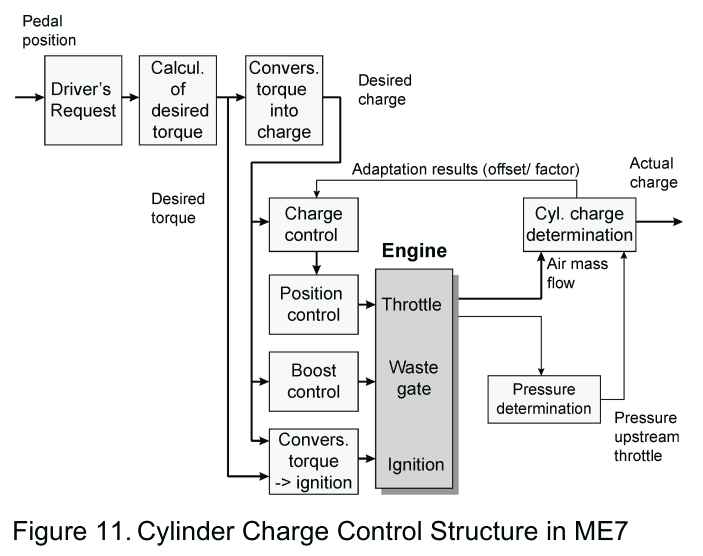
Now the accelerator pedal requests an engine torque or a wheel torque/driving force (Bosch diagrams shown below),


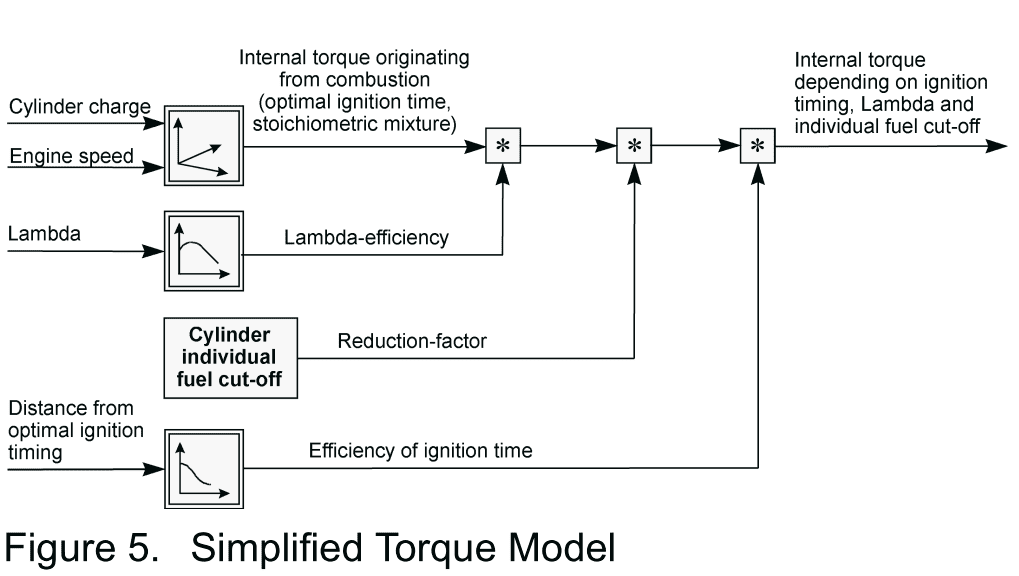
rather than the ECU continuously reacting to some measured parameters. Valve timing can be continuously varied and engine load is controlled by this valve timing, the air fuel ratio, the boost, and the electronic throttle. There's a torque model


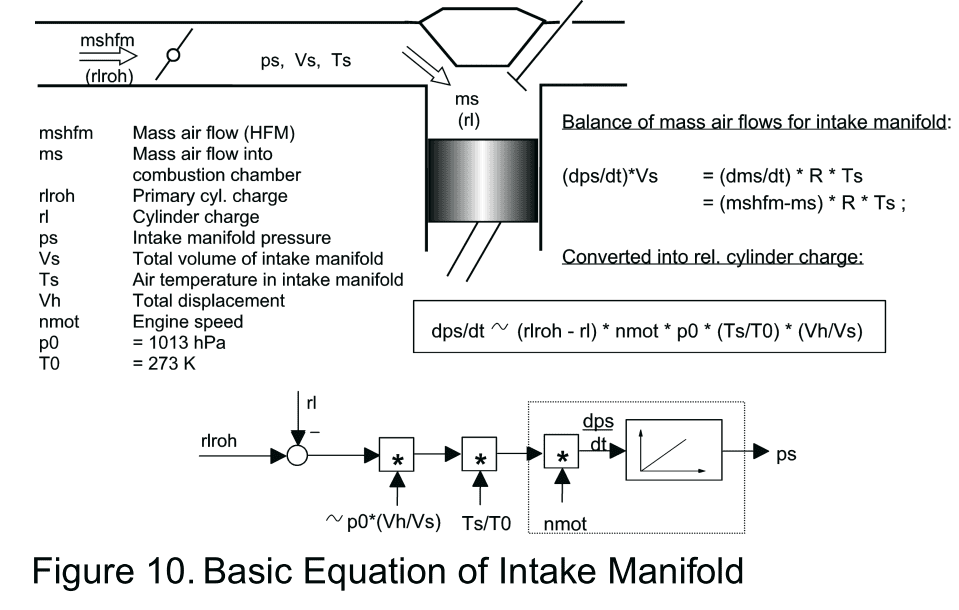
and a gasflows model (the successor to old simple speed density calculations)


used to calculate mass airflow in the air path, from airbox all the way to the intake port and then out to the exhaust ports for backpressure modeling. Changing the cam phasing changes the volumetric efficiency of the engine, so a few simple lookup tables of VE vs MAP vs Engine speed aren't accurate enough for a modern engine. There's all sorts of elaborate calculations involved.

So on modern controls like the Ecoboost uses, the ECU calculates mass airflow even if it doesn't have a MAF sensor, and if the engine does have a MAF sensor it's mostly used to correct the gasflow/speed density calculation or for some OBD purposes.
manifold_model_simplified.png
torque_model_simplified.png
torque_request_simplified.png
 
OP
OP

EI

Member
Joined
Mar 20, 2015
Threads
1
Messages
8
Reaction score
0
Location
Tampa
First Name
Dan
Vehicle(s)
Supercharged 240sx
I need to get a service manual with the right diagrams for the 2.3, but from memory there is a pressure sensor after the turbo plus one in the manifold.
I am rather familiar with how MAF systems work, I have owned and tuned give or take 20 240sx's. Sadly though, those are the newest cars I have ever owned as well, lol. I know the premise and over all how MAP based systems work, just never owned one yet. Hopefully soon I will get my EcoBoost though. : )
 

dabsevo

Well-Known Member
Joined
Mar 6, 2015
Threads
12
Messages
221
Reaction score
59
Location
Los Angeles
Vehicle(s)
2015 Ecoboost Black
I got a question, why does the WRX community advise against venting out to atmosphere on their cars? Apparently getting a BOV or having the stock one vent out to atmosphere causes weird things to happen and isn't good for the car. What's the difference?
 

Sponsored

arghx7

Well-Known Member
Joined
Feb 3, 2015
Threads
3
Messages
284
Reaction score
97
Location
cold
Vehicle(s)
50 years Ecoboost
I got a question, why does the WRX community advise against venting out to atmosphere on their cars? Apparently getting a BOV or having the stock one vent out to atmosphere causes weird things to happen and isn't good for the car. What's the difference?
The amount of air entering the engine is measured with a mass airflow sensor on current Subaru engines. When you vent the air, the ECU basically gets confused. On the 2.3 Ecoboost engine, there is no mass airflow sensor. Mass airflow is modeled based on readings from other sensors (temperature, pressure, etc).
 

MAPerformance

Well-Known Member
Joined
Jan 14, 2015
Threads
137
Messages
1,681
Reaction score
1,001
Location
Cottage Grove, MN
Website
www.maperformance.com
First Name
Sales
Vehicle(s)
2015 Ecoboost Base w/ Performance Package
I got a question, why does the WRX community advise against venting out to atmosphere on their cars? Apparently getting a BOV or having the stock one vent out to atmosphere causes weird things to happen and isn't good for the car. What's the difference?

Because they are too lazy to convert to speed density like I did on my STI ;) haha.


But, in all seriousness it is because they have a MAF that is anticipating the air from the stock bpv (and aftermarket) to re-enter the intake system post MAF. So it adds extra fuel for that air, but it never happens so the car runs rich and cause poor idle.
 
OP
OP

EI

Member
Joined
Mar 20, 2015
Threads
1
Messages
8
Reaction score
0
Location
Tampa
First Name
Dan
Vehicle(s)
Supercharged 240sx
I had mentioned why in my 2nd post I did in here, but I guess I wasn't specific, lol.
Sponsored


Top